
SEO is changing fast.

And I know it can feel stressful.
You write articles. You wait for Google. You check Search Console. You see impressions, but clicks are still low. Then AI Overviews appear, ChatGPT search grows, and you start asking a scary question:
“Is normal SEO still worth it?”
Yes, it is.
But in 2026, SEO needs a bigger system.
You are not writing only for Google blue links anymore. You are writing for Google Search, AI Overviews, ChatGPT, Perplexity-style answers, social discovery, email lists, affiliate clicks, and your own tools or products.
That sounds big, but do not worry.
This guide will make it simple.
I learned this while building content systems for AI tool websites. Some articles got impressions but no clicks. Some were too general. Some had weak internal links. Some had good information, but no money path. The problem was not only content quality. The problem was the missing system.
An AI SEO strategy is not “write more articles.”
It is a complete plan for traffic, visibility, and monetization.
Google says AI features in Search use the same basic Search principles: helpful, crawlable, indexable content that gives value to people. OpenAI also says public websites can appear in ChatGPT search, and publishers should not block OAI-SearchBot if they want content to be discovered, surfaced, cited, and linked.
So the new SEO goal is simple:
Create helpful content that humans want to read, search engines can understand, and AI systems can cite.
What Is an AI SEO Strategy?
An AI SEO strategy is a plan to grow visibility in normal search results and AI-powered answers.
It includes:
keyword research
content clusters
AI Overviews optimization
ChatGPT search visibility
internal links
technical SEO
content updates
affiliate monetization
tools, templates, or products
tracking in Search Console
In simple words:
AI SEO means building a website that can be found, trusted, and clicked in a search world where AI answers are everywhere.
Old SEO question:
“How do I rank on Google?”
New SEO question:
“How do I become one of the best sources for this topic across Google, AI Overviews, ChatGPT, and human readers?”
That is a better question.
Why AI SEO Matters in 2026
AI search changes the way people find answers.
Some users still click normal search results.
Some read AI Overviews first.
Some ask ChatGPT.
Some compare answers across tools.
Some find your site through Pinterest, LinkedIn, or Facebook after seeing your topic many times.
So your strategy cannot depend on one article or one traffic source.
You need a system.
Google Search Console can still show you important data like queries, pages, clicks, impressions, and position. Google explains that Search Console performance reports help you see how users find your site in Search.
But you also need to think about AI visibility.
That means:
Are your articles easy to understand?
Are they clear enough to cite?
Do they answer real questions?
Do they show experience?
Do they connect to a topic cluster?
Do they lead readers to a next step?
That is how SEO becomes a business system, not just a traffic game.
The AI SEO System: Big Picture
Here is the full system:
| Part of the System | Main Goal | Example |
|---|---|---|
| Topic strategy | Choose what your site should be known for | AI SEO, AI writing tools, AI humanizers |
| Keyword research | Find real user questions | how to rank in AI Overviews |
| Content clusters | Build authority around one topic | SEO pillar + supporting articles |
| AI formatting | Help AI systems understand your content | clear headings, tables, FAQ |
| Technical SEO | Make pages easy to crawl and index | sitemap, robots.txt, noindex rules |
| Tracking | Measure what is working | Search Console impressions and clicks |
| Monetization | Turn traffic into income | affiliate links, tools, templates, books |
This is the system we will build step by step.
Choose One Main SEO Topic First
Do not start with random articles
Start with one main topic.
For example, your SEO pillar could be:
AI SEO Strategy
AI Overviews SEO
AI Search Visibility
Content Optimization for AI
SEO Tools for AI Content Sites
This main topic should connect to your business.
If your website helps people use AI content tools, then AI SEO is a smart pillar because your readers want traffic, content, and monetization.
A weak topic plan looks like this:
one article about SEO
one article about resumes
one article about Pinterest
one article about AI news
one article about Etsy
one article about ChatGPT prompts
That can become messy.
A stronger plan looks like this:
Main pillar: AI SEO Strategy
Supporting post: AI Overviews Keyword Research
Supporting post: AI Content Optimization
Supporting post: AI Search Visibility
Supporting post: AI Overviews Tracking
Supporting post: AI Overviews vs Organic Results
Supporting post: How to Rank in AI Overviews
Now Google and readers can understand your topic.
TIP: Pick one pillar and write 8–12 supporting articles around it before jumping to the next big topic.
Build a Pillar and Satellite Structure
A pillar is a big main guide.
A satellite is a smaller article that supports the pillar.
For example:
Pillar:
AI SEO Strategy (2026): Complete System for Traffic, Visibility & Monetization
Satellites:
AI Overviews Keyword Research
AI Content Optimization
AI Overviews Tracking
AI Search Visibility
AI Overviews vs Organic Results
How to Rank in AI Overviews
AI Overviews in Search Console
Best AI SEO Tools
AI SEO Checklist
AI SEO Content Calendar
This structure helps in two ways.
First, readers can move from one article to another.
Second, search engines can see that your site covers the topic deeply.
This is very important for new websites.
A new site often cannot win with one article. But it can build topical authority over time. Topical authority means your site becomes trusted for a topic because it covers many useful parts of that topic.
TIP: At the end of every satellite article, link back to the main pillar using clear anchor text like “complete AI SEO strategy.”
Find Keywords That Match AI Search Behavior
AI search users ask questions.
They do not always type short keywords.
So do not only target keywords like:
SEO tools
AI SEO
content optimization
Also target natural questions like:
how to optimize content for AI Overviews
how to track AI search visibility
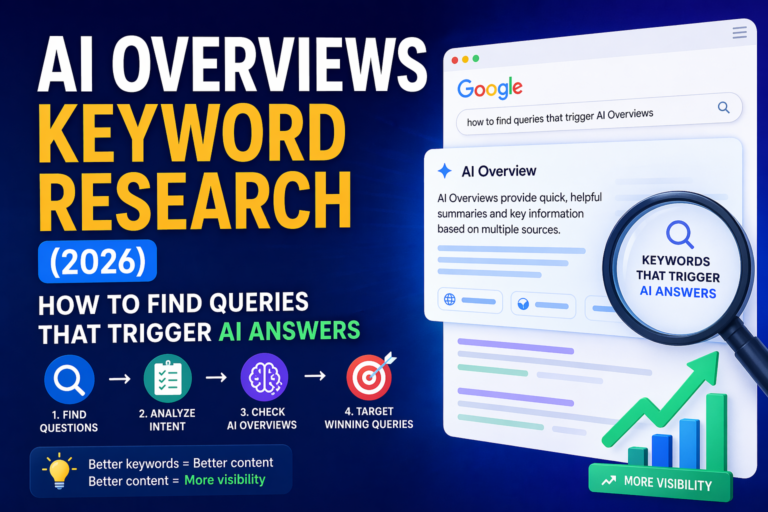
how to find keywords that trigger AI answers
why did impressions go up but clicks stay low
how to monetize AI SEO traffic
how to rank in ChatGPT search results
These are better because they show intent.
Intent means what the user wants to do.
Some users want to learn.
Some want to compare.
Some want to buy.
Some want to fix a problem.
Your keyword research should include all of them.
Example keyword map:
| User Intent | Keyword Example | Best Content Type |
|---|---|---|
| Learn | what is AI SEO | Explainer |
| Do | how to optimize content for AI Overviews | Tutorial |
| Compare | AI Overviews vs organic results | Comparison |
| Track | how to track AI visibility | Workflow guide |
| Buy | best AI SEO tools | List post |
| Monetize | how to make money with AI SEO traffic | Strategy guide |
TIP: Do not chase only high-volume keywords. Smaller question keywords can bring better readers because they have a clear problem.
Format Content for AI Overviews and ChatGPT
AI systems need clear structure.
Your article should be easy to scan.
Use:
clear H2 and H3 headings
short definitions
step-by-step sections
tables
examples
FAQ
simple summaries
internal links
For example, instead of writing a long paragraph about AI Overviews, write:
What are AI Overviews?
AI Overviews are Google’s AI-generated summaries that appear for some searches. They give users a quick answer and may include links to sources.
That is clear.
Now add a real example:
If someone searches “how to rank in AI Overviews,” Google may show a summary with steps and source links. Your article has a better chance if it has clear steps, examples, and direct answers.
This is better than vague writing.
TIP: Put the direct answer near the top of the article. Then explain the details below.
Add Real Experience to Every Important Article
AI can write generic content very fast.
So your content needs human experience.
Experience can be simple.
You can include:
what you tested
what worked
what failed
what you changed
what you saw in Search Console
what tool you used
what example you built
what mistake you made
Example:
“When I changed meta titles on several pages, impressions became unstable for a while. That reminded me not to change too many important pages at once. Now I track title changes in a simple sheet.”
That is useful because it sounds real.
It also teaches a lesson.
Another example:
“I tested two article formats. The first one had long sections and no table. The second one had short answers, examples, and FAQ. The second version was easier to read and easier to connect with internal links.”
TIP: Add one mini story in each article. It can be only 3–4 sentences, but it makes the content feel more trustworthy.
Make Your Technical SEO Clean
Technical SEO is the boring part.
But it matters.
Technical SEO means your site is easy for search engines to crawl, index, and understand.
Crawl means a bot can visit your page.
Index means the page can be stored and shown in search results.
Check these basics:
your sitemap works
important posts are indexable
daily news posts can be noindex if they are not evergreen
robots.txt does not block important bots
canonical tags are correct
pages load fast
mobile layout is clean
internal links are not broken
For AI search, also check crawler access.
OpenAI says OAI-SearchBot is used to surface websites in ChatGPT search features, and sites that opt out of OAI-SearchBot will not be shown in ChatGPT search answers, though they may still appear as navigational links.
So if ChatGPT visibility matters to you, do not block OAI-SearchBot by mistake.
TIP: After changing SEO plugins, cache plugins, robots.txt, or indexing settings, check your most important pages again.
Create a Content Calendar With Purpose
A content calendar is not just a list of article ideas.
It should have a strategy.
For each article, write:
pillar
keyword
intent
article type
internal links
affiliate opportunity
update date
status
Example:
| Article | Intent | Money Path | Internal Link |
|---|---|---|---|
| AI SEO Strategy | Learn / plan | SEO tools, templates | SEO pillar |
| Best AI SEO Tools | Buy / compare | Affiliate links | AI SEO Strategy |
| AI Overviews Tracking | Do / track | Tracking templates | AI SEO Strategy |
| AI Content Optimization | Learn / improve | Content tools | AI SEO Strategy |
This keeps your website organized.
It also prevents random publishing.
TIP: Before writing a new article, ask: “Which pillar does this support?” If the answer is unclear, wait or rewrite the idea.
Build Internal Links Like a Roadmap
Internal links are not decoration.
They are a roadmap.
They tell readers:
where to start
what to read next
which guide is the main guide
which post explains the details
For example:
From AI SEO Strategy, link to:
AI Overviews Keyword Research
AI Content Optimization
AI Search Visibility
AI Overviews Tracking
Best AI SEO Tools
From AI Content Optimization, link back to:
AI SEO Strategy
How to Rank in AI Overviews
AI Overviews Keyword Research
This creates a circle of helpful content.
But do not overdo it.
A page with 30 random links can feel messy.
TIP: Add 3–6 strong internal links in each article. Choose links that help the reader take the next step.
Track Search Console Data Every Week
Search Console is still one of your most important tools.
Use it to check:
queries
pages
impressions
clicks
CTR
average position
CTR means click-through rate. It shows how many people clicked compared with how many people saw your result.
Google’s Search Console documentation explains that the performance report can show click and impression data, and you can break it down by queries, pages, countries, devices, and more.
For AI SEO, pay attention to these patterns:
High impressions, low clicks
Page one position, weak CTR
Queries with “how,” “best,” “vs,” or “why”
Pages that rank but do not convert
Old articles losing impressions
New articles getting impressions but no clicks yet
Example:
If an article has 1,000 impressions and 5 clicks, the topic has visibility, but the title may not be strong enough.
If an article has 50 impressions and 5 clicks, the keyword may be small but strong.
TIP: Do not panic after one bad day. Compare 28 days to the previous 28 days before making big changes.
Improve CTR Without Breaking the Page
CTR matters.
If people see your result but do not click, your title or description may be weak.
But be careful.
Changing too many meta titles at once can make tracking harder.
A better method:
Pick 3–5 pages.
Improve titles carefully.
Wait 2–3 weeks.
Watch Search Console.
Then improve the next group.
Good title example:
Weak:
AI SEO Strategy
Better:
AI SEO Strategy 2026: Complete System for Traffic, Visibility & Monetization
The better title gives:
topic
year
benefit
clear promise
TIP: Do not change every title on your site in one day. Test in small groups so you can see what works.
Add Monetization Early, But Keep It Natural
Traffic without monetization is only half a business.
Monetization means turning attention into income.
For an AI SEO website, you can monetize with:
affiliate links
tool reviews
comparison posts
templates
ebooks
paid tools
email list
consulting
digital products
But do not make every article feel like a sales page.
Match the money path to the intent.
Example:
A tutorial article can link to a helpful tool.
A comparison article can include affiliate links.
A pillar article can link to reviews and templates.
A checklist article can offer a free download.
A tool page can lead to a paid version later.
For example, an article about AI content optimization can naturally link to AI writing tools, SEO tools, or content planning templates.
TIP: Add monetization where it helps the reader. If the link solves the reader’s problem, it feels natural.
Use Affiliate Links the Smart Way
Affiliate links work best when the reader is already close to a decision.
Good affiliate article types:
best tools
tool reviews
tool comparisons
tutorials
alternatives
use-case guides
Examples:
Best AI SEO Tools for Bloggers
Surfer SEO vs Frase for AI Content
How to Use Koala for SEO Blog Posts
Best AI Writing Tools for SEO Content
Best AI Humanizer Tools for SEO Articles
But affiliate links should not be random.
Add context.
Weak:
“Try this tool.”
Better:
“If you already have articles but need better outlines and on-page SEO suggestions, this tool may help.”
That is more useful.
TIP: Put affiliate links in articles where the user is choosing a tool, not in every paragraph.
Create Your Own Tool or Template
This is where SEO becomes stronger.
Affiliate income is good, but your own tool can build your brand.
Examples:
AI SEO title generator
AI Overviews keyword tracker
content brief generator
Etsy listing generator
social media post generator
AI content optimizer checklist
Search Console analysis template
A tool gives users a reason to come back.
It can also collect emails or support a paid version later.
For example:
Free version: 3 uses per day
Paid version: unlimited uses, saved history, export, templates
This is a smart path because you first build traffic, then convert repeat users.
TIP: Start with one simple tool that solves one painful problem. Do not build a huge platform first.
Build Email Capture From SEO Traffic
Search traffic is powerful, but it is not fully yours.
Google can change.
AI Overviews can change.
Rankings can move.
An email list gives you more control.
Simple email offers:
free AI SEO checklist
AI content calendar template
Search Console tracking sheet
AI Overviews keyword sheet
SEO title formula guide
Add the offer inside related articles.
Example:
In an article about AI Overviews tracking, offer a free tracking sheet.
In an article about AI SEO strategy, offer a free checklist.
TIP: Your free offer should match the article. Do not offer a random newsletter signup. Give something useful.
Repurpose Articles Into Social Content
One SEO article can become many social posts.
For example, this article can become:
1 LinkedIn post about AI SEO systems
1 Facebook post about traffic stress
3 Pinterest pins
1 short checklist graphic
1 email newsletter
1 carousel about AI SEO mistakes
This helps discovery.
It also supports your brand.
Many people will not find you from Google first.
They may see your content on Pinterest or LinkedIn, then later search your brand.
TIP: After publishing each article, create at least 3 social pieces from it. Do not let the article sit alone.
Update Winners Before Writing Too Much New Content
New content matters.
But old winners can become better.
Check your Search Console.
Find pages with:
high impressions
positions 5–20
low CTR
strong topic fit
affiliate potential
Then improve them.
Add:
better intro
new FAQ
comparison table
internal links
updated examples
clearer title
better CTA
new screenshots
This is often faster than writing a brand-new article.
TIP: Every month, improve your top 5 pages by impressions before publishing too many new posts.
Create a Monetization Map
A monetization map shows how each content type can make money.
Example:
| Content Type | Traffic Goal | Monetization Path |
|---|---|---|
| Pillar guide | Build authority | Internal links, email list |
| Tool review | Buyer traffic | Affiliate links |
| Tutorial | Practical help | Affiliate links, tool signup |
| Comparison | Decision traffic | Affiliate links |
| Checklist | Email capture | Template download |
| Free tool | Repeat visits | Paid upgrade later |
| News post | Freshness and trust | Brand visibility |
This helps you avoid a common mistake:
writing many articles with no income path.
Every article does not need to sell.
But every cluster should have a money path.
TIP: For each pillar, choose 2–3 money pages. Then use supporting posts to send readers there naturally.
Measure the Right Numbers
Do not measure only traffic.
Traffic is important, but it is not the full story.
Track:
impressions
clicks
CTR
average position
indexed pages
affiliate clicks
email signups
tool users
returning visitors
top pages by revenue
Example:
One article may bring 1,000 visits and no money.
Another article may bring 100 visits and 5 affiliate clicks.
The second one may be more valuable.
For AI SEO, also track:
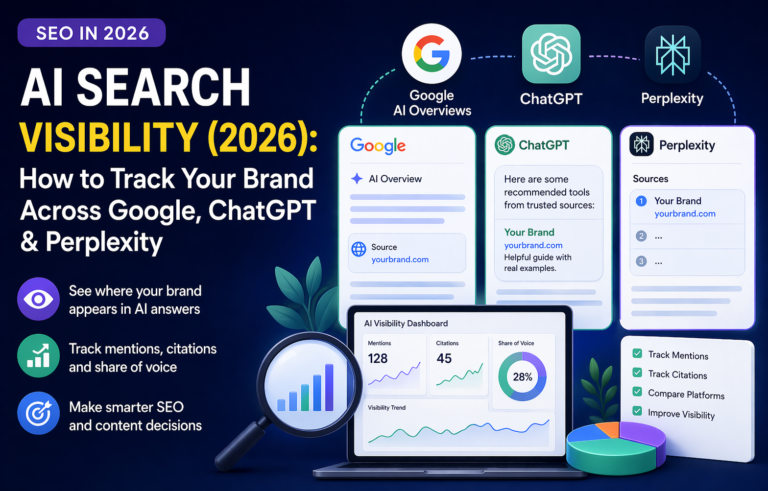
which pages get cited in AI answers
which pages appear for question keywords
which articles bring branded searches
which posts support money pages
TIP: Create a simple monthly dashboard. Do not make it too complex. Track the numbers you will actually use.
Avoid These AI SEO Mistakes
Mistake 1: Publishing random articles
More content is not always better.
More connected content is better.
Mistake 2: Writing only for AI
Your reader is still human.
Do not make the page robotic.
Mistake 3: Ignoring technical SEO
If your page is blocked or noindexed, even great content may not work.
Mistake 4: No internal links
A strong article alone is weaker than a strong article inside a cluster.
Mistake 5: No monetization path
Traffic is nice, but your site also needs income.
Mistake 6: Changing too many things at once
If you change titles, layout, internal links, and content all together, you may not know what helped or hurt.
TIP: Improve in small batches. Track what changed and when.
Use a Simple 90-Day AI SEO Plan
Here is a practical 90-day plan.
Days 1–30: Build the foundation
Choose one pillar.
Write or improve the main pillar article.
Create 5 supporting articles.
Set internal links.
Check indexing.
Set up Search Console tracking.
Days 31–60: Build visibility
Add 5–8 more supporting articles.
Improve titles for low-CTR pages.
Create social posts for each article.
Add one free template or checklist.
Start tracking affiliate clicks.
Days 61–90: Build monetization
Improve the top pages by impressions.
Add comparison tables to buyer posts.
Create one simple tool or lead magnet.
Build email capture.
Update older posts.
Connect all money pages to the pillar.
TIP: Do not try to do everything in one week. A simple 90-day system is better than a chaotic 10-day sprint.
Example AI SEO Cluster for a New Website
Here is a strong SEO cluster example:
Main pillar:
AI SEO Strategy (2026): Complete System for Traffic, Visibility & Monetization
Supporting articles:
AI Overviews Keyword Research
AI Content Optimization
AI Search Visibility
AI Overviews Tracking
How to Rank in AI Overviews
AI Overviews vs Organic Results
AI Overviews in Search Console
Best AI SEO Tools
AI SEO Checklist
How to Use Search Console for AI SEO
How to Monetize AI SEO Traffic
AI SEO Content Calendar
Money pages:
Best AI SEO Tools
Best AI Writing Tools for SEO Content
AI Content Optimization Tools
AI SEO Templates
Your own AI SEO tool
This is a real system.
It can bring traffic.
It can build trust.
It can send readers to money pages.
It can support future tools and products.
Final Thoughts
AI SEO in 2026 is not only about ranking.
It is about becoming a trusted source in a search world that now includes AI answers.
You need helpful content, clear structure, technical basics, internal links, tracking, and monetization.
Start with one pillar.
Build satellites around it.
Format your content so AI systems and humans can understand it.
Track what works.
Then connect traffic to income through affiliate links, templates, tools, email, and products.
That is the complete system.
Not random SEO.
Not only AI.
A real content business strategy.
FAQ
❓ What is an AI SEO strategy?
An AI SEO strategy is a plan to grow traffic and visibility in Google, AI Overviews, ChatGPT search, and other AI answer systems. It combines keyword research, content clusters, technical SEO, tracking, and monetization.
❓ Is normal SEO still worth it in 2026?
Yes. Normal SEO still matters, but it now works together with AI search. You still need helpful content, crawlable pages, strong internal links, and good Search Console tracking.
❓ How do I optimize content for AI Overviews?
Use clear headings, short answers, step-by-step sections, tables, examples, and FAQ. Make sure your content is helpful and easy to understand.
❓ How can my website appear in ChatGPT search?
OpenAI says public websites can appear in ChatGPT search. To help your content be discovered and cited, do not block OAI-SearchBot in robots.txt.
❓ How do I monetize AI SEO traffic?
You can monetize with affiliate links, reviews, comparisons, templates, ebooks, email lists, and your own tools. The best method depends on the article intent.
❓ How many articles do I need for an AI SEO pillar?
A strong pillar can start with 8–12 supporting articles. Over time, you can expand the cluster with tutorials, comparisons, tool reviews, templates, and case studies.
❓ What should I track in Search Console?
Track impressions, clicks, CTR, average position, queries, and top pages. Google Search Console helps you see which queries bring users to your site and how your pages perform in Google Search