This page explains exactly how I tested Jasper AI for AIContent-Tools.com. It is the methodology behind my Jasper review series.
I did not want to rate Jasper after one prompt. I tested different parts of the platform, saved the inputs, followed the workflows, reviewed the outputs, and documented the process with 81 screenshots.
The screenshots cover blog writing, Jasper IQ, Brand Voice, AI Agents, product descriptions, web search, content repurposing, AI visibility, SEO/AEO/GEO rewriting, landing pages, content calendars, social media, audience profiles, competitor research, and a comparison with Etsy AI Lab.
If you want the final product verdict rather than the testing process, start with my Jasper Review: Is This AI Writing Tool Worth It in 2026? .
Why Publish the Testing Methodology?
AI tool reviews are difficult to judge when you cannot see what the reviewer actually did.
A sentence such as “Jasper writes great content” tells you very little. What prompt was used? Was Brand Voice active? Which agent was selected? Was the result edited? Was the tool given detailed instructions?
These details can completely change the output.
It also keeps the supporting reviews focused. For example, my Jasper Brand Voice Review can concentrate on Brand Voice while linking here for the larger methodology.
What Did We Test in Jasper?
I divided the testing into practical marketing jobs instead of trying to click every button once.
Writing
Blog posts, introductions, outlines, rewriting, educational explanations, metadata, and formatting instructions.
Brand Context
Jasper IQ, Brand Voice, audience profiles, website-based style training, and reusable context.
Marketing Agents
Blog, product, landing page, content planning, social media, AI visibility, and competitor-analysis workflows.
Search
Web verification, SEO metadata, SEO/AEO/GEO rewriting, and AI-readiness tools.
Repurposing
Turning one source into LinkedIn, X, Facebook, email, and other marketing formats.
Real Business Tasks
Etsy AI Lab landing page, AIContent-Tools.com content calendar, handmade product descriptions, and website competitor analysis.
Our Core Testing Rule: Use Real Tasks
I tried to avoid tests that exist only to make an AI tool look impressive.
Several workflows used real projects connected with AIContent-Tools.com. For example, Jasper was asked to create content about Etsy product descriptions, learn from existing AIContent-Tools.com URLs, build a landing page for Etsy AI Lab, create a 30-day content plan for the site, and analyze AIContent-Tools.com in a competitor audit.
The Testing Process We Repeated
I started with a practical goal, such as writing an article, creating a landing page, planning content, or generating social copy.
This makes it possible to understand what Jasper was actually asked to do.
When Jasper suggested an agent, I followed that workflow rather than pretending the product was only a blank AI chat.
Depending on the test, this included topic, audience, product benefits, Brand Voice, keywords, source content, or custom instructions.
I saved screenshots during important stages, not only after the final output.
I looked for clarity, usefulness, generic language, missing details, unsupported claims, and whether the result matched the task.
In some workflows I used rewriting, content repurposing, image generation, metadata, or another related agent.
A test is less useful if we only save the best outputs. Weak or generic content is part of the evidence.
Test Area 1: Blog Writing From Prompt to Finished Draft
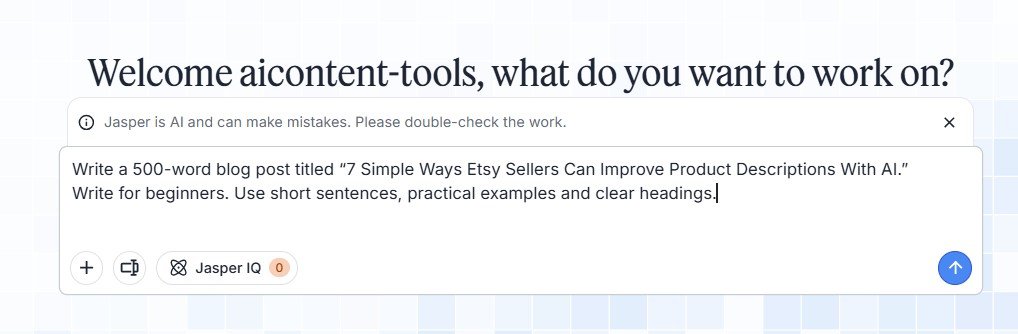
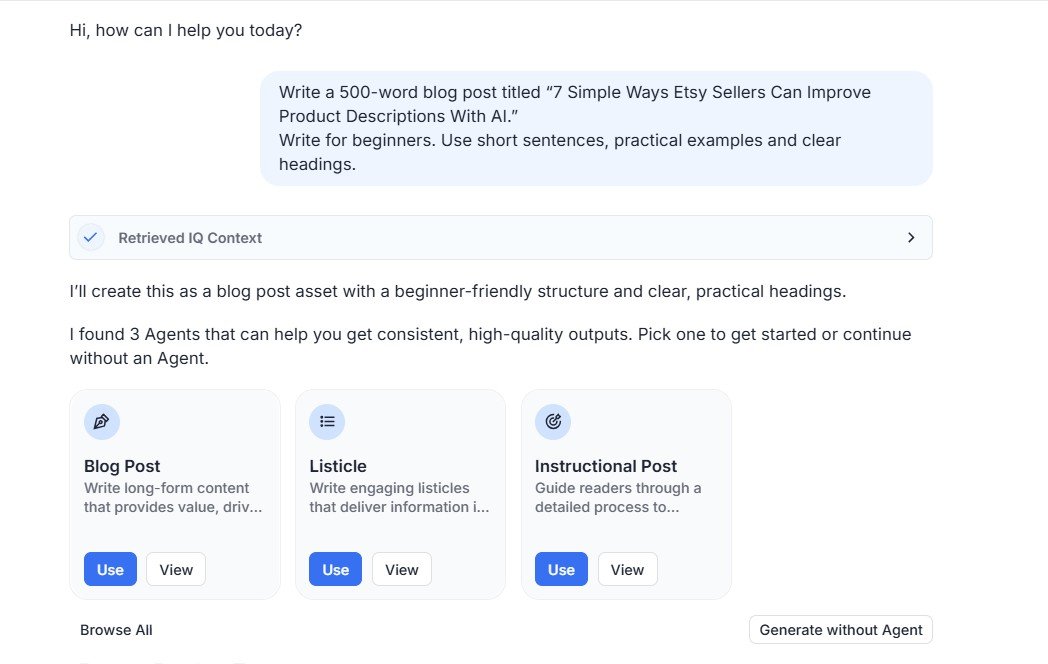
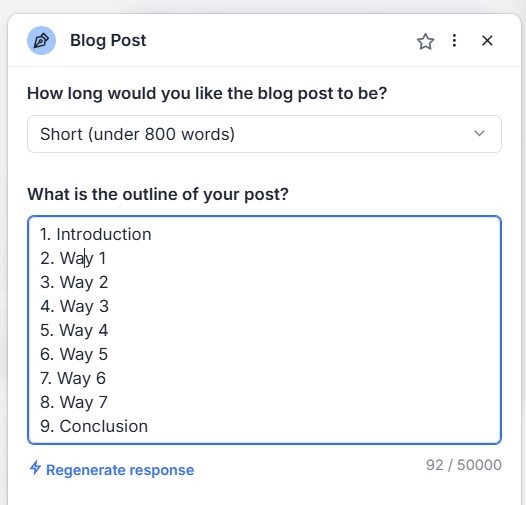
The blog workflow was one of the most complete tests. I saved the original prompt, Jasper’s agent recommendation, configuration, outline, generation process, metadata, editing options, image tools, and the completed article.
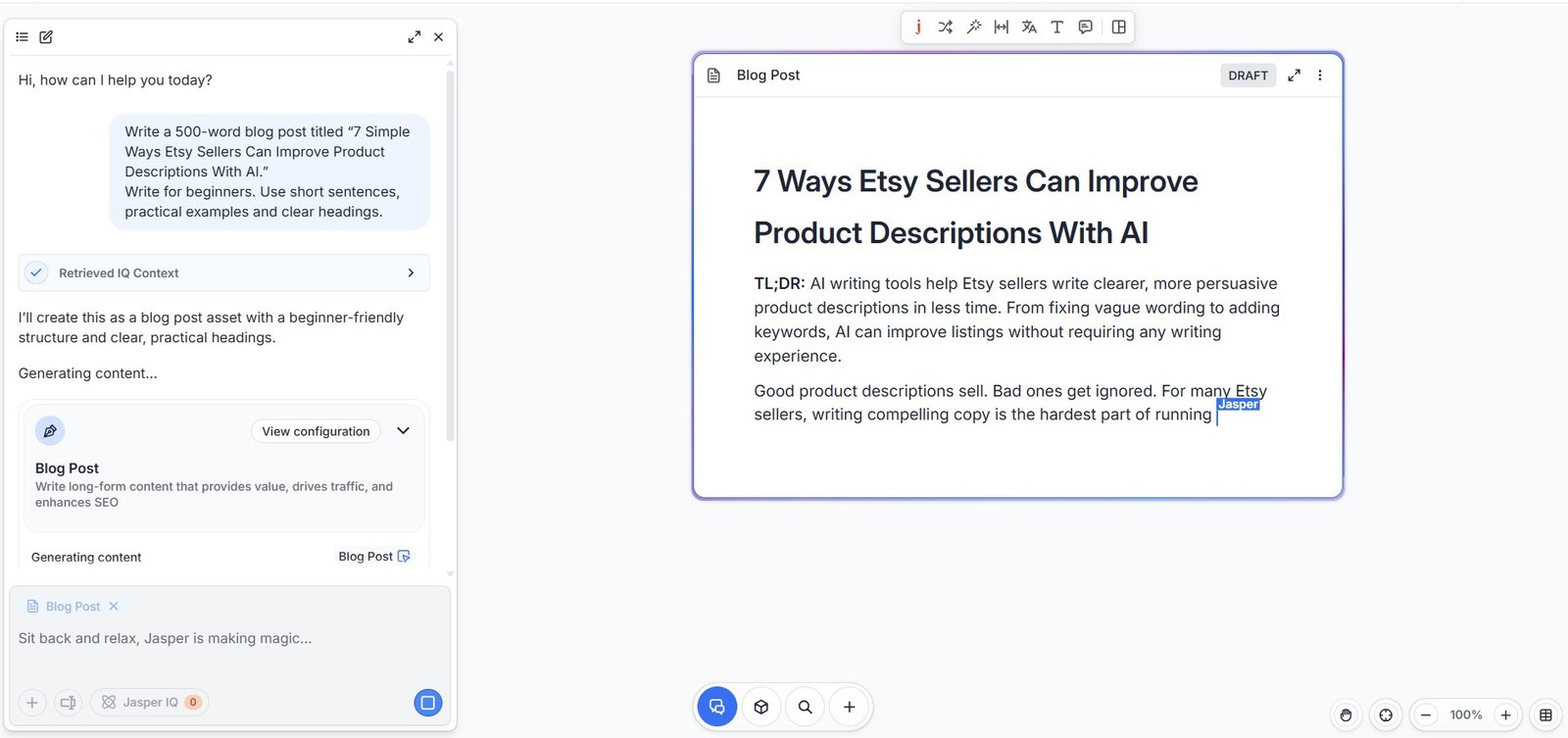
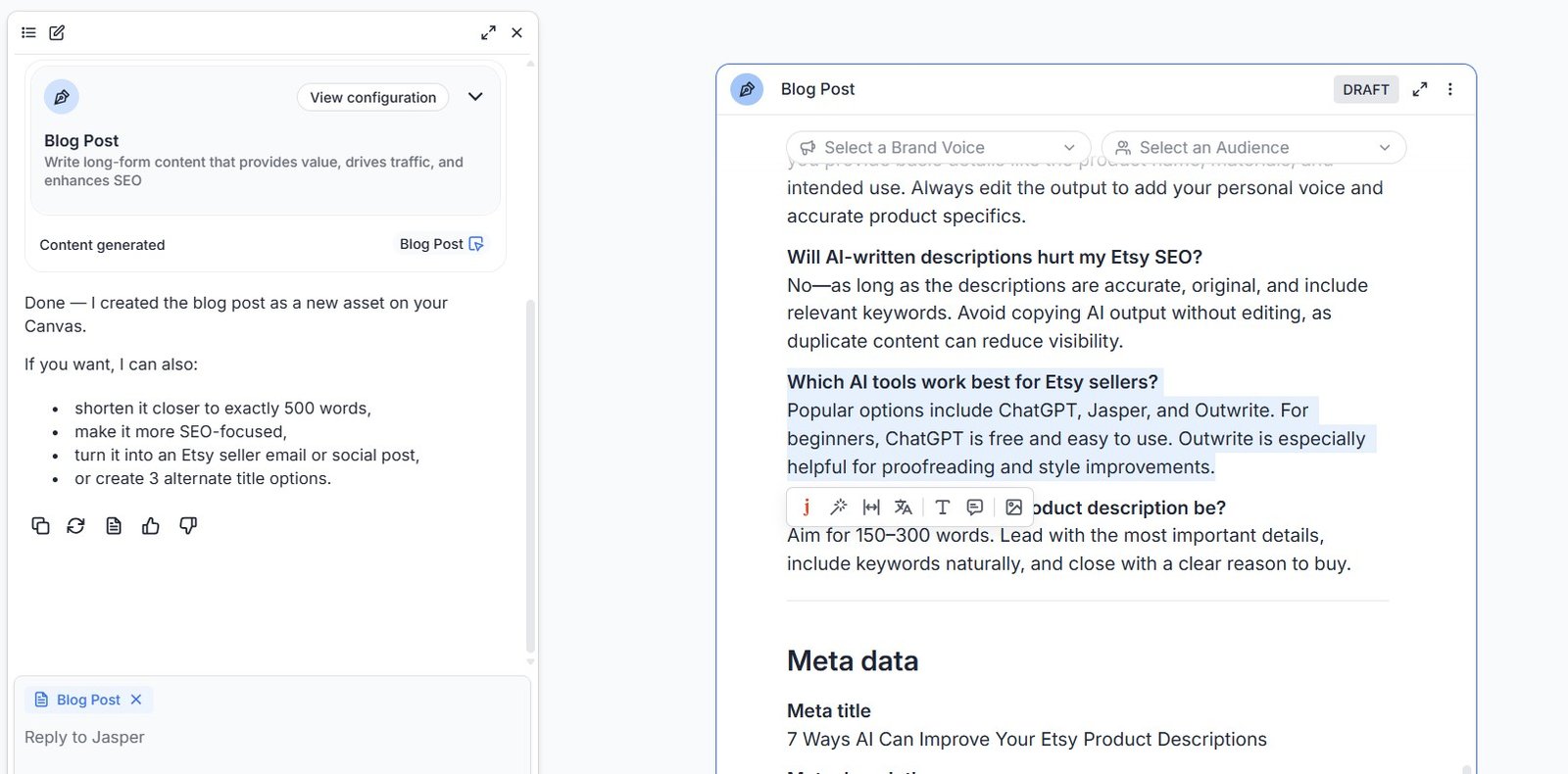
This matters because judging only the final paragraph would miss a large part of the product. Jasper’s workflow includes planning and follow-up actions around the draft.
For a more beginner-focused walkthrough, see my Jasper Tutorial .
Test Area 2: Simple Prompt vs More Context
I also wanted a basic reference point. A tool can look excellent when the prompt is extremely detailed, but beginners often start with short instructions.
So I tested simple generation too.
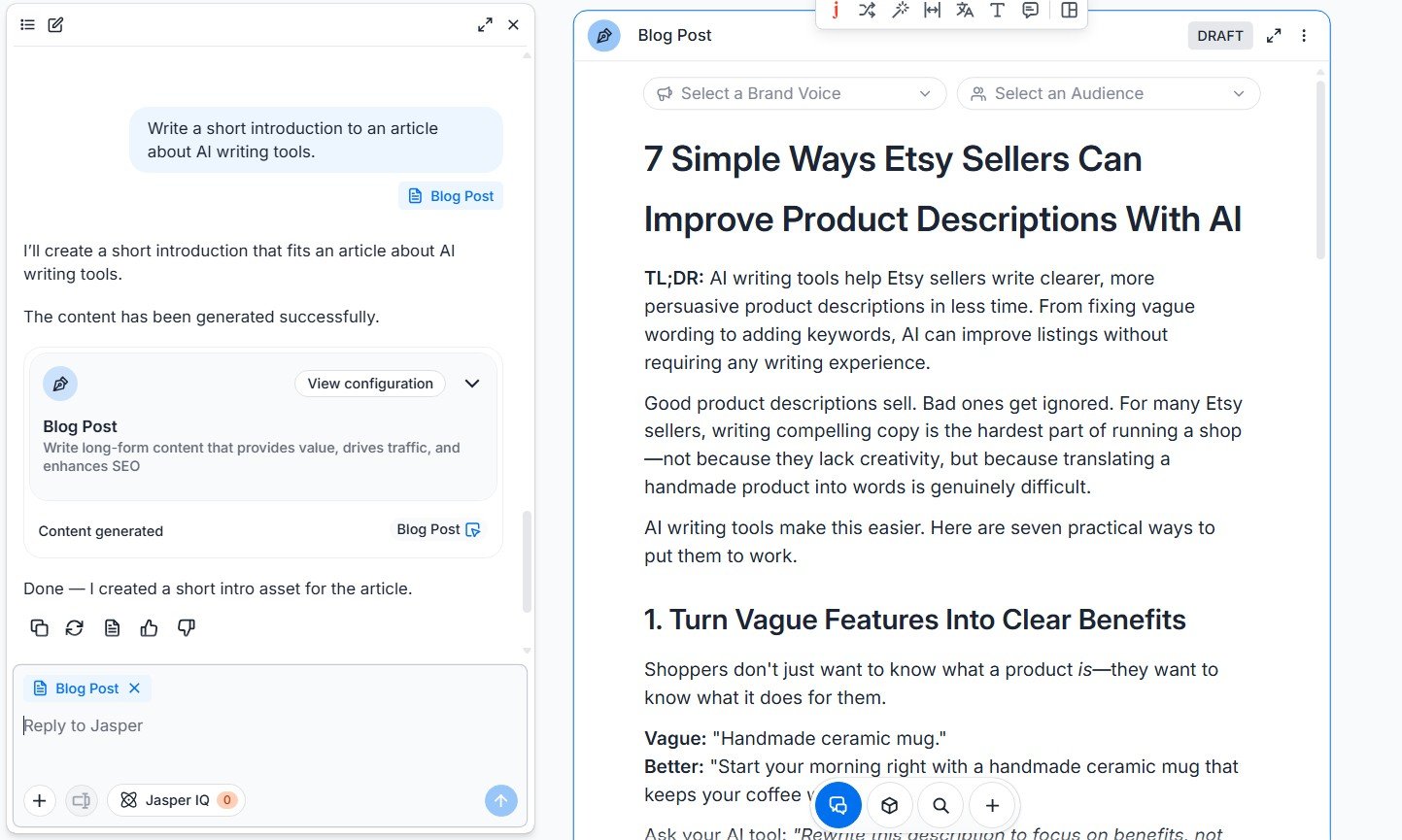
I then used the same general type of content with additional context such as Brand Voice. This helped show whether reusable brand information changed the output.
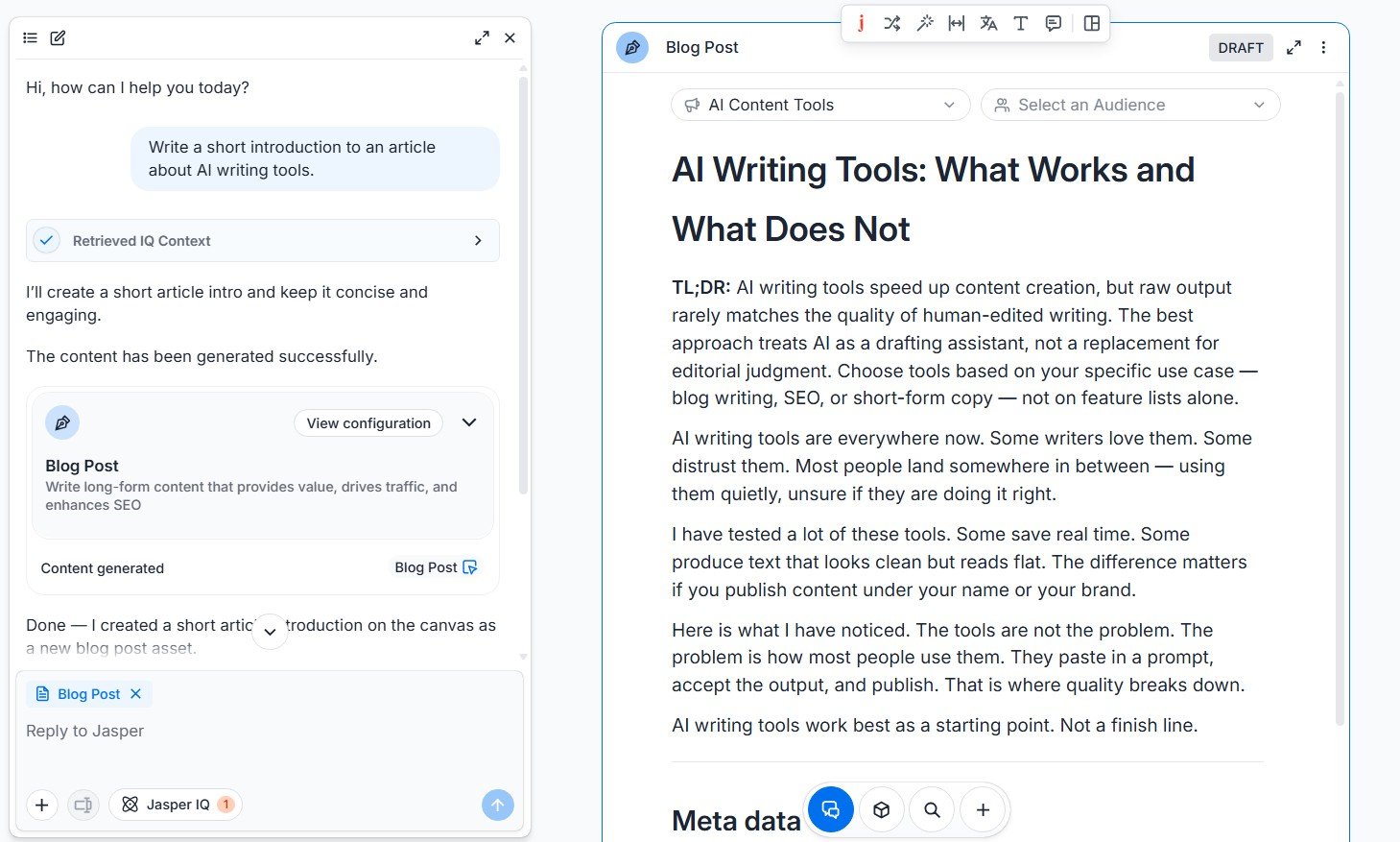
The complete Brand Voice experiment is here: Jasper Brand Voice Review: Can It Really Match Your Writing Style? .
Test Area 3: Jasper Brand Voice
The Brand Voice test was not based on selecting a generic tone such as friendly or professional.
I created a custom voice for AI Content Tools, trained it with real website URLs, let Jasper analyze the samples, and then reviewed the completed style profile.
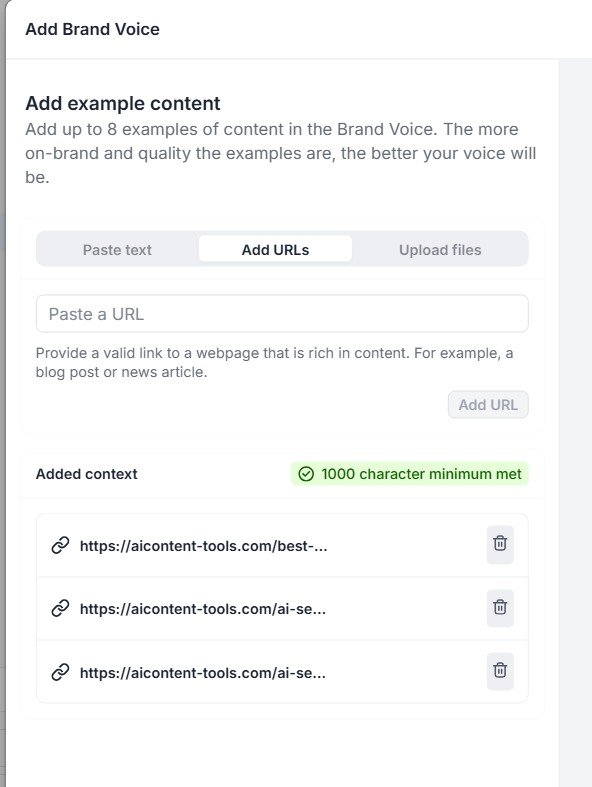
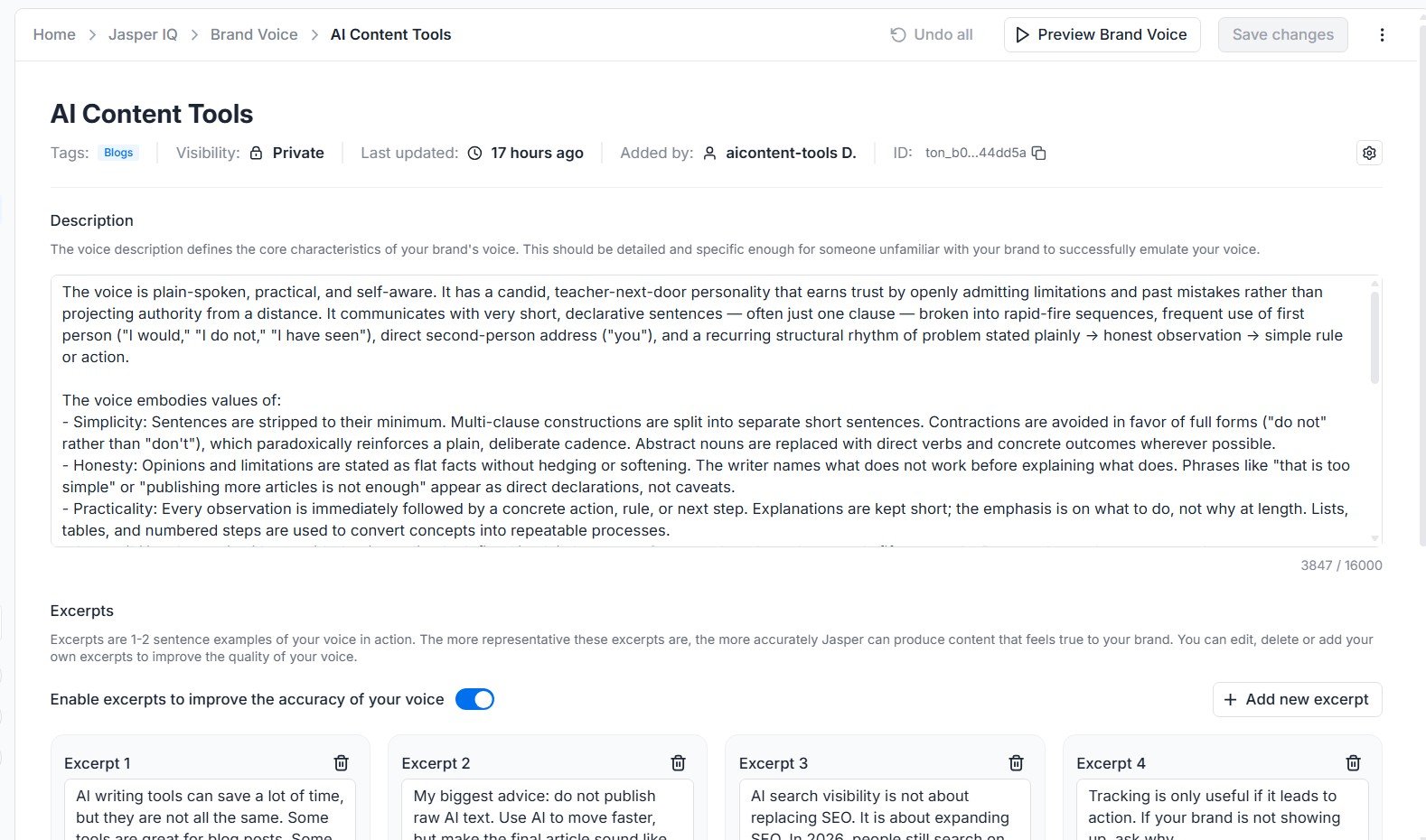
After setup, I used that voice in more than one format, including article content, LinkedIn, and product descriptions. This helped test whether the feature was reusable rather than useful for one isolated output.
Test Area 4: Beginner Explanation Quality
AIContent-Tools.com is written for people who may be new to AI. Because of that, I also tested whether Jasper could explain a difficult idea simply.
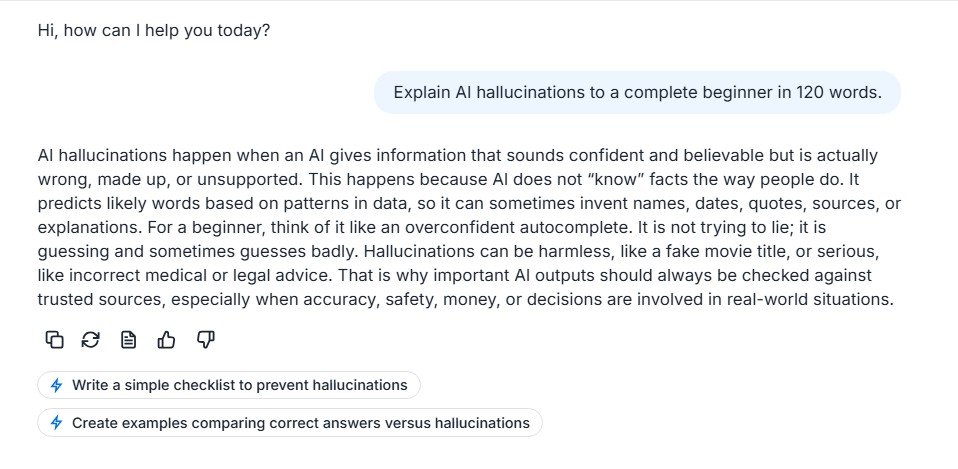
In this type of test I looked for a different quality than in marketing copy. The important questions were:
- Is the explanation understandable?
- Does it avoid unnecessary jargon?
- Does it answer the question directly?
- Would a beginner know what the term means after reading it?
Test Area 5: Following Detailed Instructions
A useful AI writing tool should also handle constraints.
I tested Jasper with a more complex prompt containing detailed rules about formatting, sentence length, banned words, and content structure.
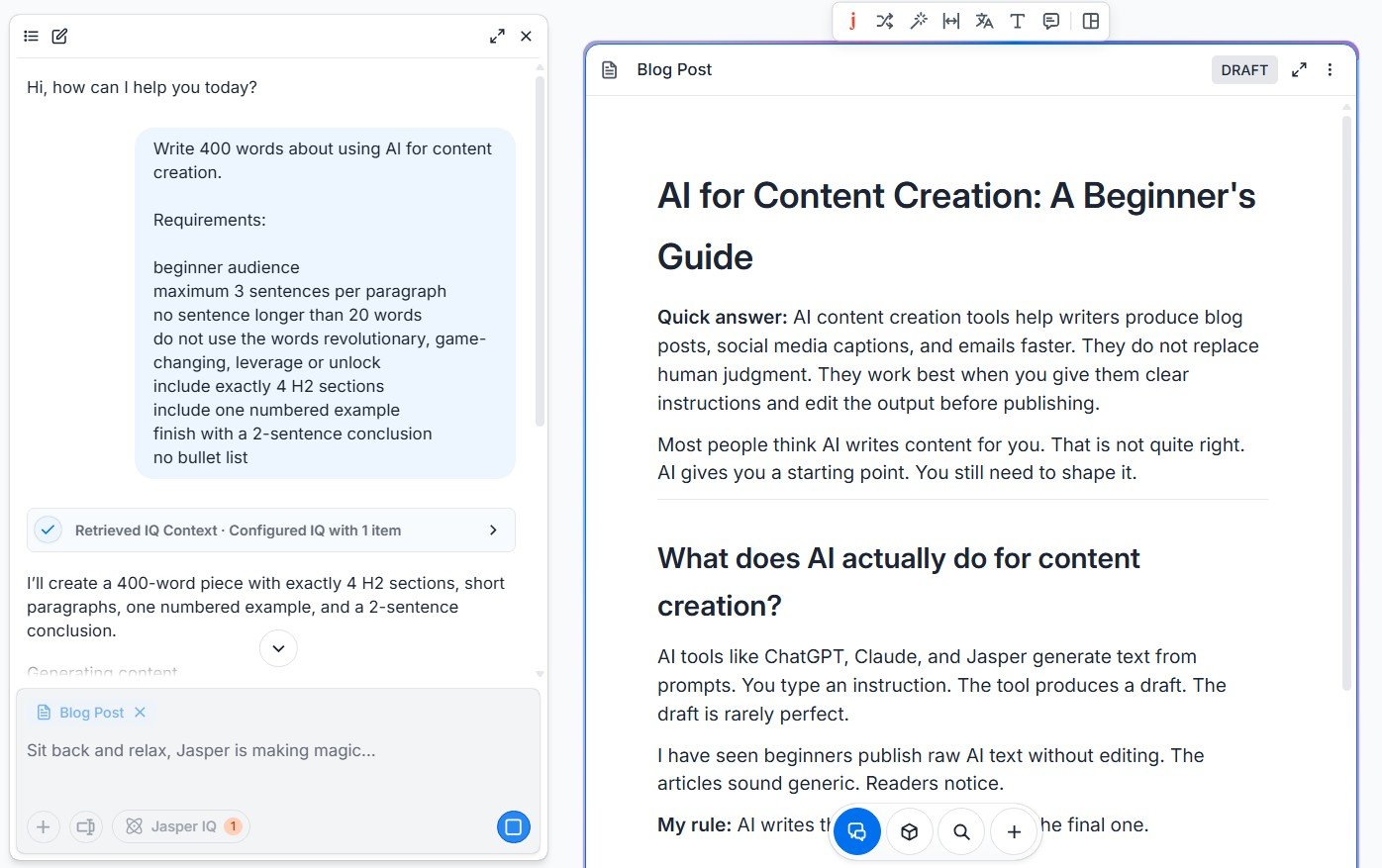
This type of test is important because real publishing workflows often have rules. A content team may have a style guide, required sections, forbidden phrases, or a specific page format.
Test Area 6: We Looked for Weak Output Too
I did not want this project to become a gallery of only Jasper’s best results.
During the article review I found a weak, generic marketing claim. I saved it instead of hiding it.
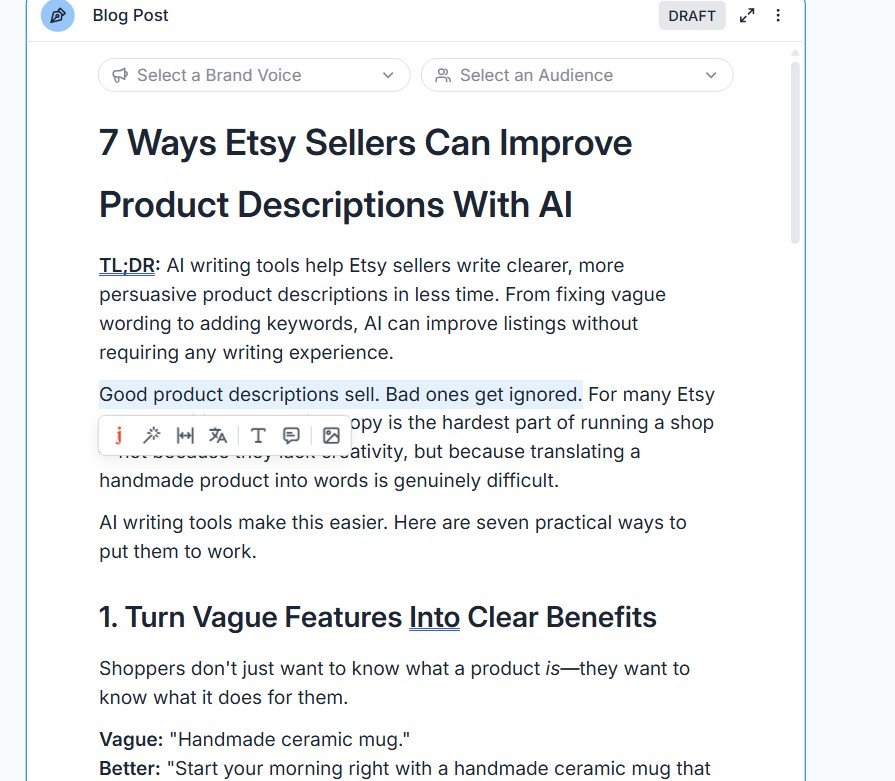
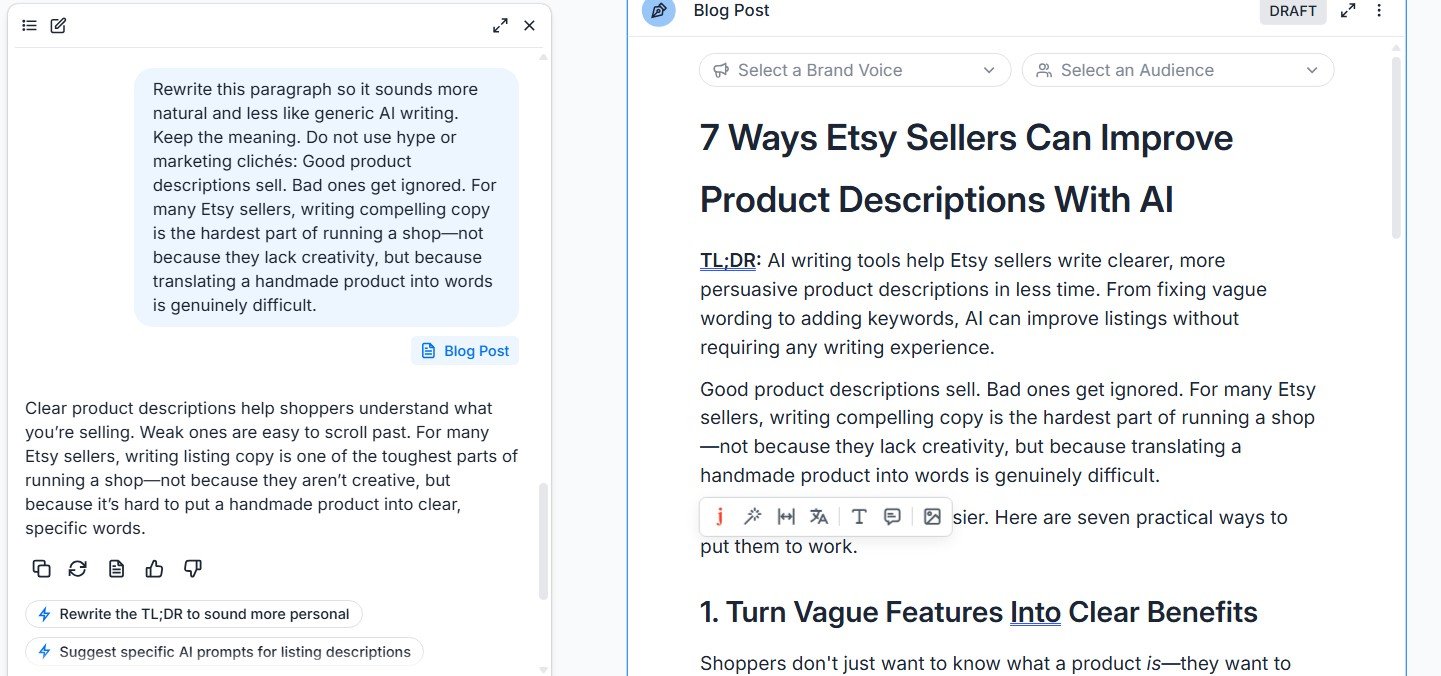
I then used Jasper’s rewriting tools to see whether a weak paragraph could be made more natural.
Test Area 7: Web Search and Current Information
Some AI tasks depend on current information. I tested whether Jasper would use web search for questions such as pricing and recent feature updates instead of relying only on an old internal answer.
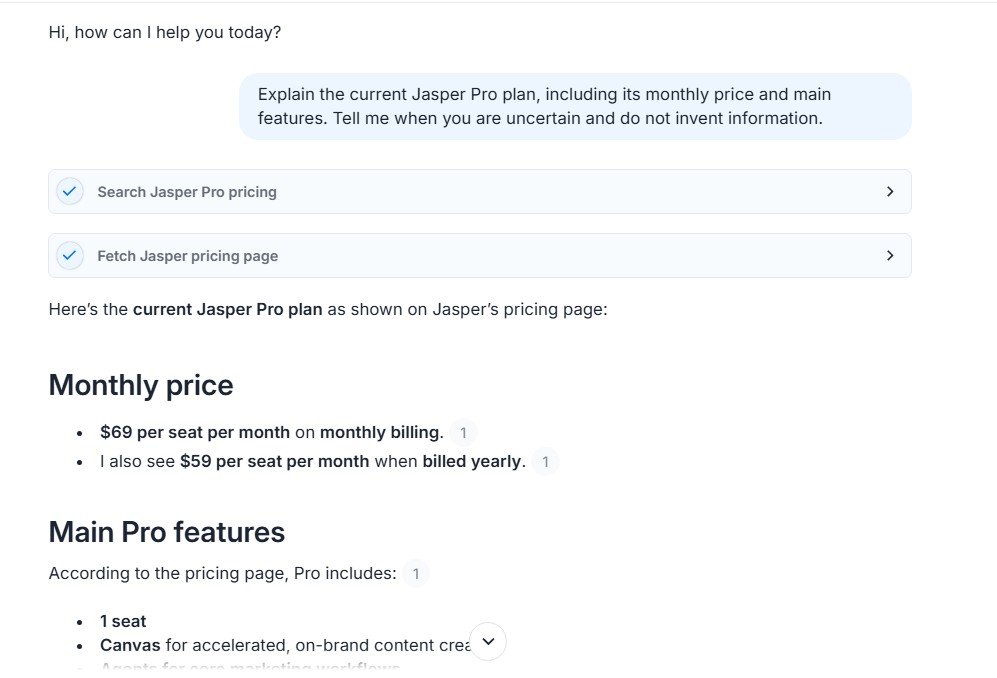
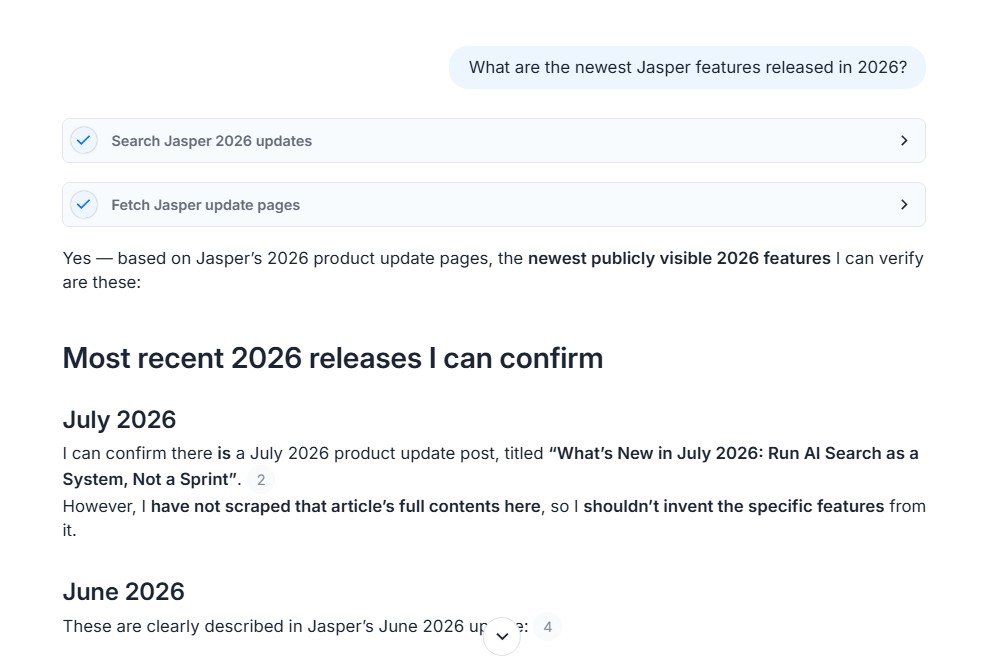
This test was not designed to prove that every web result is correct. The goal was to check the workflow: does Jasper search when the task requires fresh information, and does it try to verify details rather than invent them?
Test Area 8: Jasper AI Agents
Jasper contains a large Agent Library. I explored more than 20 agents, agent types, and related workflows.
I did not rate every agent as a separate product. Instead, I looked at whether agents made different marketing jobs easier to structure.
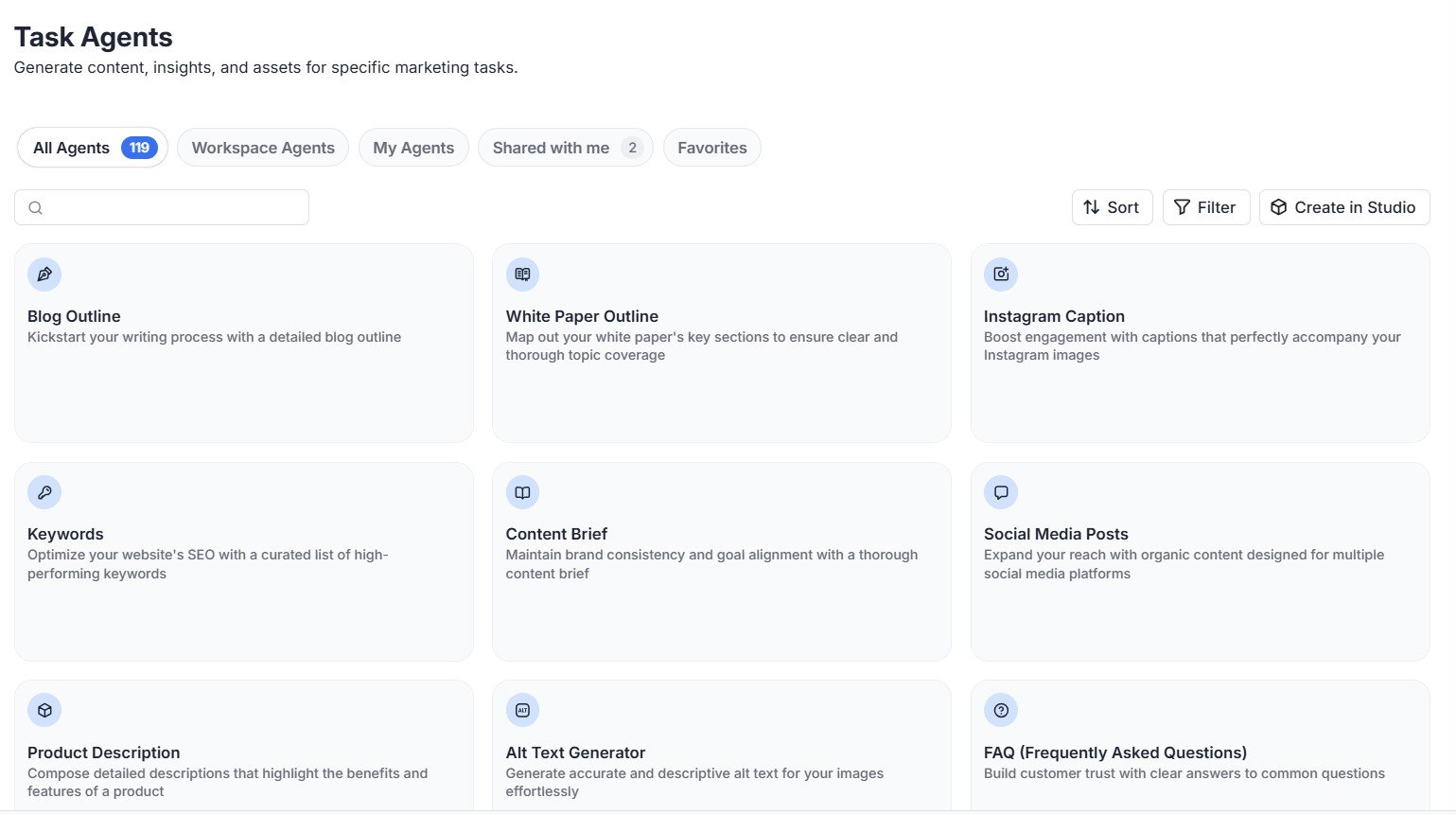
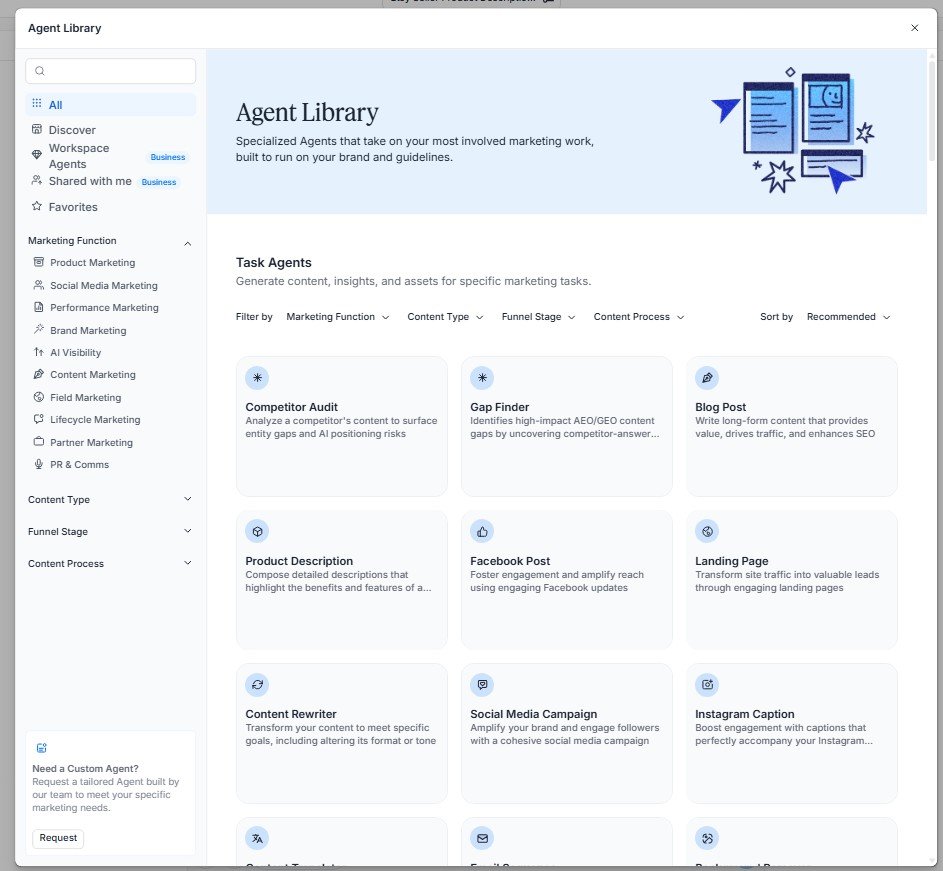
I also checked categories such as Social Media Marketing, AI Visibility, Field Marketing, PR and Communications, Partner Marketing, Lifecycle Marketing, Advertising, Audio and Video, Image tools, Content Planning, and Content Creation.
See the dedicated Jasper AI Agents Review: We Tested More Than 20 Agents for the full analysis.
Test Area 9: Content Repurposing
A content platform should do more than create another blog post. I tested how Jasper handles turning one piece of source content into other formats.
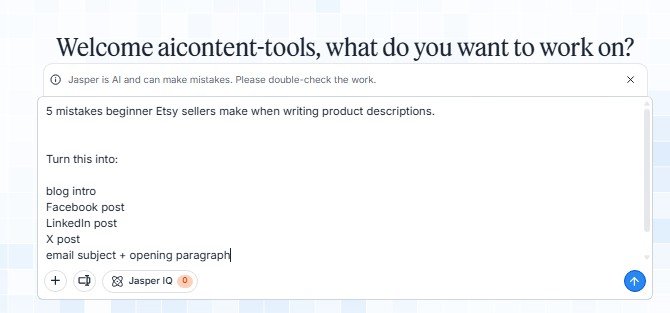
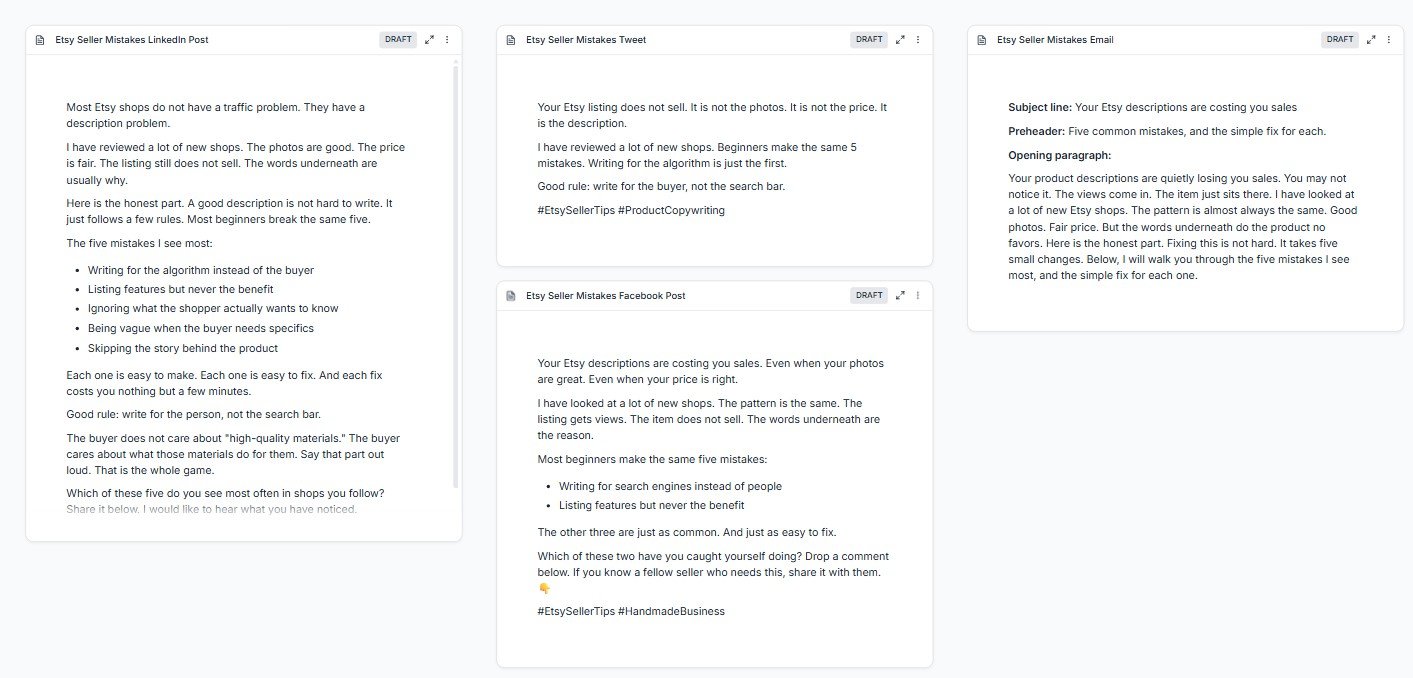
The main thing I checked was whether the formats felt like separate channel outputs, not simply copies of the same paragraph.
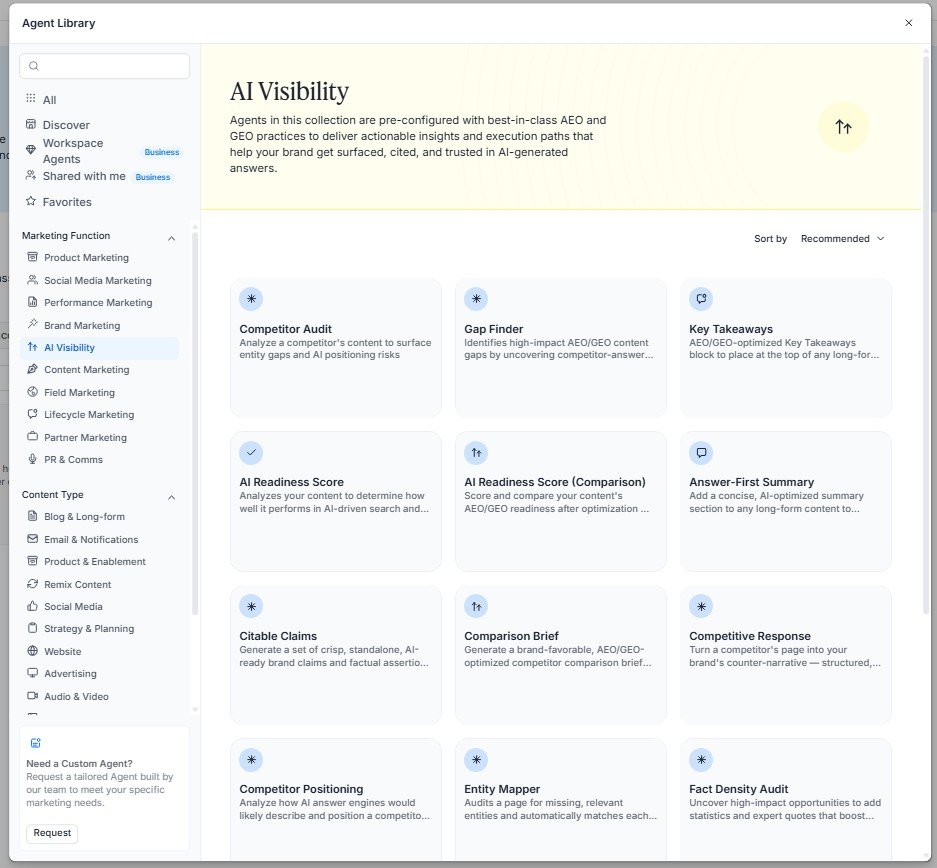
Test Area 10: SEO, AEO, GEO and AI Visibility
Search-related claims need careful testing because words such as AI visibility, AEO, and GEO can sound more certain than they really are.
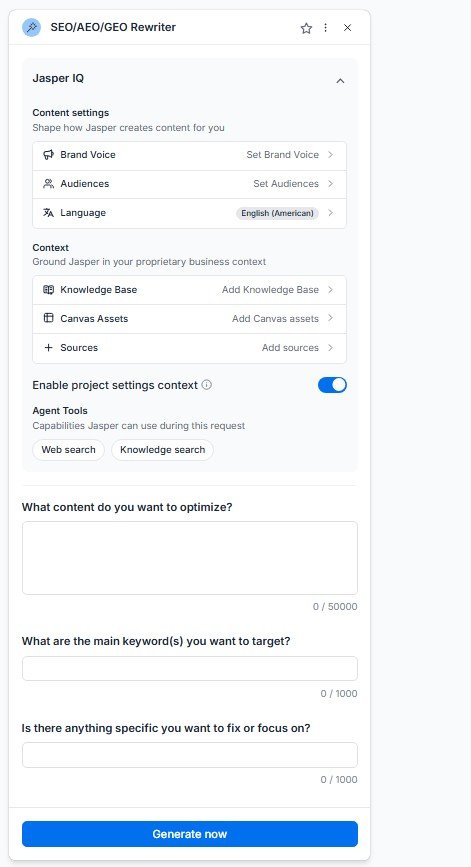
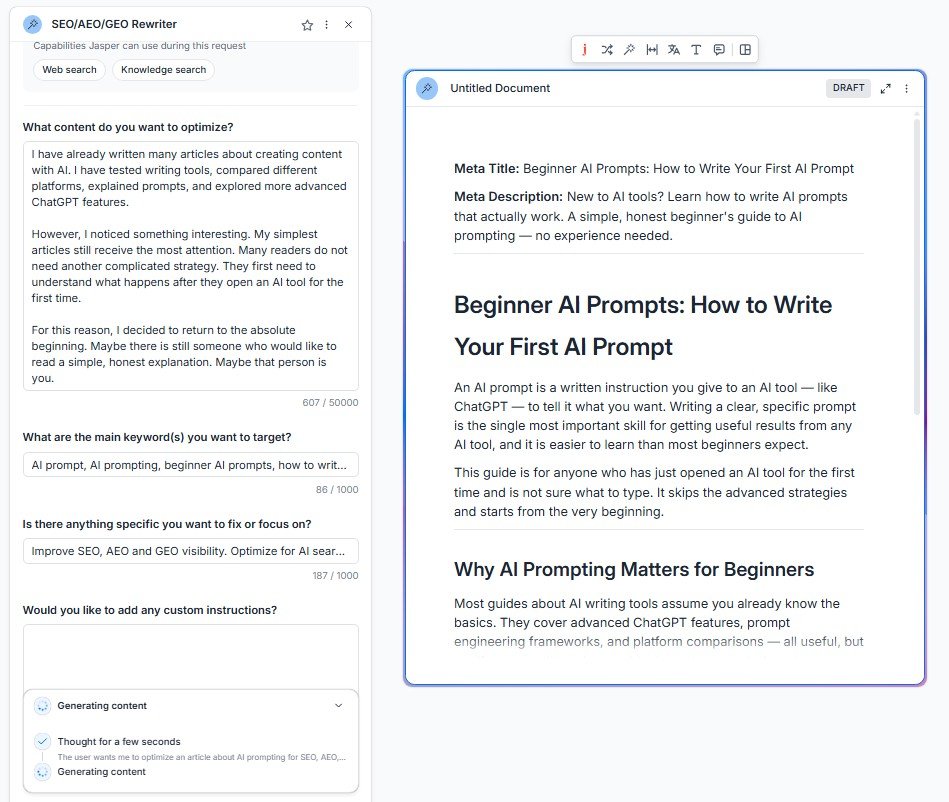
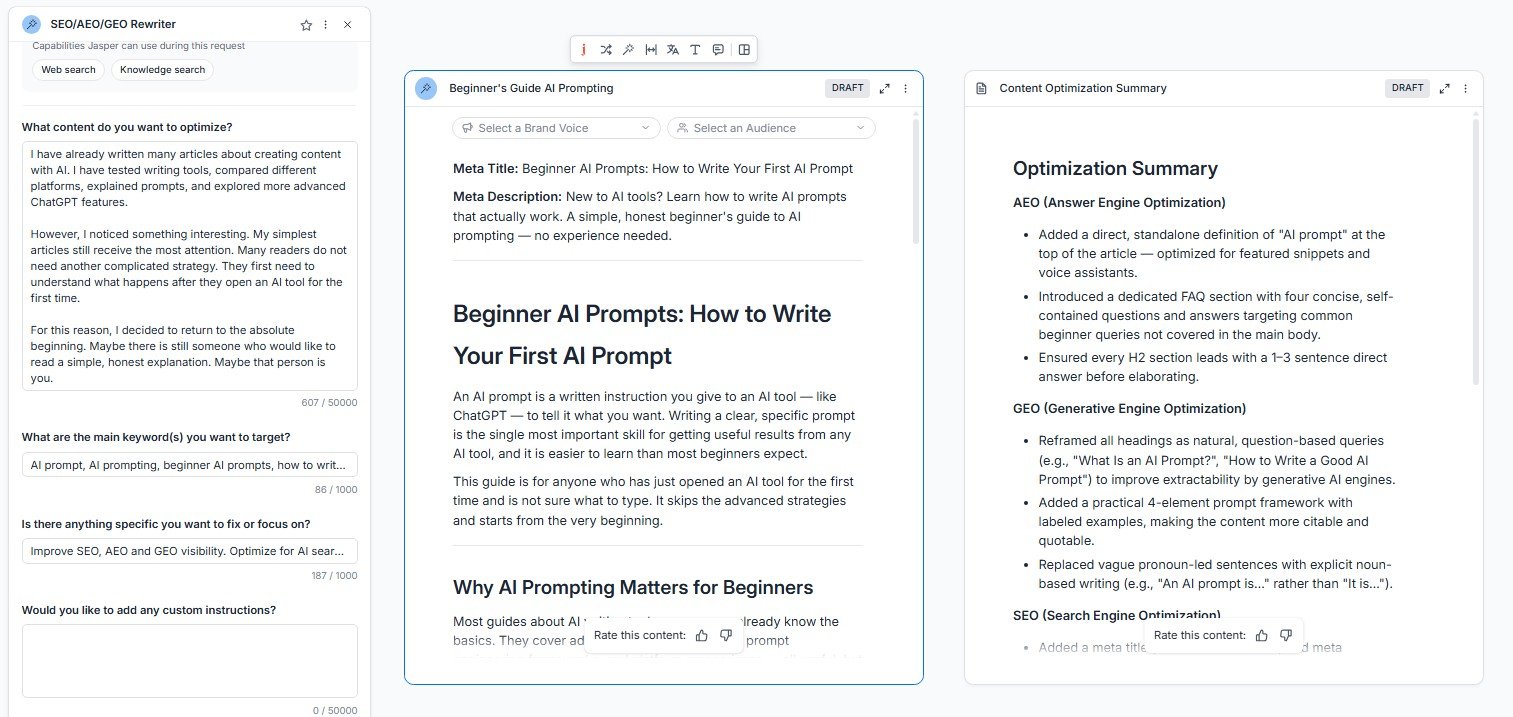
I explored Jasper’s AI Visibility area and then ran the SEO/AEO/GEO Rewriter workflow.
Read the dedicated Jasper SEO, AEO and GEO Rewriter Review .
Test Area 11: Landing Page Generation
For the landing-page test I used Etsy AI Lab, so I already knew the product and could judge whether Jasper described it correctly.
The process included agent recommendation, product and benefit inputs, custom structural instructions, and a complete generated landing-page draft.
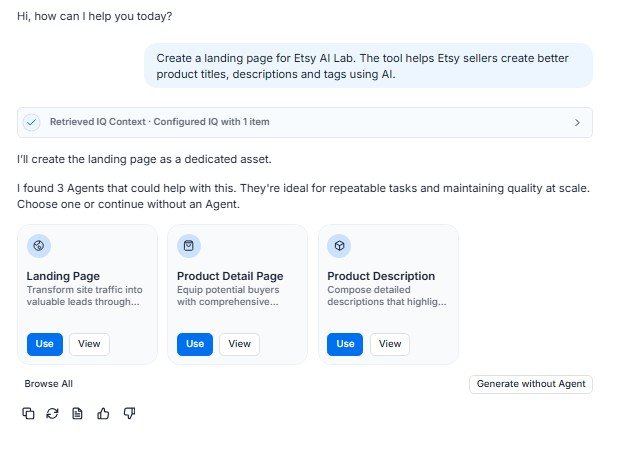
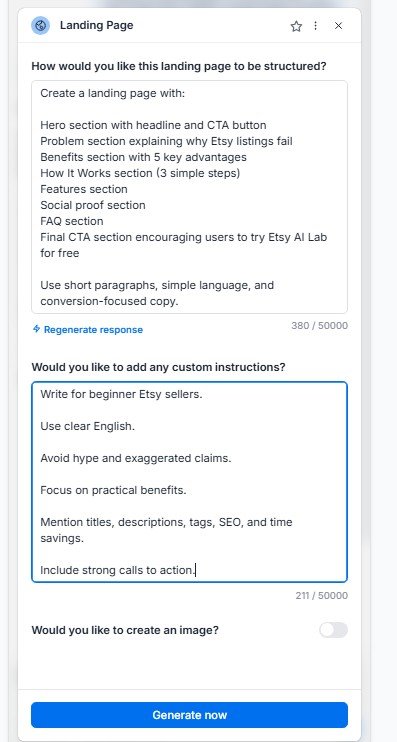
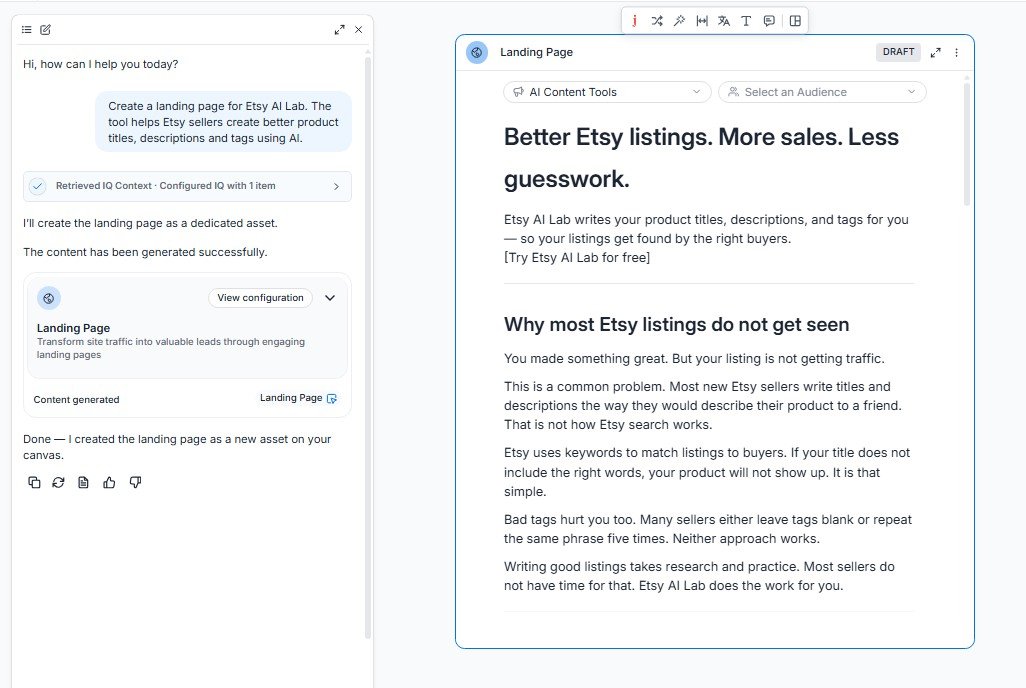
The full breakdown is available in my Jasper Landing Page Generator Review .
Test Area 12: Content Planning
I also tested a task where the output was a plan rather than final marketing copy.
Jasper was asked to create a 30-day content plan for AIContent-Tools.com. The workflow included goals, topics, publishing settings, custom instructions, and a generated editorial calendar.
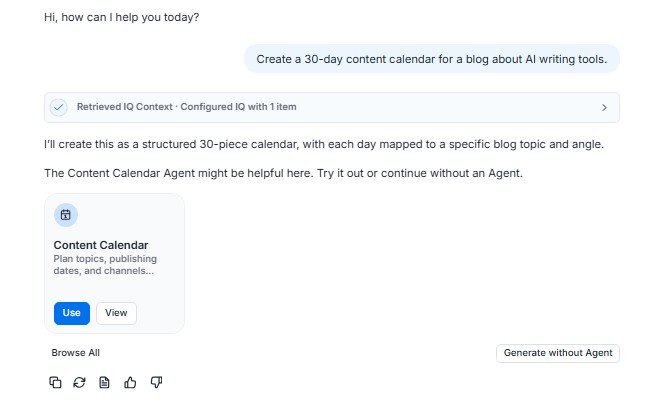
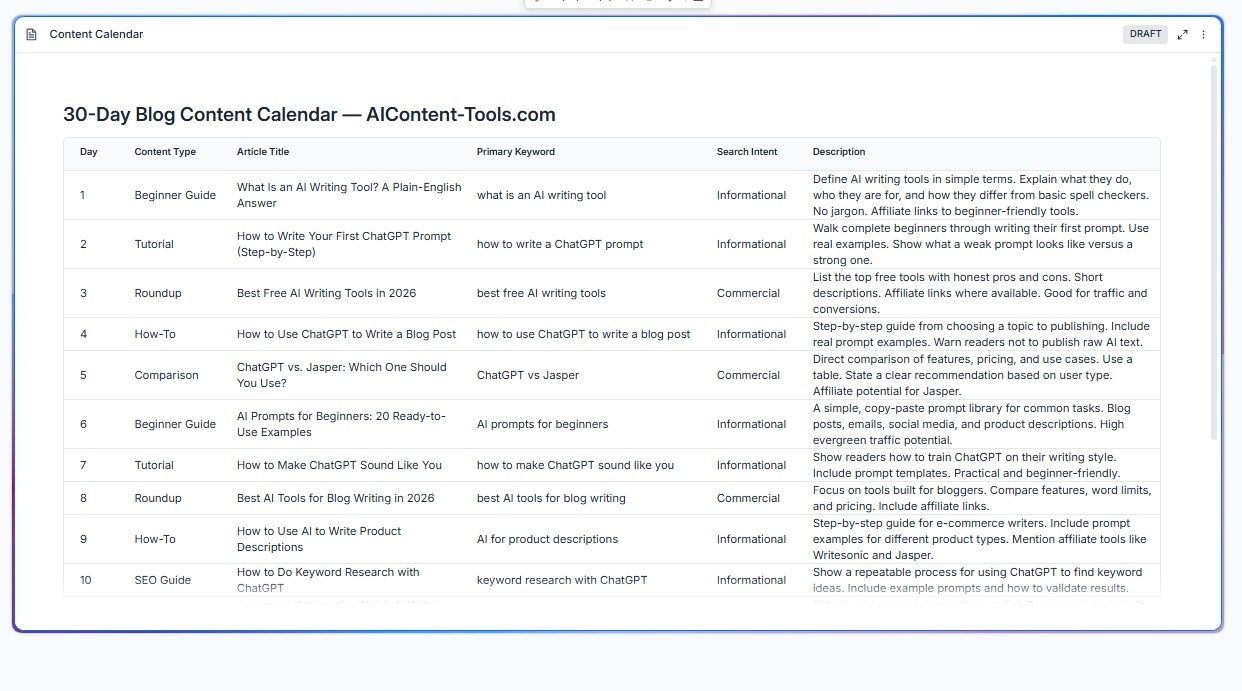
This test becomes a separate supporting article: Jasper Content Calendar Review .
Test Area 13: Social Media Generation
I tested both repurposed social content and a dedicated Facebook Post workflow.
In the Facebook test, Jasper recommended relevant social agents, asked for details such as the key message, hashtags, CTA, and caption length, and then generated a finished post.
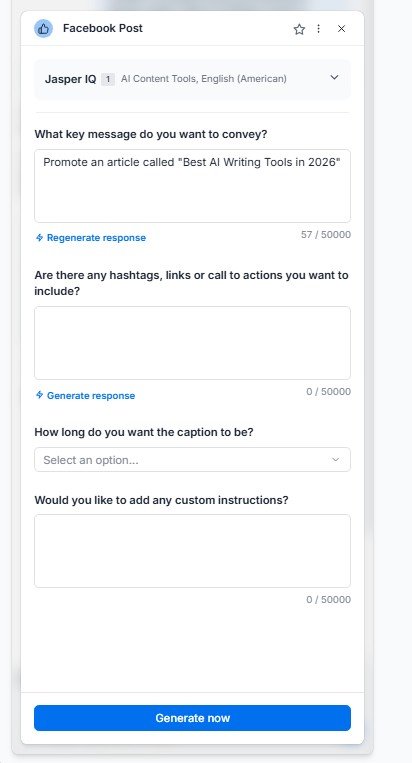
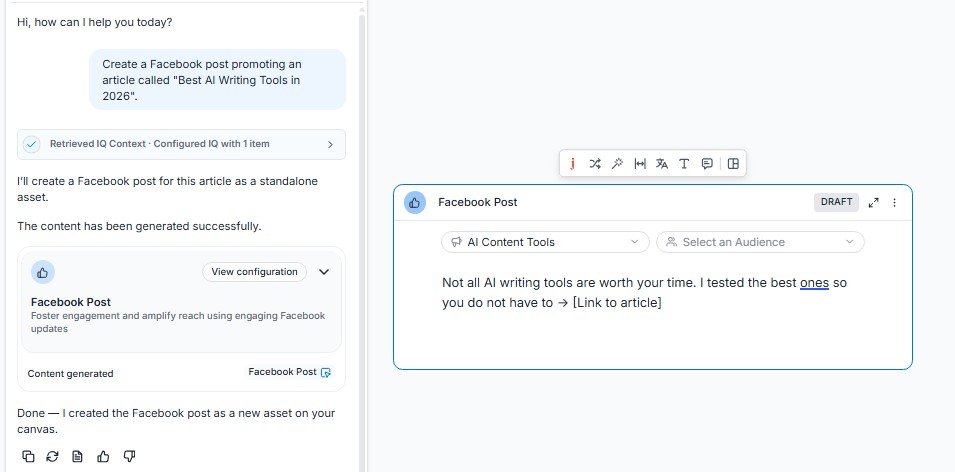
See: Jasper Social Media Post Generator Review .
Test Area 14: Product Description Comparison
For one test I used the same type of handmade product across Jasper and Etsy AI Lab.
Etsy AI Lab generated a full Etsy-oriented listing with title, description, tags, SEO angle, and buyer angle. Jasper generated product-description content for the handmade crochet sunflower bookmark.
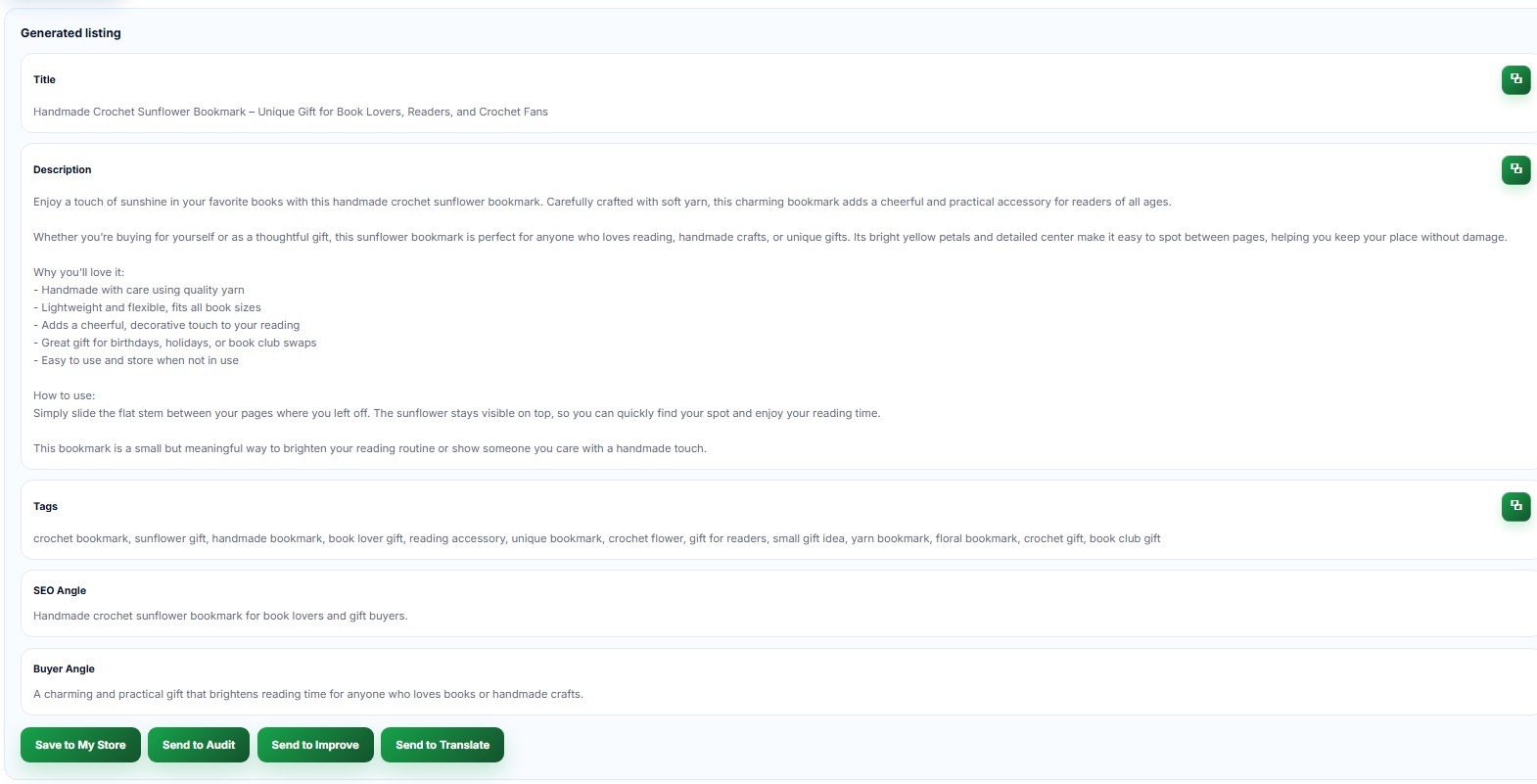
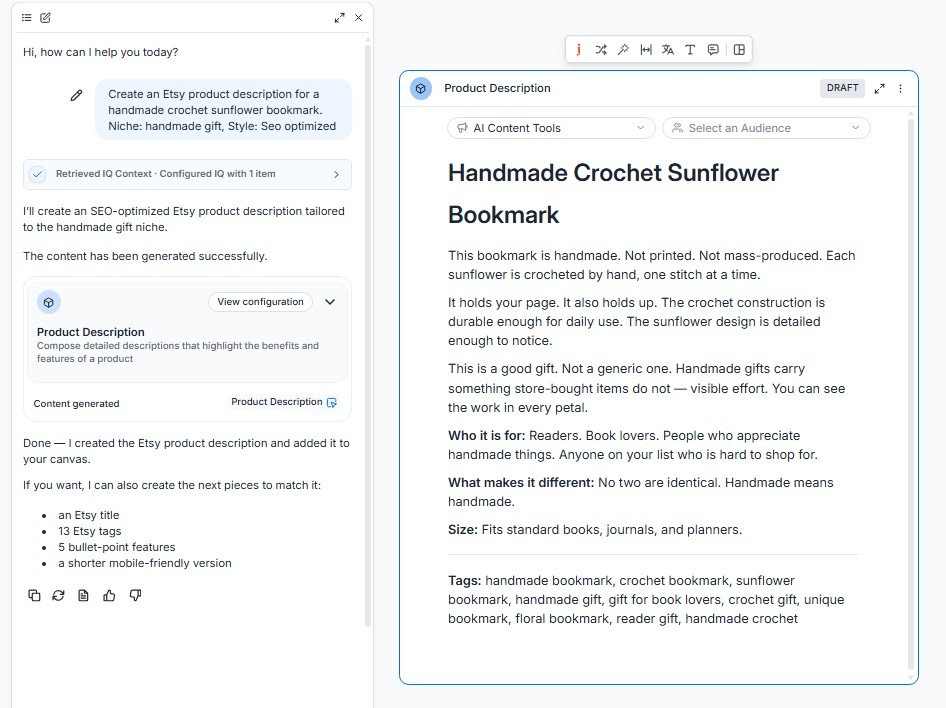
The dedicated comparison is: Jasper vs Etsy AI Lab: Product Description Test .
Test Area 15: Audience Profiles and Competitor Analysis
I also tested features that support content creation without directly writing the final article.
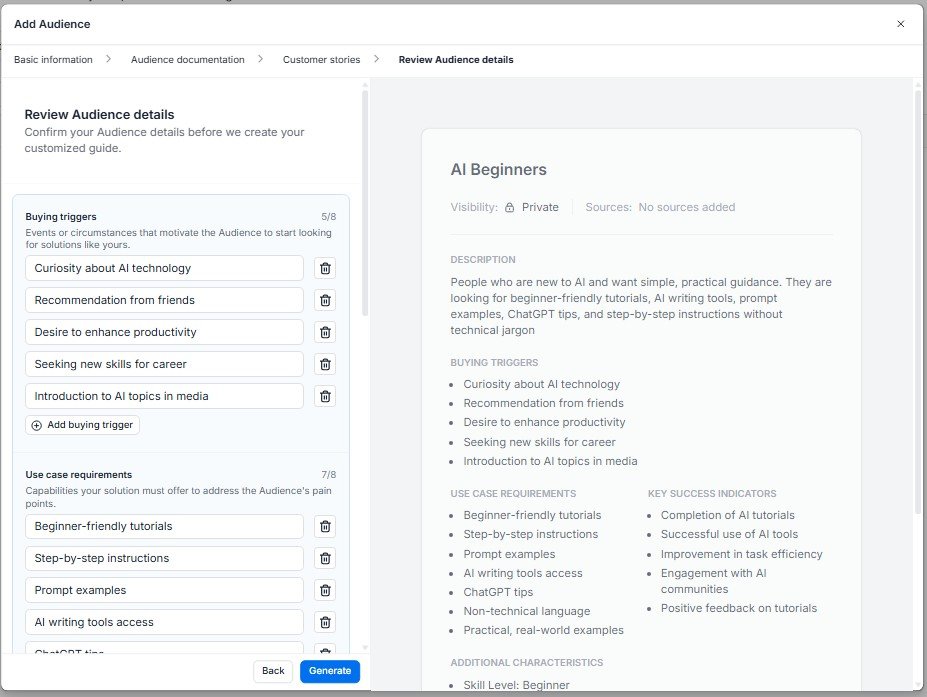
First, I created an audience profile for beginner AI users. Jasper generated a more detailed description of their needs, motivations, content requirements, and other characteristics.
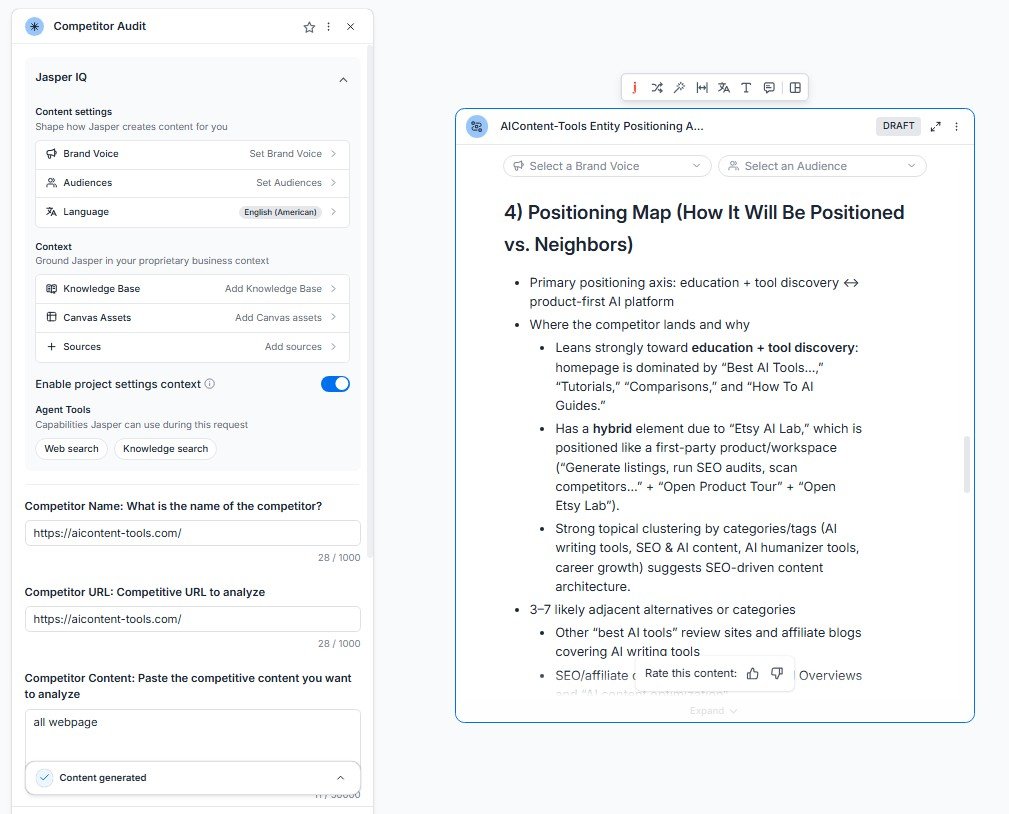
I then used the Competitor Audit workflow with AIContent-Tools.com. Jasper analyzed the site’s positioning and content strategy.
These tests helped me evaluate Jasper as a broader marketing platform, not only as a tool for generating paragraphs.
How We Judged Jasper’s Outputs
I did not use one score for every type of task. A social post and a competitor audit should not be judged in exactly the same way.
Instead, I used a group of practical questions.
| Area | What I Looked For |
|---|---|
| Task match | Did Jasper actually do the job requested? |
| Clarity | Can the output be understood easily, especially by a beginner? |
| Structure | Does the format fit the task: article, landing page, calendar, social post, or report? |
| Specificity | Does the content use the real inputs, or does it drift into generic marketing language? |
| Instruction following | Did Jasper respect the requested length, format, audience, and custom rules? |
| Context use | Did Brand Voice, audience, product data, or other supplied context appear to matter? |
| Editing required | How much manual correction, fact-checking, shortening, or rewriting would I still do? |
| Workflow value | Did the specialized agent make the task easier than starting from a blank prompt? |
What Our Scores Mean
The scores in my Jasper reviews are editorial scores based on hands-on use. They are not laboratory measurements.
A high score means
- The workflow was easy to use.
- The result matched the task well.
- The feature saved useful work.
- The first draft was a strong starting point.
- The feature offered value beyond a very simple prompt.
It does not mean
- The output was perfect.
- No editing was required.
- Every user will get the same result.
- SEO rankings are guaranteed.
- The tool is best for every business.
Why We Saved the Inputs, Not Only the Outputs
AI results depend on context.
If two reviewers use different prompts, different audiences, different Brand Voices, and different source material, they may receive very different text.
That is why many of the 81 screenshots show setup screens, forms, prompts, and configuration rather than only polished final outputs.
Did We Edit Jasper’s Outputs Before Judging Them?
The purpose of the screenshots was to capture Jasper’s workflow and generated results.
When I found weak text, I treated that as part of the test. I did not silently rewrite a weak Jasper sentence and then present the edited version as if Jasper created it perfectly on the first try.
In some tests I deliberately used Jasper’s own rewriting or improvement tools afterward. When that happened, it was a separate step in the workflow.
This distinction matters because a good AI platform may still be useful even when its first draft needs editing. But the review should make that editing requirement clear.
Was This a Scientific Benchmark?
No.
This is a hands-on editorial test based on real content and marketing workflows.
I did not run every prompt hundreds of times, calculate statistical variance, or compare outputs across identical model temperatures in a controlled lab.
Why AI Results Can Change
You may repeat one of my prompts and receive a different answer. That is normal for generative AI.
Results can change because of:
- different Brand Voice or audience settings,
- different source content,
- changes to Jasper’s agents or interface,
- changes to the underlying AI system,
- new web information,
- small differences in instructions,
- normal variation in generated language.
This is another reason screenshots are useful. They document what the workflow looked like when the test was performed.
Screenshot Evidence From the Testing Project
The full project contains 81 screenshots. The table below links to a representative set from the major test areas. I am not showing our internal file IDs because those labels are only for site organization.
| Screenshot | What It Shows |
|---|---|
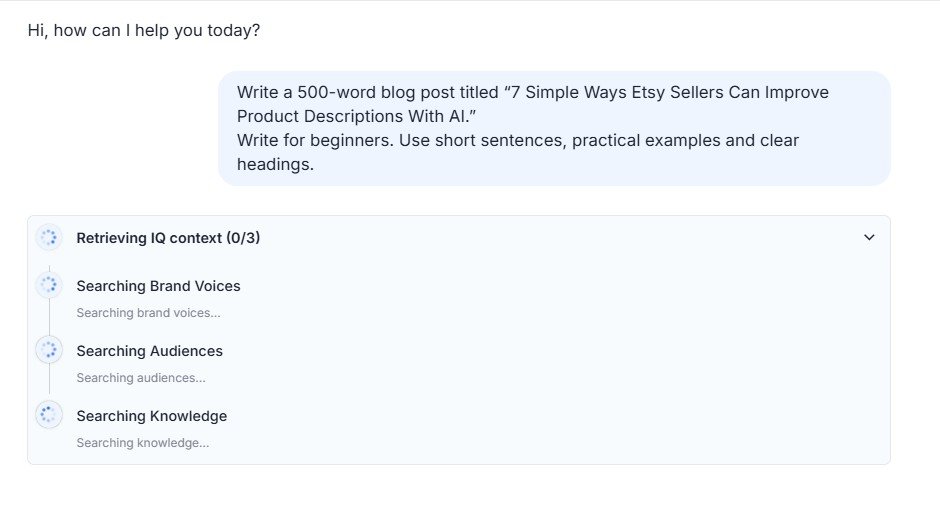
| View original blog prompt | The starting prompt for the Etsy product-description article test. |
| View Jasper IQ context retrieval | Jasper retrieving Brand Voice, audience, and knowledge context before content generation. |
| View agent recommendation | Jasper recommending Blog Post, Listicle, and Instructional Post agents. |
| View generated outline | The outline created before full article generation. |
| View completed blog workflow | The finished article workflow with follow-up content and optimization options. |
| View Brand Voice training | Brand Voice training using real AIContent-Tools.com URLs. |
| View completed Brand Voice profile | The finished style analysis created from the website samples. |
| View beginner explanation test | Jasper explaining AI hallucinations in simple educational language. |
| View weak-output example | A generic marketing claim saved during manual review instead of being hidden. |
| View detailed-instructions test | A complex prompt with many formatting and structural requirements. |
| View pricing verification test | Jasper using web search to verify current pricing information. |
| View Agent Library | The broader library of marketing automation and content agents. |
| View multi-channel outputs | LinkedIn, X, Facebook, and email content generated from one source. |
| View AI Visibility agents | The Jasper category focused on AEO, GEO, and AI-search-related workflows. |
| View SEO/AEO/GEO result | The rewritten article after search and AI-search optimization. |
| View optimization summary | Jasper’s explanation of the changes made during the SEO/AEO/GEO workflow. |
| View generated landing page | The landing-page draft created for Etsy AI Lab. |
| View 30-day content calendar | The editorial calendar generated for AIContent-Tools.com. |
| View Facebook post result | A completed social post generated from a real article-promotion task. |
| View Etsy AI Lab listing output | A complete Etsy-oriented listing with title, description, tags, SEO angle, and buyer angle. |
| View Jasper product result | Jasper’s product-description output for the same type of handmade product test. |
| View audience profile | The completed AI Beginners profile with needs and motivations. |
| View competitor audit | Jasper analyzing AIContent-Tools.com positioning and content strategy. |
How the Methodology Connects to Our Jasper Review Series
I created separate articles for the workflows that deserve more detail. This keeps the main Jasper Review readable while still giving readers access to the evidence behind individual conclusions.
Other Jasper Content Used in the Test Cluster
If you are completely new to Jasper, start with my Jasper Tutorial .
If you are deciding whether Jasper belongs in your tool stack, compare it with the Best AI Writing Tools in 2026 or read Writesonic vs Jasper .
What Would Make Our Jasper Testing Stronger in the Future?
This testing project is already much broader than a one-prompt review, but there are still useful ways to improve it.
- Repeat selected prompts after major Jasper updates.
- Compare the same task across more competing tools.
- Track whether major workflow features change over time.
- Test more outputs with different audiences and Brand Voices.
- Add more real business examples instead of artificial prompts.
- Separate first-draft quality from final edited quality.
If an important workflow changes, the supporting review can be updated while this methodology page continues to explain how the overall project is organized.
How We Try to Keep the Reviews Fair
My goal is not to find a reason to give every Jasper feature a high score.
I try to separate three questions:
Does it work?
Did the feature complete the task it claims to help with?
Is it useful?
Did the workflow save meaningful work or improve the process?
Who needs it?
A feature can work well and still be unnecessary for a casual user.
That final question matters. A marketing team may value reusable Brand Voice, agent workflows, content planning, and multi-channel repurposing. Someone who needs one short AI paragraph each month may not.
Methodology Limitations
No product review is perfect. These are the main limitations of this Jasper test.
| Limitation | Why It Matters |
|---|---|
| Generative variation | The same prompt can produce a different answer on another run. |
| Product updates | Jasper can change agents, interface elements, or available settings after screenshots are taken. |
| Editorial judgment | Scores such as writing quality and usefulness include human judgment. |
| Limited repetitions | This is not a statistical benchmark with hundreds of repeated generations. |
| Our use cases | The tests focus mainly on content marketing, AI education, Etsy-related content, and website workflows. |
| Search outcomes | SEO/AEO/GEO tests evaluate the tool’s workflow, not guaranteed future rankings or AI citations. |
How to Read Our Jasper Reviews
When you see a score or conclusion in one of my Jasper articles, I recommend reading it together with three things:
- The use case. What job was Jasper doing?
- The evidence. What input and output screenshots support the conclusion?
- The limitation. What still required human judgment or editing?
That is more useful than treating one number as a universal answer.
FAQ: How We Tested Jasper AI
How many Jasper screenshots did you collect?
The testing database used for this project contains 81 screenshots covering writing, Jasper IQ, Brand Voice, agents, search, landing pages, content planning, social media, product content, audience profiles, competitor analysis, and related workflows.
Did you test Jasper with real projects?
Yes. Several tests used AIContent-Tools.com and Etsy AI Lab, including Brand Voice training from real site URLs, a 30-day content calendar, a landing page, and a competitor-analysis workflow.
Did you test only Jasper’s blog writer?
No. Blog writing was one part of the project. I also explored Jasper IQ, Brand Voice, more than 20 agents and agent categories, SEO/AEO/GEO tools, social content, content planning, product descriptions, web search, audiences, and competitor research.
Were Jasper outputs edited before screenshots were taken?
The purpose of the screenshots was to document the Jasper workflow and results. Weak output was kept as evidence. When Jasper’s own rewriting or improvement feature was used afterward, that was treated as a separate step.
Is this a scientific benchmark?
No. It is a hands-on editorial test based on practical marketing and content workflows. It is designed to show how the product behaved in real tasks, not to measure statistical model performance.
Can another user get different Jasper results?
Yes. Generative AI can produce different wording, and results can also change with different prompts, Brand Voice settings, audiences, source material, or product updates.
Do your SEO, AEO, and GEO tests prove a page will rank?
No. Those tests evaluate the optimization workflow and the changes Jasper makes. They do not prove future Google rankings or inclusion in AI-generated answers.
Why do you publish so many screenshots?
Screenshots make the review easier to verify. They show not only what Jasper produced, but also prompts, configuration screens, agent choices, Brand Voice setup, and other context behind the result.
Final Methodology Note
The most important thing I learned while building this test is simple:
AI tools should be tested as workflows, not as one impressive paragraph.
A real user has to choose a tool, give it information, configure the task, evaluate the result, fix mistakes, and decide whether the process saved useful time.
That is what this Jasper testing project tries to document.
Give Jasper realistic content and marketing tasks, document the inputs and workflow, keep both strong and weak outputs, and judge how useful the result is after human review.
Ready for the Results?
Now that you know how the testing was done, see the main Jasper review or explore one of the individual feature tests.
Read the Full Jasper Review → Explore the AI Agents Test →Testing note: This methodology describes the hands-on Jasper testing project documented for AIContent-Tools.com in 2026. Jasper’s interface, features, agents, and generated outputs can change over time.