
Jasper often describes itself as an AI platform built for marketing teams. But after using Jasper as an individual user, I had one big question: where exactly are the team features?
At first, Jasper can look like another AI writing tool. You open an Agent, enter instructions, and generate a blog post, product description, landing page, or social media content.
But when we looked deeper, we found another side of Jasper.
Our main finding: Jasper makes much more sense when you stop looking at it as an AI writer and start looking at it as a marketing workspace.
Its more interesting features are not simply about writing faster. They are about organizing AI work across campaigns, audiences, brand rules, marketing channels, workflows, and eventually entire teams.
For this review, we tested Jasper’s Agent Library, marketing funnel organization, Ad Campaign Agent, Jasper Grid, Audiences, content workflow statuses, custom instructions, and multi-channel generation.
We also found several limitations that are important if you are deciding whether Jasper is really worth paying for.
If you want a broader look at the platform first, read our full Jasper review. You can also see our separate Jasper AI Agents test and our complete Jasper testing methodology.
Is Jasper Really Built for Teams?
Yes, but there is an important detail.
The version most individual users test does not immediately feel like traditional team software.
You do not open Jasper and see something that looks like Slack, Asana, or Microsoft Teams. Instead, Jasper’s team approach is built into the way marketing work is organized.
That includes things such as:
- shared brand context,
- audience profiles,
- specialized marketing Agents,
- campaign workflows,
- content status tracking,
- large-scale content production with Grid,
- consistent instructions across many assets,
- and additional workspace controls in the Business plan.
This difference matters.
Jasper is not trying to become a team chat application. It is trying to create a controlled environment where many marketing assets can be produced using the same brand information and strategy.
Jasper Pro vs Business: The Important Difference
Jasper currently separates its offering into Pro and Business plans.
Pro is the plan that most individual users will see first. Business uses custom pricing and is aimed at organizations that need more control, scale, collaboration, security, and support.
| Need | Pro | Business makes more sense |
|---|---|---|
| Individual content creation | Yes | Usually unnecessary |
| Blog posts and marketing copy | Yes | Yes |
| Brand context | Yes | More useful at larger scale |
| Multiple team members | Very limited | Yes |
| Advanced workspace controls | Limited | Yes |
| Large content operations | Possible in smaller workflows | Better fit |
| Custom organizational needs | Limited | Business-focused |
This is why testing only Jasper’s writing quality does not tell the whole story.
1. Jasper Agent Library Looks More Like a Marketing Department Than a Writing Tool
One of the first things that changed our view of Jasper was the Agent Library.
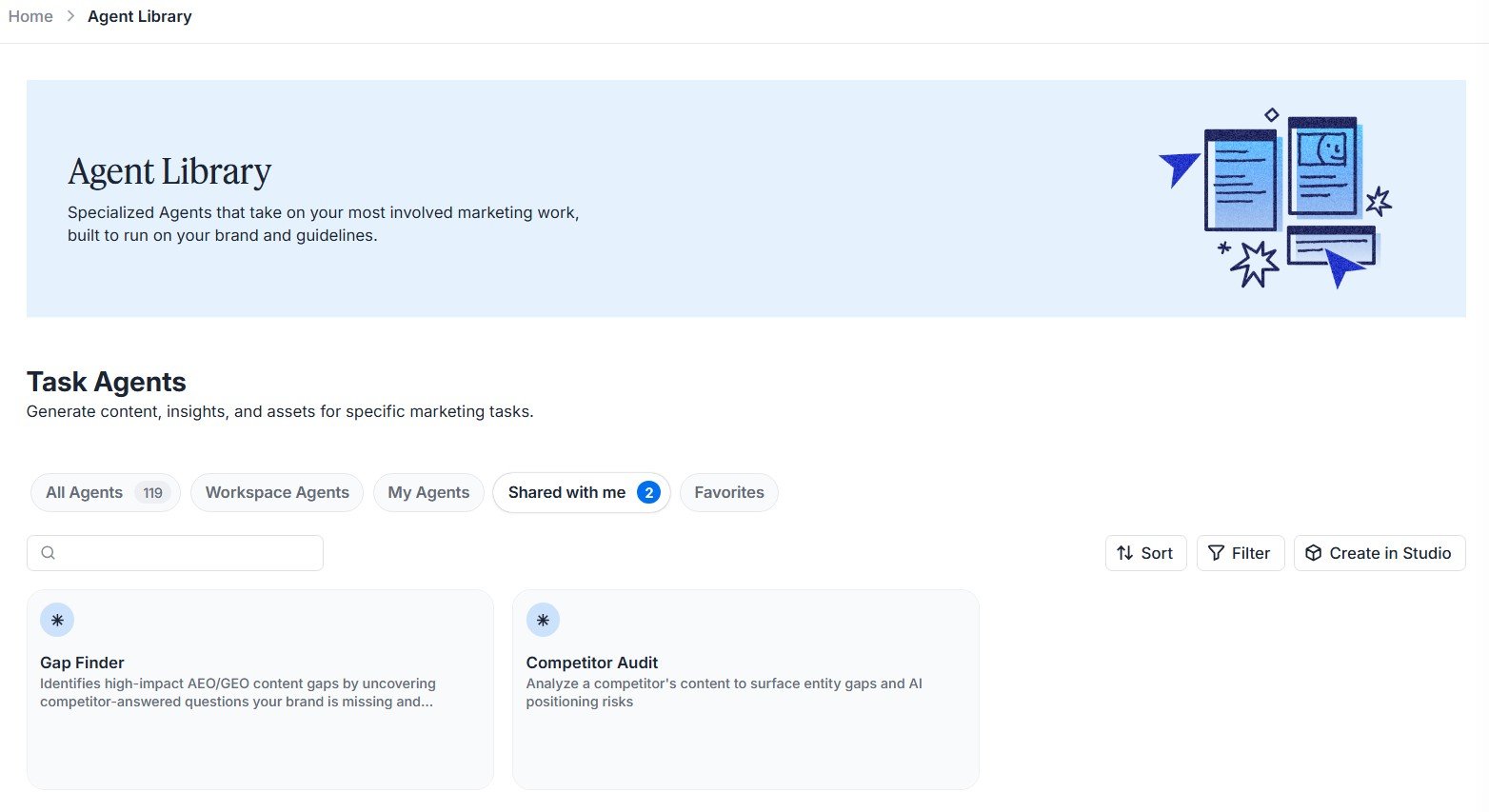
Instead of giving you one empty chatbot and expecting you to invent every workflow yourself, Jasper provides specialized Agents designed for specific marketing jobs.
In our account, the library showed more than one hundred Agents.
We found Agents for areas including:
- website content,
- advertising,
- images,
- PR,
- audio and video,
- social media,
- email,
- product descriptions,
- landing pages,
- research,
- and AI search optimization.
This approach can be useful for a team because employees do not need to create every prompt from zero.
Instead, they can start with a workflow that already understands the general type of marketing task.
2. Jasper Organizes Agents Around the Marketing Funnel
This was one of the more interesting things we found during testing.
Jasper does not only organize tools by content format. You can also explore them according to the marketing funnel.
Consideration stage
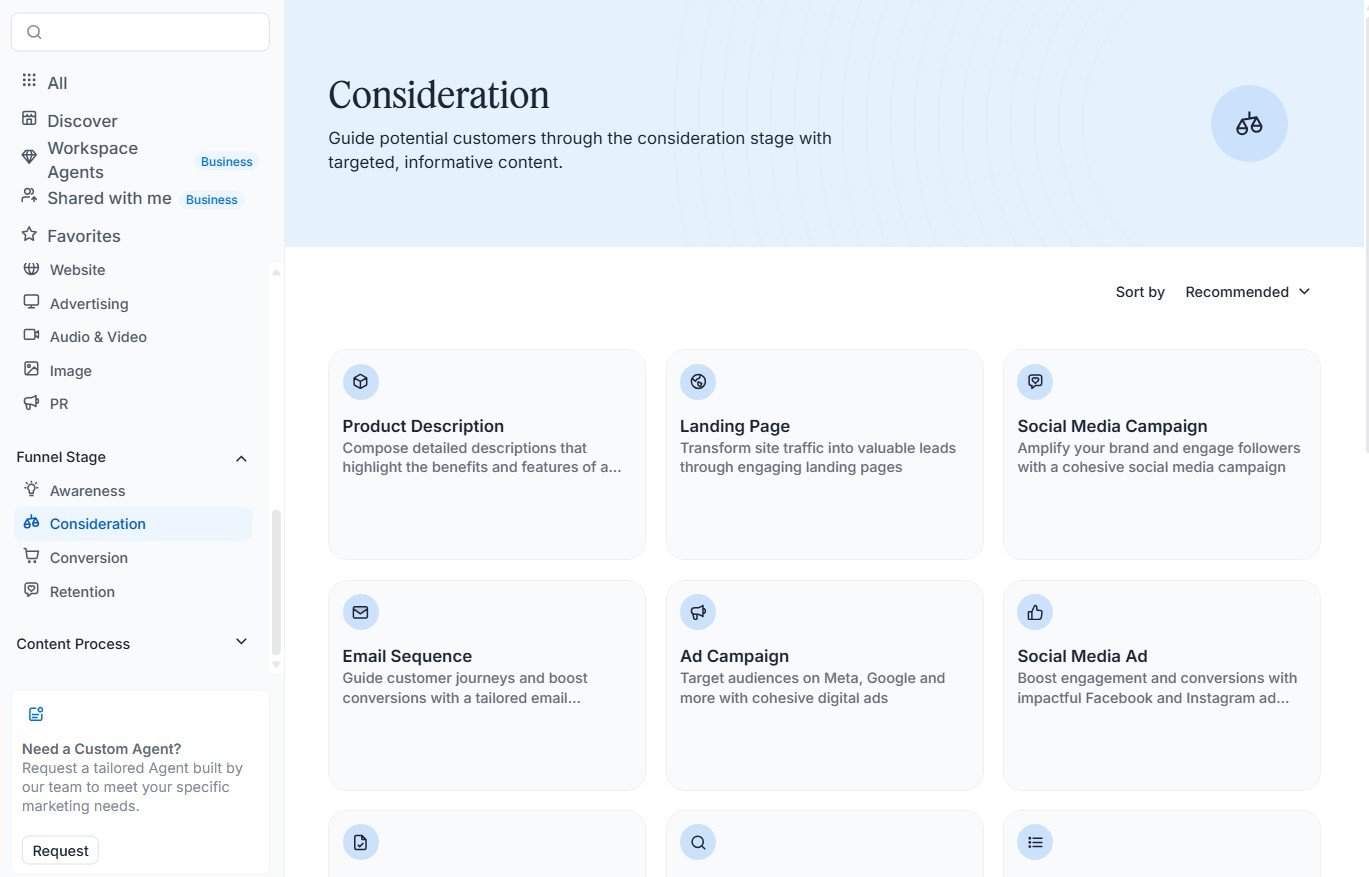
For the consideration stage, Jasper showed tools such as Product Description, Landing Page, Social Media Campaign, Email Sequence, Ad Campaign, and Social Media Ad.
Retention stage
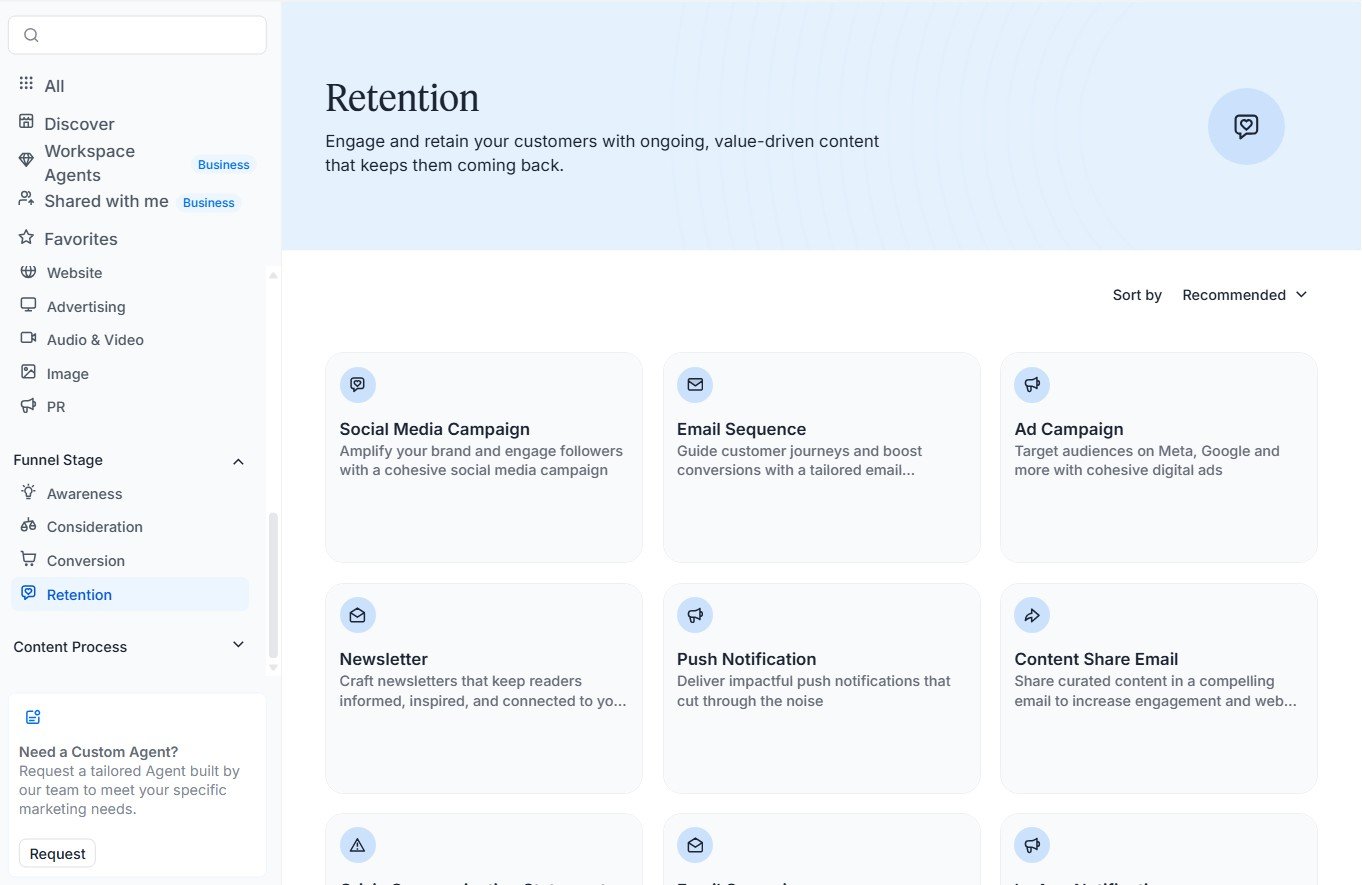
When we switched to Retention, the recommendations changed. Jasper showed options such as Newsletter, Push Notification, Content Share Email, Social Media Campaign, and Email Sequence.
This may look like a small interface detail, but it tells us something important about Jasper’s direction.
That is much closer to the way a marketing department works than the standard blank chatbot experience.
3. We Tested the Ad Campaign Agent
We wanted to see what happens when one Jasper Agent has to create content for several advertising platforms.
The Ad Campaign Agent was a good test because it promises something that would actually save a marketing team time: produce related advertising assets without writing separate prompts for every channel.
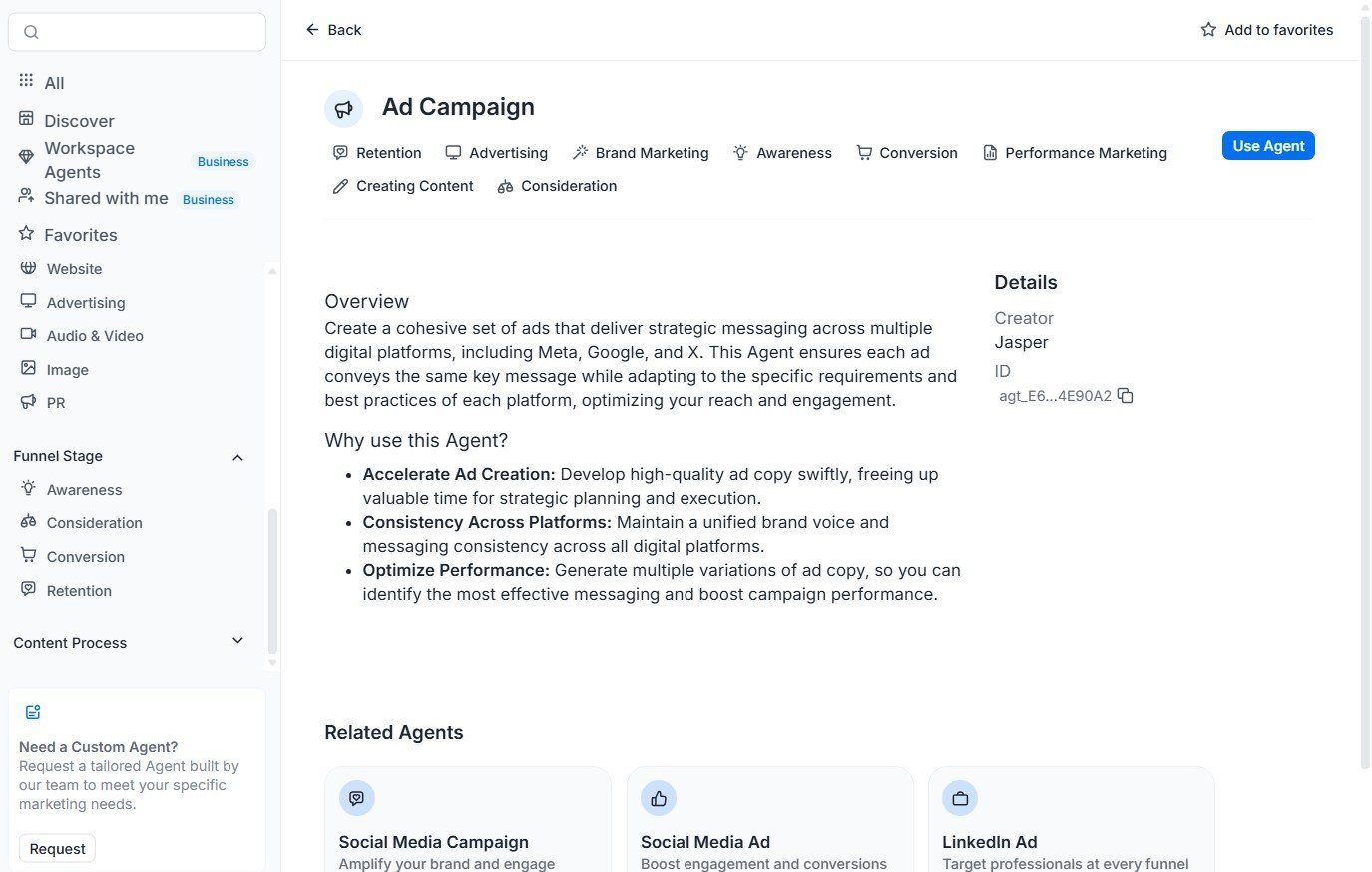
The Agent description focuses on three ideas:
- faster ad creation,
- consistent messaging across platforms,
- and multiple versions that can be tested and optimized.
Those are exactly the types of problems that become more important when several people work on the same brand.
4. One Instruction Can Control Content Across Several Advertising Platforms
We selected all of the available advertising options in our test:
- Meta Ads,
- LinkedIn Ads,
- X Ads,
- Google Search Ads,
- Google Display / PMax,
- and Google Video Ads.
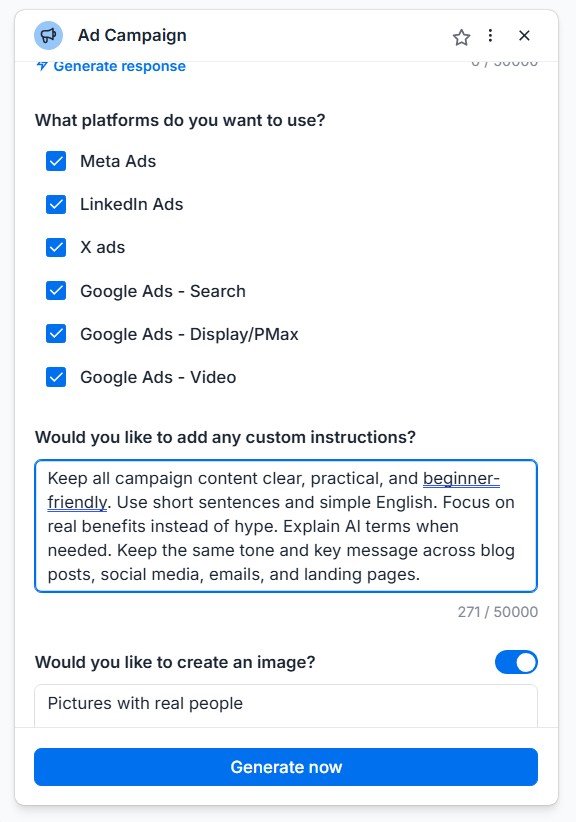
We also entered the following custom instruction:
Our instruction:
Keep all campaign content clear, practical, and beginner-friendly. Use short sentences and simple English. Focus on real benefits instead of hype. Explain AI terms when needed. Keep the same tone and key message across blog posts, social media, emails, and landing pages.
This is where Jasper starts to make more sense for teams.
A marketing lead could establish instructions once and then use them as a common direction for many pieces of content.
That does not eliminate human review. It does, however, give everyone a more consistent starting point.
5. Jasper Generated Multiple Channel Assets in One Workflow
After running the Agent, we did not receive one generic advertisement.
Jasper created separate outputs for different platforms.
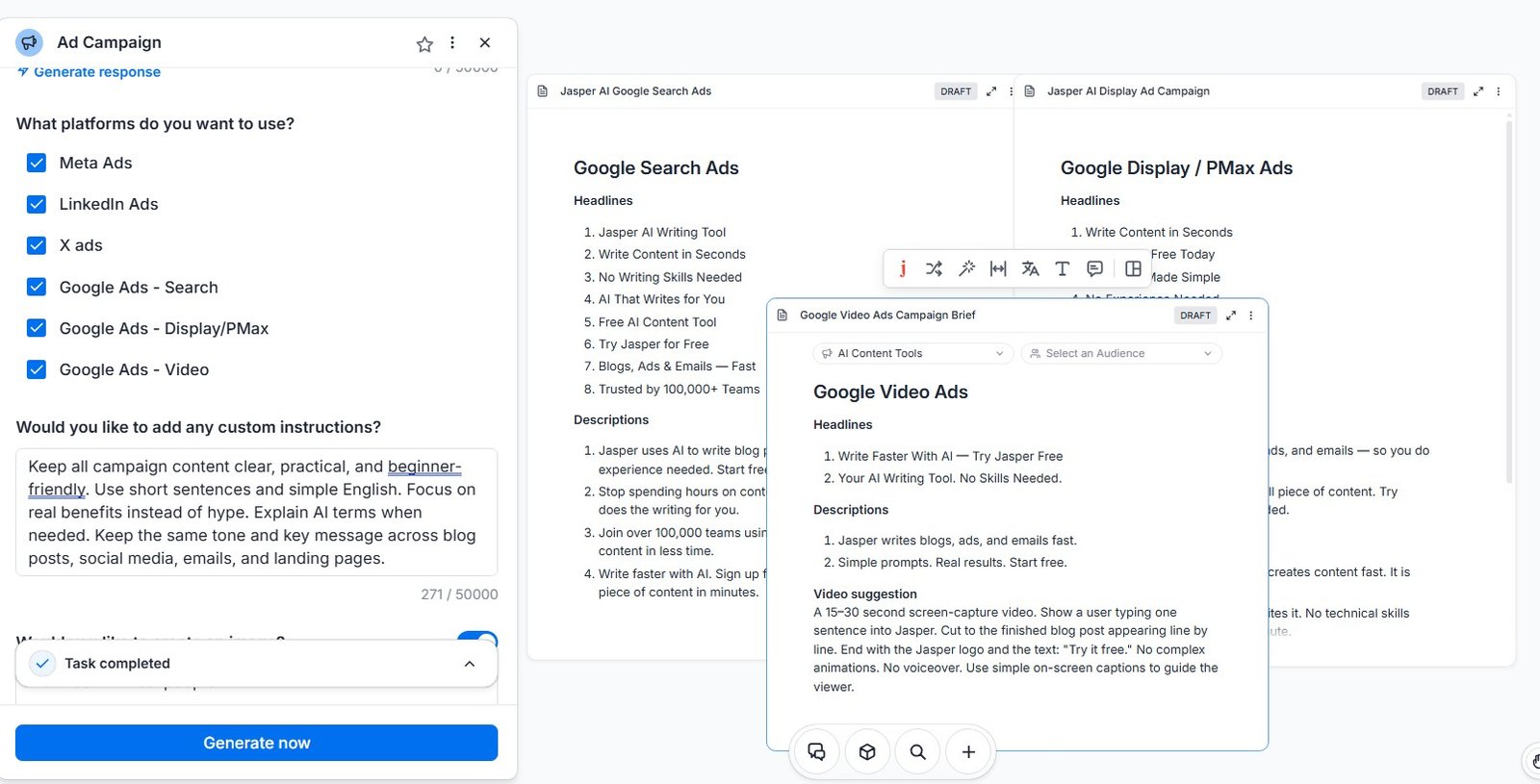
For example, our test produced individual content for Google Search, Google Display / PMax, and Google Video.
The format changed depending on the channel.
That is important because good multi-channel marketing should not mean copying exactly the same paragraph everywhere.
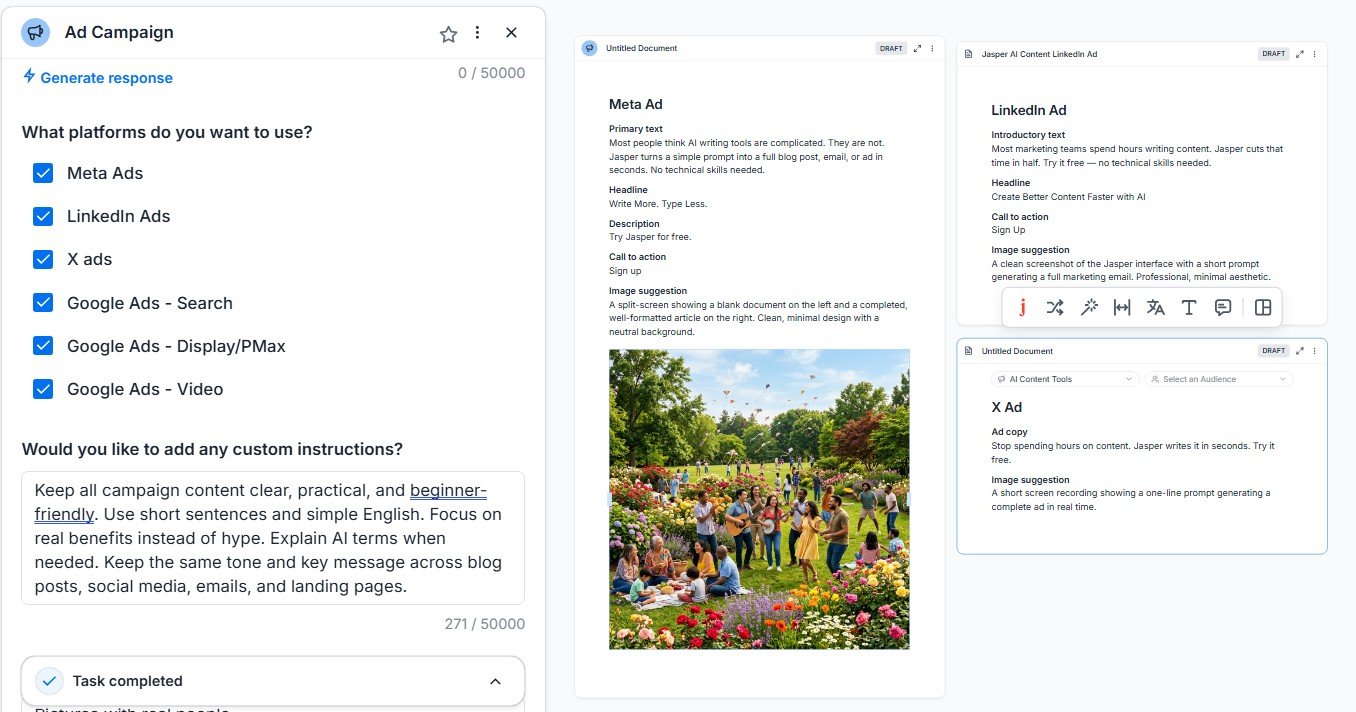
Jasper also generated content for Meta, LinkedIn, and X.
This is one of the clearest examples we found of why Jasper may be more attractive to a marketing department than to a solo blogger.
6. Content Statuses Add a Simple Review Workflow
Another small feature becomes much more important when more than one person is involved.
Jasper documents can have workflow statuses.
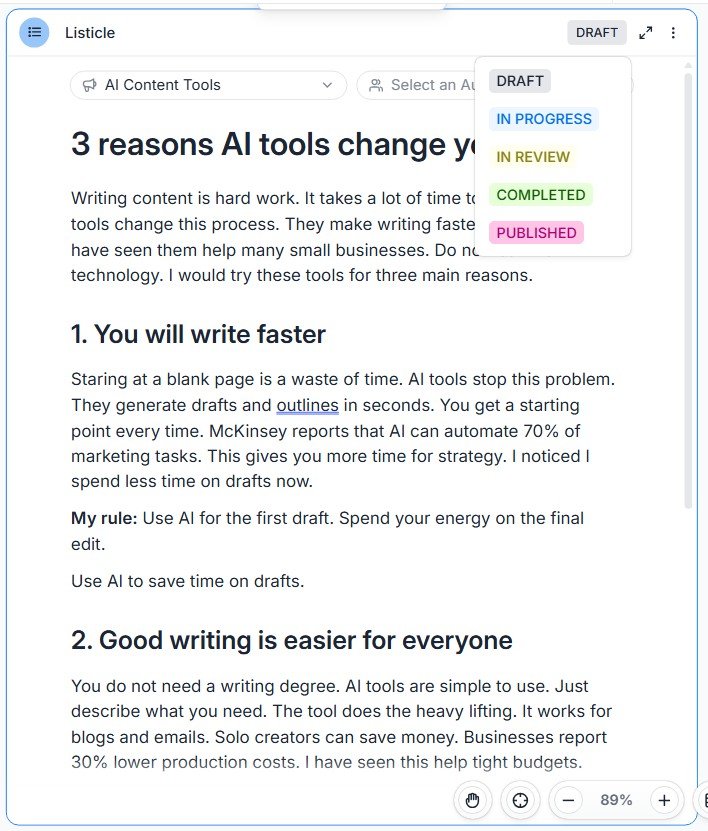
We found the following statuses:
- Draft,
- In Progress,
- In Review,
- Completed,
- Published.
A solo creator may barely notice this.
For a content team, however, it answers a basic question: What is happening with this asset right now?
A writer can create content, an editor can review it, and the team can see when it is ready or published.
Jasper is not a complete replacement for project management software, but this is another sign that the platform is designed around repeatable marketing operations rather than isolated AI prompts.
7. Jasper Audiences Goes Far Beyond “Write for Beginners”
This was another feature that made more sense once we looked at Jasper as a shared marketing system.
For our AI Content Tools tests, we created an audience called AI Beginners.
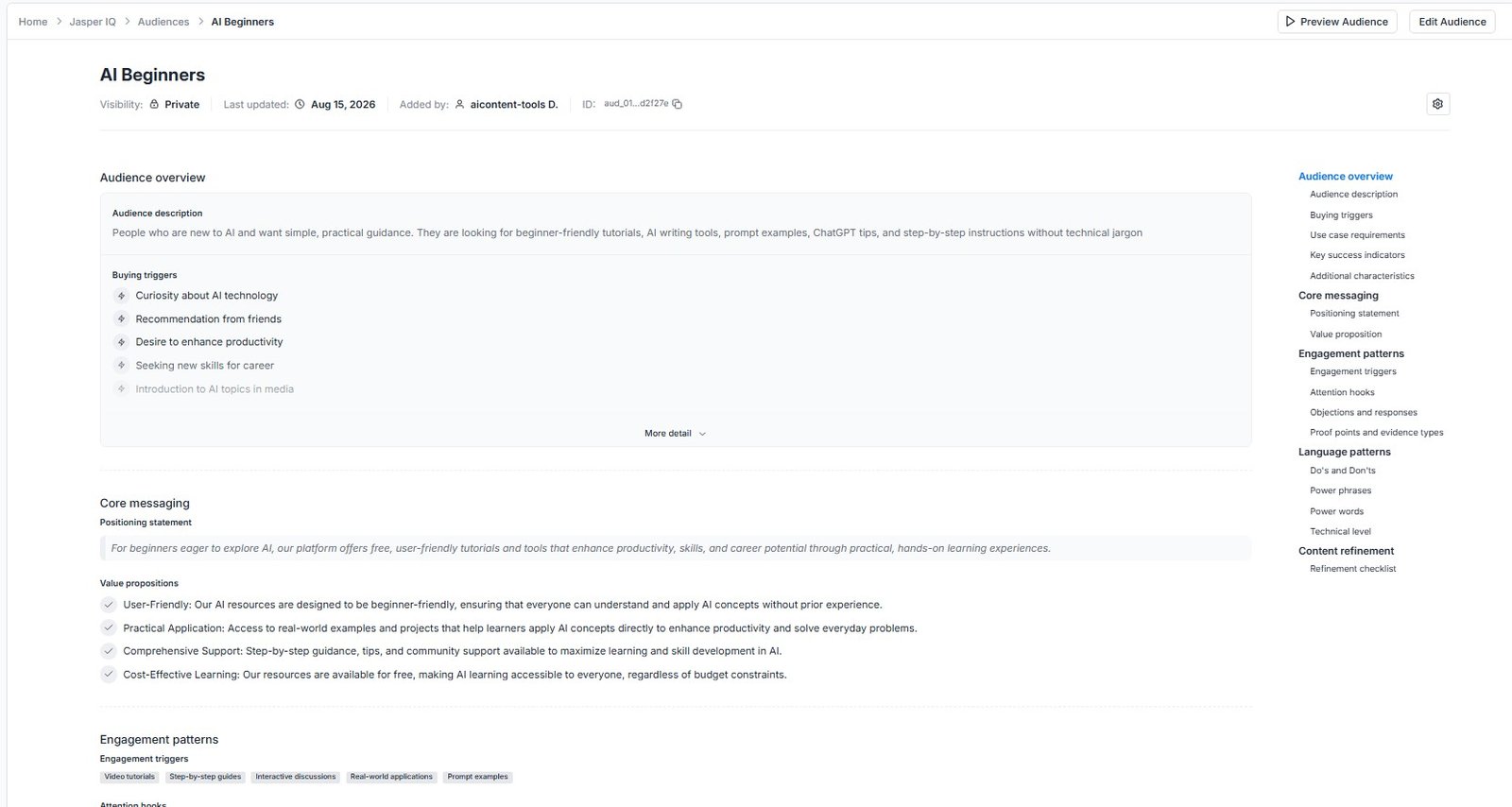
The profile can include information such as:
- audience description,
- buying triggers,
- use-case requirements,
- success indicators,
- positioning statements,
- value propositions,
- engagement triggers,
- attention hooks,
- objections and responses,
- language patterns,
- technical level,
- and content refinement rules.
This is much deeper than repeatedly typing:
“Write this for AI beginners.”
Once the audience is configured, it becomes reusable context.
That means a person writing an email, another person creating an advertisement, and someone else producing a landing page can start from the same audience definition.
8. Jasper IQ Is Really the Shared Brain Behind the System
Audiences are part of a larger Jasper system called Jasper IQ.
Jasper IQ brings together several types of reusable company context, including Brand Voice, Knowledge, Audiences, Style Guide, and Visual Guidelines.
We already tested Brand Voice extensively. You can see the results in our Jasper Brand Voice review.
The important team benefit is consistency.
Instead of every employee maintaining a separate collection of prompts such as:
- “Use our friendly tone,”
- “Do not use technical language,”
- “Here is our target customer,”
- “Here are our product facts,”
- “Use these brand terms,”
Jasper can store much of this information as reusable context.
This is a much stronger reason to use Jasper than simply saying that its AI can write a blog post.
9. Jasper Grid Is Built for Content at Scale
Jasper Grid was probably the feature that looked least like a normal AI writing application.
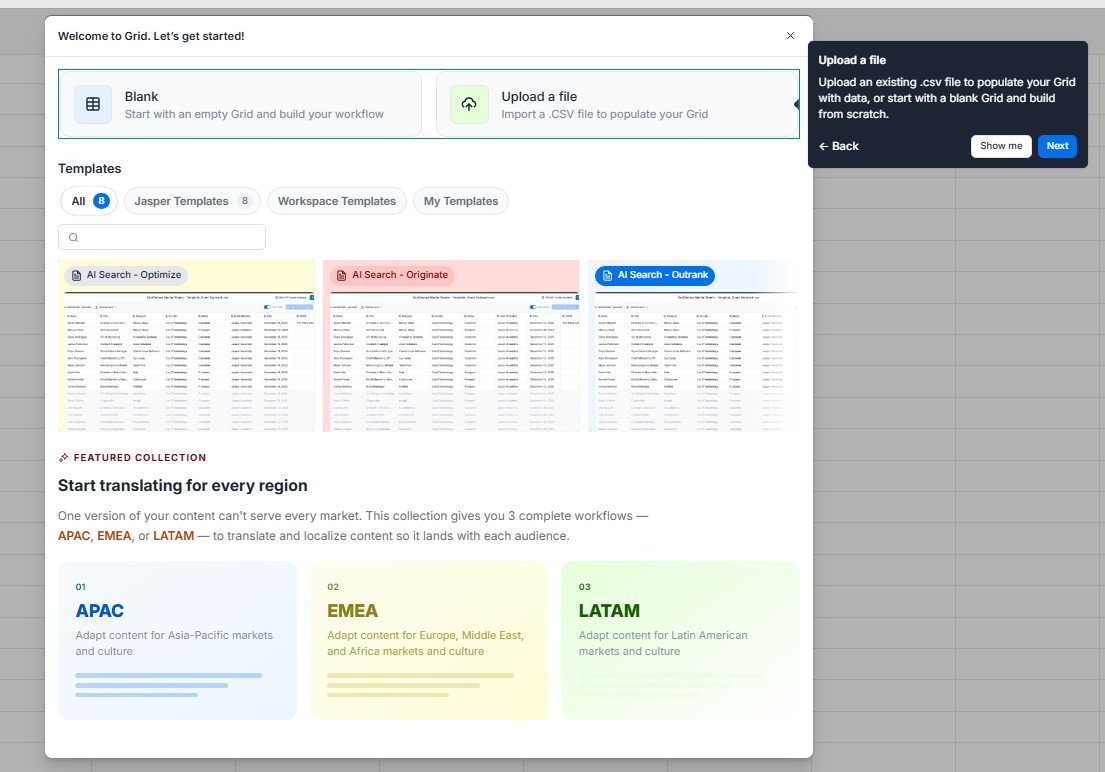
Grid uses a spreadsheet-style interface.
You can start with a blank Grid, import data from a CSV file, or select a prepared workflow.
In our account, we could also see workflows related to AI search and regional content adaptation.
This is not something most individual bloggers need.
But imagine a company that has:
- 500 products,
- 100 landing pages,
- multiple markets,
- several languages,
- or thousands of content records that need to be transformed.
At that point, opening a chatbot and manually creating one prompt after another becomes inefficient.
Grid is Jasper’s answer to that problem.

10. Agents Still Allow Human Instructions
Jasper’s pre-built Agents do not mean that you lose control over the prompt.
We tested this with the Listicle Agent.
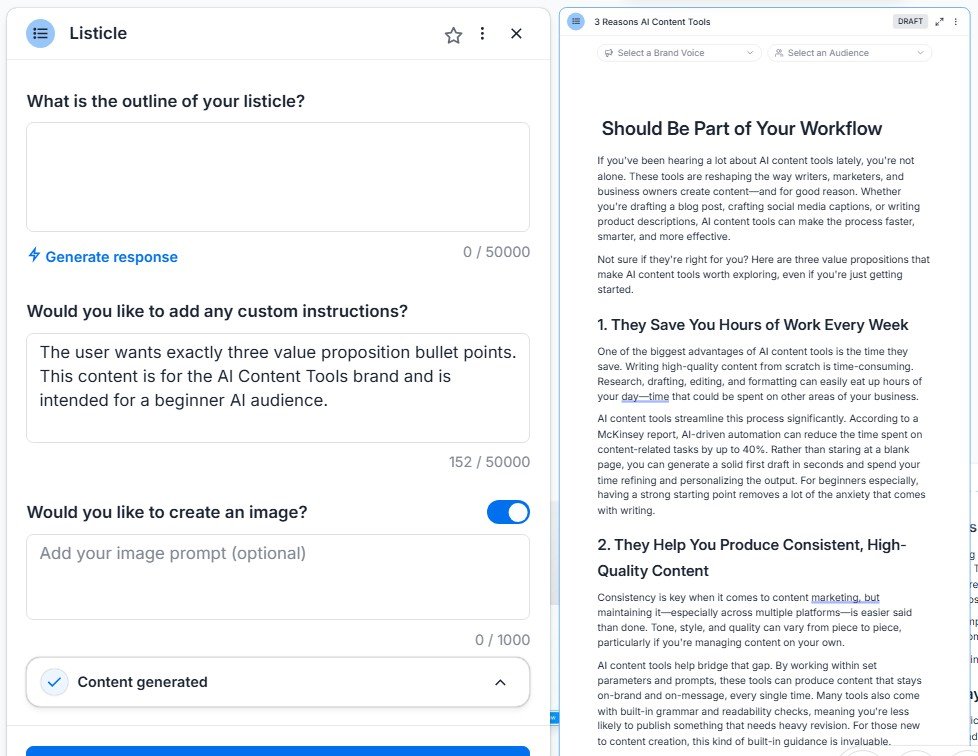
We gave Jasper specific requirements for the audience and structure, and the generated result appeared next to the Agent controls.
This balance makes sense.
The Agent provides a framework, while the human still provides campaign-specific direction.
For a team, this could make workflows easier to repeat without making every output identical.
11. Jasper Also Includes Helpful Inline Editing
Not every team feature needs to be complicated.
Jasper also provides small editing tools directly inside the document.
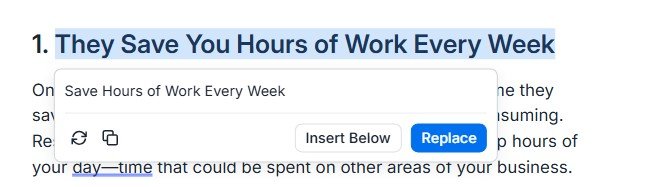
In this example, we highlighted a heading and Jasper suggested a shorter version.
We could insert it below the original or replace the original text.
This is not a reason to buy Jasper Business by itself, but it helps make the platform feel like a working content environment rather than a collection of separate generators.
12. But Our Tests Also Found Problems
A good Jasper review should not stop with the features that worked well.
We also found limitations.
AI images can contain obvious visual mistakes
During one image generation test, Jasper produced a professional-looking office scene with a marketing team working around laptops.

At first glance, the result looked good.
But there was a major visual problem: one laptop screen was facing the wrong direction.
Jasper refused our request for a text-heavy image with a URL
We also asked Jasper to create an image containing the website address for AIContent-Tools.com.
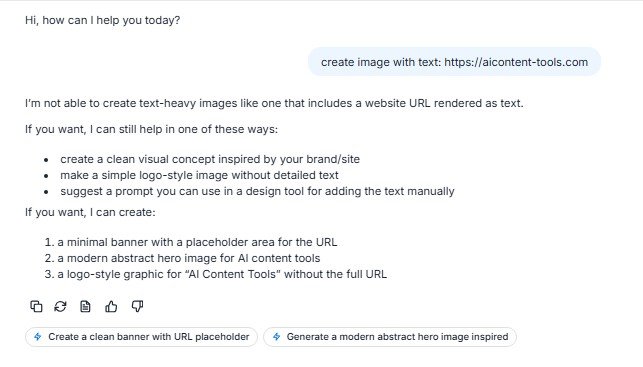
Instead of pretending it could do this perfectly, Jasper explained the limitation and suggested alternatives.
That response was actually useful.
We then asked it to create a banner with a placeholder.
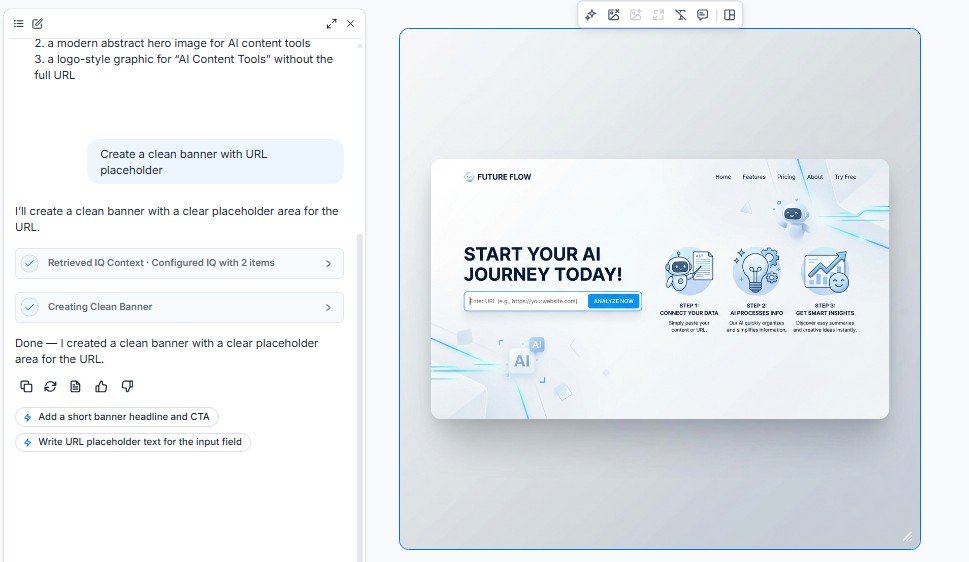
The workaround was better than producing a fake or misspelled URL.
However, it also shows that Jasper is not a replacement for a graphic designer or final quality-control process.
What Jasper Business Is Really Selling
After testing all these areas, we think the easiest way to understand Jasper Business is this:
Jasper Business is not mainly selling better sentences.
It is selling structure around AI marketing work.
The structure comes from:
- reusable company knowledge,
- consistent Brand Voices,
- detailed Audiences,
- specialized Agents,
- shared workflows,
- content statuses,
- large-scale production tools,
- workspace controls,
- and Business-level management features.
A single person can reproduce parts of this with ChatGPT, spreadsheets, templates, documents, and project management tools.
The question is whether a company wants employees assembling those systems themselves or wants more of the process inside one marketing-focused platform.
Who Actually Needs Jasper Business?
| User | Our recommendation | Why |
|---|---|---|
| Beginner blogger | ❌ No | Far more functionality than you are likely to use. |
| Affiliate marketer | ❌ Usually no | Pro or a general AI assistant will normally be enough. |
| Etsy seller | ❌ No | Business workflows are excessive for a typical individual shop. |
| Freelance writer | ❌ Usually no | The team and governance features offer little additional value. |
| Small marketing team | ⚠️ Maybe | Worth investigating if brand consistency and repeatable campaigns are important. |
| Marketing agency | ✅ Strong fit | Multiple brands, audiences, campaigns, and repeatable workflows make the platform more useful. |
| Ecommerce company | ✅ Strong fit | Grid and structured content workflows become more valuable at scale. |
| SaaS marketing department | ✅ Good fit | Useful when several people create related content across channels. |
| Large enterprise marketing team | ✅ Best fit | This is where governance, team controls, shared context, scale, and support can justify the Business tier. |
Jasper Business vs ChatGPT: Why Would a Team Pay More?
This is the obvious question.
ChatGPT can write ads. It can create blog posts. It can brainstorm campaigns. It can analyze documents. It can also follow detailed custom instructions.
So why use Jasper?
For an individual user, that question is difficult for Jasper.
For a larger marketing organization, the answer becomes clearer.
| Task | General AI assistant | Jasper approach |
|---|---|---|
| Write one ad | Easy | Easy |
| Create one blog post | Easy | Easy |
| Store a defined brand voice | Possible | Built into Jasper IQ |
| Define detailed audiences | Possible with instructions | Reusable Audience profiles |
| Create platform-specific campaign assets | Requires prompting/workflow setup | Specialized Agents |
| Track content status | Usually needs another tool | Built into documents |
| Mass content workflows | Possible with external automation | Jasper Grid |
| Marketing-focused governance | Depends on configuration and plan | Core part of Jasper’s Business positioning |
That is the real competition.
It is not simply:
“Which AI writes the better paragraph?”
It is:
“Which system makes it easier for our marketing organization to use AI repeatedly without losing control of the brand?”
What We Liked Most
- Agent Library: it gives marketers clear starting points instead of an empty prompt box.
- Marketing funnel organization: surprisingly useful for finding the right workflow.
- Multi-channel campaigns: one of the strongest team-oriented functions we tested.
- Audiences: much more detailed than simply telling AI who the target customer is.
- Jasper IQ: creates reusable brand context.
- Grid: genuinely different from normal one-prompt-at-a-time AI writing.
- Workflow statuses: simple, but useful when content moves between several people.
What We Did Not Like
- The team value is not obvious at first. A new Pro user may wonder why Jasper markets itself so heavily to marketing teams.
- Some features overlap with tools companies already use. Teams may still need their project management, design, CMS, analytics, and collaboration platforms.
- Business pricing is not public as a simple fixed monthly price. You need to contact Jasper for a quote.
- Smaller users will probably pay for functionality they do not need.
- AI output still requires review. Our image tests produced a very obvious visual error.
Our Verdict: Jasper Makes More Sense for Teams Than It Does for Solo Creators
Before doing these tests, we were not completely convinced by Jasper’s positioning as a platform for marketing teams.
After exploring the deeper parts of the platform, the strategy is much clearer.
Jasper is not especially interesting because it can generate another product description or another Facebook post.
There are hundreds of AI tools that can do that.
The more distinctive part of Jasper is the system around the generation.
Brand Voice tells Jasper how the company should sound.
Audiences tell it who the company is speaking to.
Knowledge provides company context.
Agents define repeatable marketing jobs.
Campaign workflows connect multiple assets.
Grid helps produce content at larger scale.
Status controls help content move through a production process.
Our conclusion: Jasper Business makes sense for the right company — not for everyone.
If you are one person writing a few articles each month, much of Jasper’s deeper system is unnecessary.
If you manage a marketing team producing large amounts of content across multiple channels, brands, products, or markets, Jasper becomes much easier to understand.
That is where Jasper’s real value is in 2026.
Should You Upgrade to Jasper Business?
Do not upgrade simply because Business has more features.
Consider it when you begin experiencing problems that individual AI tools do not solve well:
- different employees producing inconsistent messaging,
- repeating brand instructions in every prompt,
- managing many target audiences,
- creating the same campaign across many channels,
- producing content at a scale that becomes difficult manually,
- or needing stronger control over how your organization uses AI.
If those problems sound familiar, Jasper Business is worth investigating.
If they do not, the Pro plan — or even a different AI tool — may be the more sensible choice.
Continue Our Jasper Tests
We did not base this review only on Jasper’s marketing pages. We tested the platform ourselves and documented the results with screenshots.
- Jasper Review 2026 – our complete review of the platform.
- Jasper AI Agents Review – our hands-on tests of Jasper’s specialized Agents.
- Jasper Brand Voice Review – see whether Jasper can really learn your writing style.
- Jasper SEO, AEO and GEO Rewriter Review – our AI search optimization test.
- Jasper Social Media Post Generator Review – real social media generation tests.
- Jasper Product Description Generator Review – product copy tests and examples.
- Jasper Landing Page Generator Review – our landing page generation test.
- How We Tested Jasper AI – full testing methodology and explanation of our process.
- Jasper vs Etsy AI Lab – side-by-side product description test.
- Jasper Tutorial – step-by-step guide for new users.
Testing note: Jasper changes its plans and features regularly. The screenshots in this article come from our hands-on testing in August 2026. Business features and pricing can change, so check Jasper’s current plan details before purchasing.