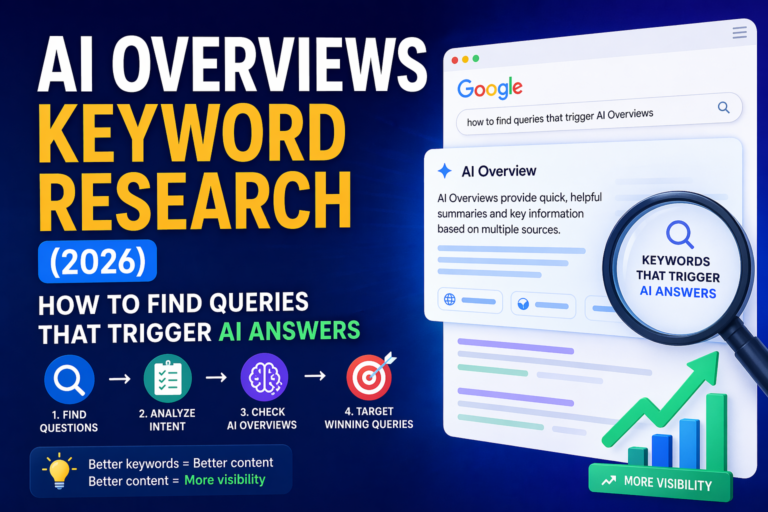
AI can help you write an article faster. It cannot automatically make that article rank.
This is one of the most important things to understand about AI content and SEO. You can generate 2,000 words in a few minutes, add a keyword, and still get almost no traffic. Search engines need more than words on a page.
Good SEO content needs to answer the right search, be useful to a real person, show clear structure, add something worth reading, and give search engines enough context to understand the page.
In this guide, I will explain SEO for AI content without complicated language. We will also look at how modern SEO now connects with Google AI Overviews, AI search tools, and content optimization systems.
Quick answer: What is SEO for AI content?
SEO for AI content means improving AI-assisted or AI-generated content so it can satisfy search intent, help readers, and have a better chance of being discovered through search.
First: What Does SEO Actually Mean?
SEO stands for Search Engine Optimization.
In simple words, SEO is the work you do to help a useful page get discovered when someone searches for information.
SEO is not about tricking Google.
It is about making the topic, purpose, quality, and structure of a page clear enough
for both readers and search systems.
Imagine you publish an article called Best AI Tools for Etsy Sellers. A person searching this phrase probably does not want a long explanation of what artificial intelligence is. They want tools, comparisons, prices, strengths, weaknesses, examples, and help choosing one.
If your article gives them exactly that, you are already doing one of the most important parts of SEO: matching search intent.
Can AI-Generated Content Rank in Google?
Yes. The simple fact that AI helped create a page does not automatically stop that page from ranking.
The bigger problem is what kind of content you publish.
If AI produces a generic article that repeats information already available on hundreds of websites, publishing it without serious editing gives readers very little reason to choose your page.
Weak AI content
“AI writing tools can revolutionize your content creation process by saving time and improving productivity.”
This sounds fine, but it tells the reader almost nothing.
Useful AI-assisted content
“I tested the blog generator twice. The first result contained several empty sections, and the second article had only 165 words even though it showed multiple planned headings.”
Now the reader learns something specific.
The second example is harder to create because it requires a real test. That is also why it is more useful.
The 7 Parts of SEO That Matter Most for AI Content
You do not need to learn every technical SEO term before publishing your first useful page. Start with these seven areas.
Choose one clear search intent
Decide what the reader is trying to accomplish. Do they want to learn, compare, buy, fix a problem, or follow a tutorial?
Use a clear primary topic
Your article should have one main subject. Related keywords can support it, but they should not turn the page into five different articles.
Create useful structure
Use descriptive H2 and H3 headings, short sections, tables when comparisons help, and examples where beginners may get confused.
Add original value
Tests, screenshots, before-and-after examples, prompts, failures, observations, comparisons, and original tools make a page much stronger.
Edit AI output
Remove filler, repeated conclusions, fake confidence, strange wording, unnecessary definitions, and claims you cannot verify.
Connect related pages
Internal links help readers continue learning and help search engines understand how pages on your site relate to each other.
Check the page after publishing
SEO does not finish when you click Publish. Pages may need updates when search intent changes, tools change, or your own testing gives you better evidence.
1. Search Intent Comes Before Keywords
Beginners often start SEO by asking: “Which keyword should I put into the article?”
A better first question is: “What does the person searching this keyword actually need?”
| Search | Likely intent | Useful page type |
|---|---|---|
| what is AI writing | Learn a basic concept | Beginner explanation |
| Jasper vs Frase | Compare two tools | Comparison with tests |
| how to use Frase | Complete a task | Step-by-step tutorial |
| best AI writing tools | Choose a product | Comparison / buyer guide |
| Frase review | Check whether a tool is worth using | Detailed review |
This sounds simple, but it prevents a common AI writing mistake: generating a large article around a keyword without deciding what the reader actually needs.
2. Do Not Ask AI to “Write an SEO Article” and Stop There
A prompt like this is easy:
AI can produce something from that prompt. But it has to make many decisions for you: audience, intent, article structure, level of detail, comparisons, examples, and what information matters most.
A stronger workflow is to give AI more context.
Better instructions usually create a better starting draft. They still do not replace research or editing.
If you want practical prompt examples, see our AI writing prompts that actually work .
3. Keyword Optimization Is Not Keyword Stuffing
You do not need to repeat the same exact keyword in every paragraph.
A good article naturally uses related words because it covers the topic properly. For example, a guide about SEO for AI content may naturally mention:
These words are useful because they belong to the subject, not because we are trying to hit an artificial keyword count.
What SEO Tools Can Help With
Modern SEO tools can do much more than count keywords. Some analyze competitors, recommend related topics, inspect headings, find content gaps, generate briefs, or score a draft.
They can be very useful, but a score should be treated as a diagnostic signal, not as proof that the page deserves to rank.
This is a useful example of why one optimization number does not tell the full story. A draft can cover keywords and structure well while still lacking strong experience, authority, or original evidence.
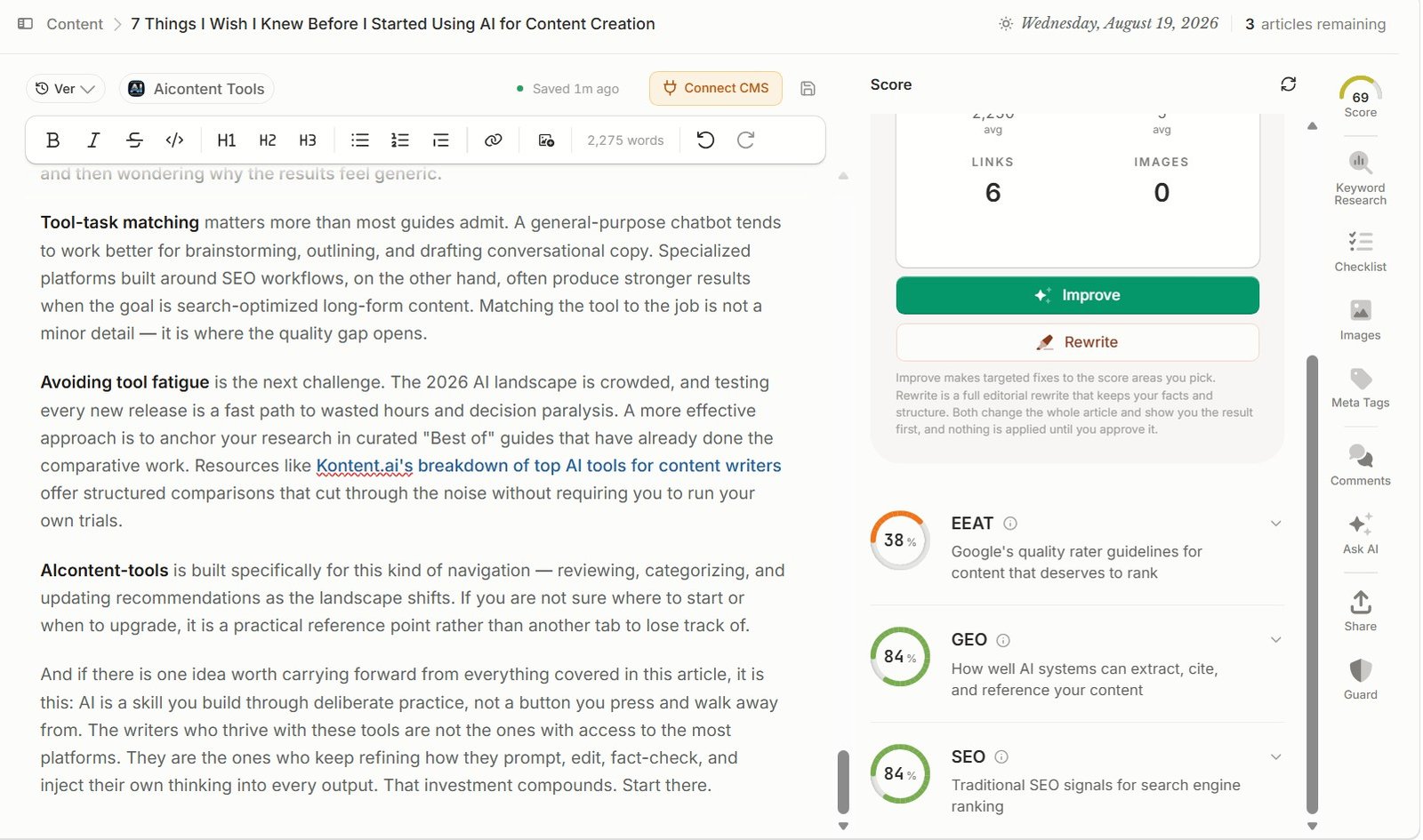
That difference matters. It shows why “SEO optimized” should not mean “publish immediately.”
You can see more of our testing in the Frase review and Frase tutorial.
4. Add Information AI Cannot Easily Fake
One of the simplest ways to improve AI-assisted content is to add things that came from your own work.
- your screenshots
- your test prompts
- the actual output you received
- problems you found
- before-and-after results
- your own comparison table
- what surprised you
- who you think should skip the tool
- original calculators or generators
- updated examples based on current product interfaces
This does not mean every article needs a huge experiment. Even one useful screenshot with a clear explanation can make a tutorial easier to trust and follow.
5. Human Editing Matters More Than “Humanizing” for a Detector
There is an important difference between making a text score lower in an AI detector and making the text genuinely better.
A humanizer can change sentence patterns or vocabulary. But SEO content still needs accurate facts, good examples, correct search intent, clear explanations, and useful judgment.
We have tested AI humanizers and seen large changes in detection scores. That is interesting, but the detector score alone does not tell us whether the new article is more helpful.
Related: Read our guide to humanizing AI text manually if you want to improve tone, flow, examples, and readability instead of only chasing a detector score.
6. Internal Links Help Build a Useful Content Cluster
Internal links connect one page on your website to another.
They are useful for SEO, but more importantly, they help the reader find the next useful step.
For example, this beginner article should not contain every advanced tactic about AI Overviews, generative search, tracking, GEO, and citations.
Instead, it can introduce the ideas and then send readers to deeper guides.
A simple SEO content cluster
Beginner: What is SEO for AI content?
↓
Next level: SEO & AI Content – Advanced Tactics
↓
AI search optimization: AI Content Optimization for AI Overviews & ChatGPT
↓
Visibility: Track AI Search Visibility
7. SEO Is No Longer Only About Ten Blue Links
Search has changed.
A website may now appear through traditional organic results, Google AI Overviews, AI Mode, images, videos, shopping results, or answers generated by other AI search systems.
This has created terms such as AEO and GEO.
| Term | Simple meaning |
|---|---|
| SEO | Improving content and websites for search discovery and rankings. |
| AEO | Answer Engine Optimization — making useful answers easy for answer systems to understand. |
| GEO | Generative Engine Optimization — improving the chance that content can be discovered or referenced in generative search experiences. |
These ideas overlap. You do not need to create one article “for Google,” another “for ChatGPT,” and another “for AI Overviews.”
Strong technical foundations, useful content, clear structure, trustworthy information, and original value remain useful across these systems.
What We Saw When Testing AI SEO Tools
AI SEO platforms are already combining classic SEO with AI visibility features. Our tests make this shift easy to see.
Frase did not treat “optimized” as one simple score. In our generated article, SEO and GEO were strong while E-E-A-T was much weaker. This is exactly why automatic optimization still needs human review.
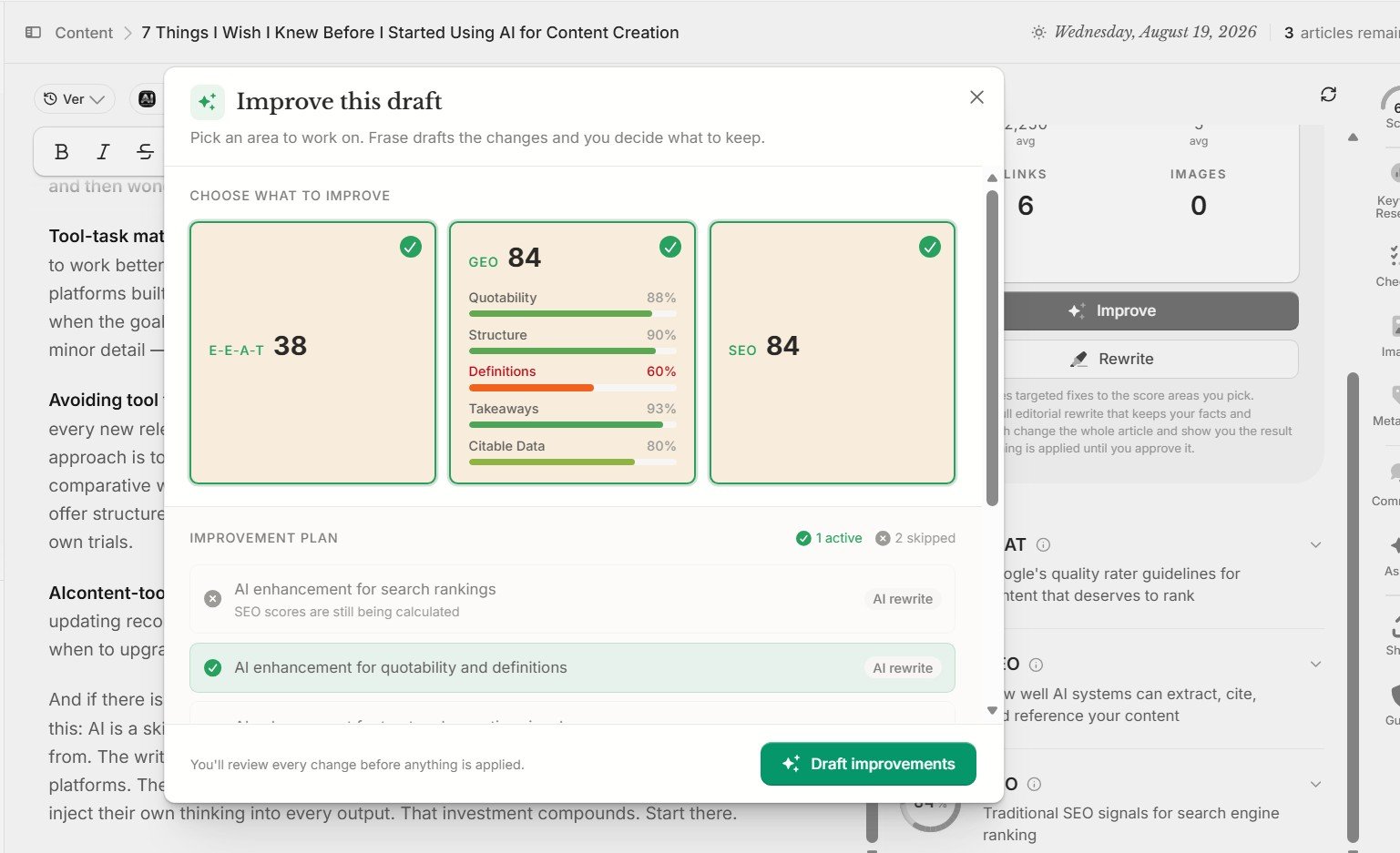
During another Frase optimization step, the tool predicted that some AI edits could actually reduce the GEO score. This is a good reminder not to accept every automated suggestion.
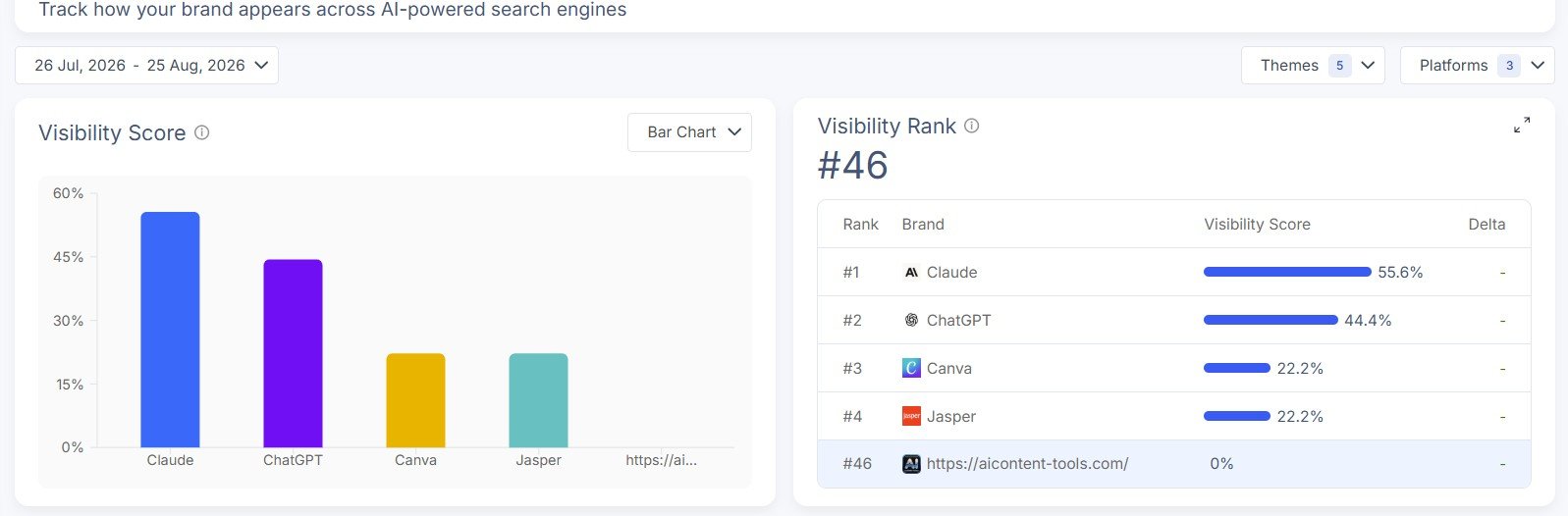
In Scalenut Brand Monitor, we could see visibility across AI platforms and compare AIContent-Tools with other brands.
Our site showed 0% visibility and rank 46 in this specific test. That is not a flattering result, but it is useful data because it gives us a real baseline.
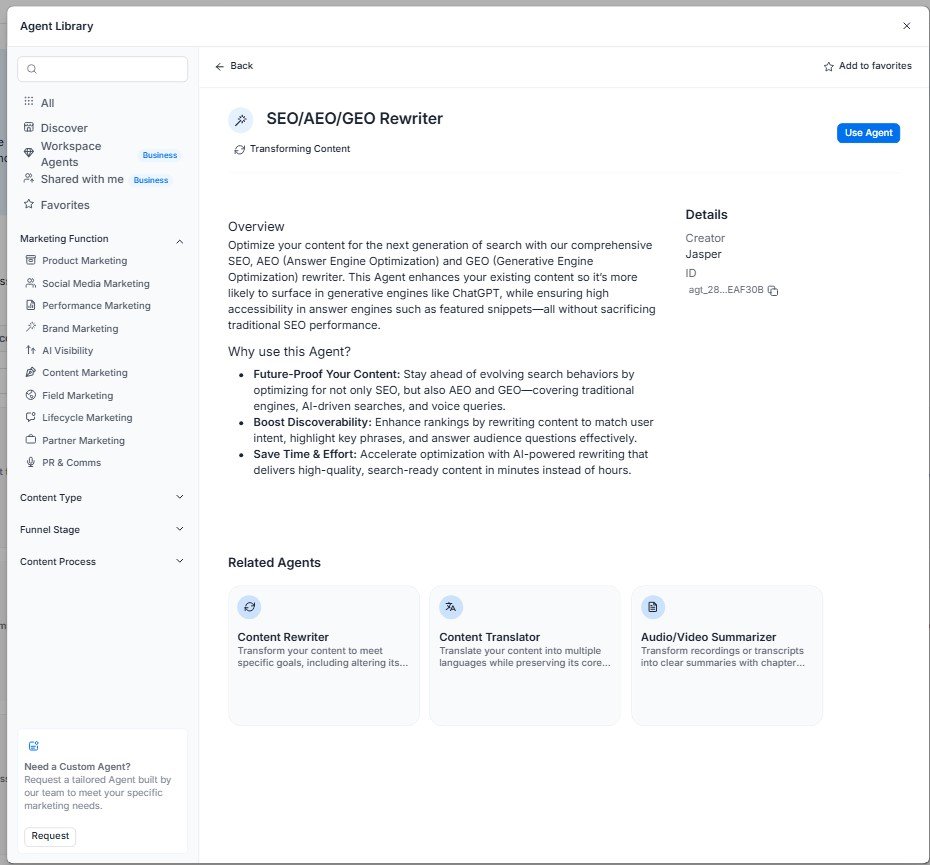
Jasper now includes an SEO/AEO/GEO Rewriter agent. In our test, the tool accepted existing content, target keywords, and instructions about what needed improvement.
Does a High SEO Score Mean You Will Rank?
No.
This is important because SEO software can make optimization look very precise. You may see a score of 68, 84, or 95 and feel that the article is now “ready for Google.”
A content score is created by that tool using its own system. It is not a Google ranking score.
Use SEO scores to find possible weaknesses. Do not treat them as a promise of rankings.
Rankings can depend on many things beyond the article itself, including competition, site authority, links, technical accessibility, search intent, freshness, reputation, and how useful the page is compared with alternatives.
What About E-E-A-T?
You will often see the letters E-E-A-T in SEO discussions. They stand for Experience, Expertise, Authoritativeness, and Trust.
Beginners sometimes turn this into another checklist: add an author box, add some links, add a date, and the job is done.
I prefer a simpler way to think about it:
This is one reason real testing is powerful for AI tool reviews. A screenshot showing a failed test can sometimes build more trust than ten paragraphs saying a product is “powerful and innovative.”
AI Content Mistakes That Can Hurt SEO
| Mistake | Why it is weak | Better approach |
|---|---|---|
| Publishing the first AI draft | No fact-checking or editorial judgment | Edit, verify, cut filler, add evidence |
| Creating many almost identical pages | Pages may compete with each other and add little value | Merge overlapping intent into stronger pages |
| Keyword stuffing | Text becomes awkward and less useful | Cover the topic naturally |
| Invented statistics | Destroys trust | Verify the source or remove the number |
| Generic tool reviews | Reader cannot tell whether the tool was actually tested | Add prompts, screenshots, results and limitations |
| Writing only to hit a word count | Creates filler | Use the length needed to answer the search properly |
| Ignoring internal links | Useful related pages stay disconnected | Build logical topic clusters |
Do Long Articles Rank Better?
Not automatically.
A 4,000-word article can be worse than a 1,200-word article if half of it repeats the same points.
The right length depends on the search. A simple definition may need a short page. A detailed software review may need much more space because readers need screenshots, tests, pricing, limitations, alternatives, and a verdict.
Do not tell an AI writer to create 3,000 words just because you think Google prefers long articles. Give it a useful structure first.
Should You Add Images to SEO Content?
Add images when they help the reader understand something.
For a tutorial, screenshots can show exactly where to click. For a review, screenshots can prove that a feature was tested. For a comparison, a chart or table can make differences easier to see.
Decorative images are less important.
Simple SEO Workflow for AI-Written Articles
Here is a practical workflow you can use without turning every article into a huge SEO project.
Choose the reader and search intent
Know who the article is for and what they want to accomplish.
Research the topic
Check what questions need answering, what competitors cover, and what useful information appears to be missing.
Create the outline
Plan useful sections before generating hundreds of words.
Use AI for the first draft
Give clear instructions about audience, tone, purpose, examples, limitations, and facts that must not be invented.
Add your evidence
Insert screenshots, tests, observations, examples, comparisons, original data, or first-hand experience.
Edit like a human
Remove filler. Shorten weak sentences. Check facts. Ask whether each section genuinely helps the reader.
Optimize the page
Review the title, headings, internal links, image alt text, meta description, URL, and overall topic coverage.
Publish and monitor
Watch impressions, clicks, ranking changes, reader behavior, and new information that may make the page outdated.
AI SEO Tools Can Help, But They Should Not Make Every Decision
Tools such as Frase, Scalenut, Jasper and other SEO platforms can speed up research and highlight missing topics.
They are especially useful when you have many pages to review. But our own tests also show why you should inspect their recommendations instead of clicking Apply automatically.
If you are choosing an AI writing platform, start with our Best AI Writing Tools guide, where we connect individual reviews, tests, and comparisons.
Technical SEO Still Matters
Great content cannot perform well if search engines cannot properly access or understand the page.
Technical SEO can become complicated, but beginners should at least check:
- the page is not accidentally set to noindex
- the page loads correctly on mobile
- important content is visible and usable
- the URL is included in your site structure
- internal links point to the page
- images are not unnecessarily huge
- the site uses HTTPS
- duplicate pages are handled correctly
- Google Search Console can see the page
Technical SEO cannot make weak content excellent. But technical problems can stop strong content from getting a fair chance.
SEO vs AI Search Optimization: Do You Need Both?
In 2026, I would not treat them as two completely separate jobs.
Good SEO fundamentals still matter. At the same time, publishers now have another question: Can our content also be understood, selected, mentioned, or cited inside AI-driven search experiences?
This is where GEO, AI visibility tracking, and AI Overviews optimization become useful.
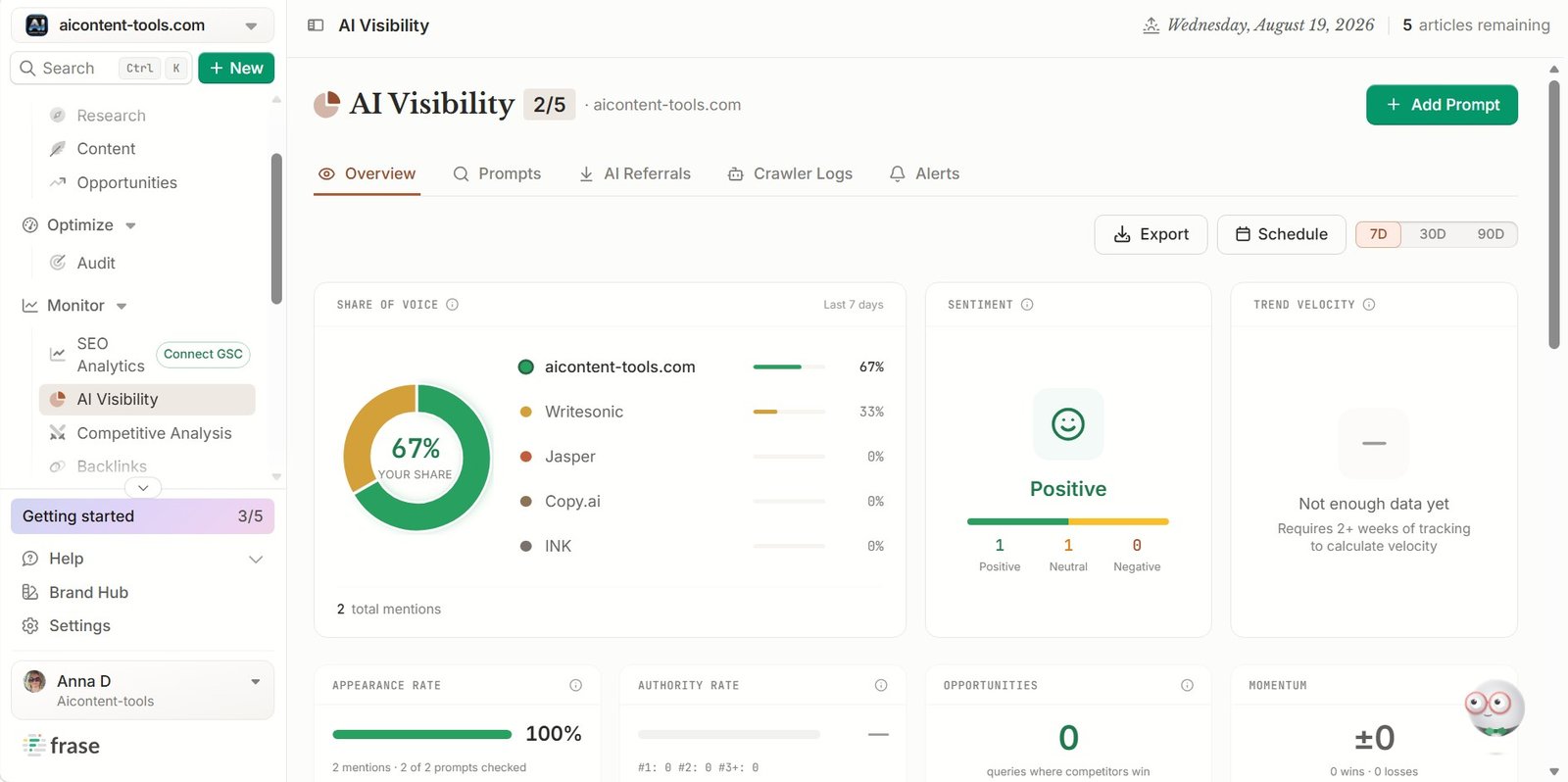
But beginners should not skip normal SEO and jump directly into complicated GEO tricks. Build pages that are genuinely useful first.
A Simple SEO Checklist Before You Publish AI Content
- Does the article answer one clear search intent?
- Is the main topic obvious from the title and early part of the article?
- Are the H2 and H3 headings useful and descriptive?
- Did I remove generic AI filler?
- Did I check important facts and current information?
- Did I add my own examples, tests, screenshots, or observations where possible?
- Are internal links useful for the reader?
- Does the page offer something better than a generic AI-generated answer?
- Are images useful and correctly described with alt text?
- Is the article easy to read on mobile?
- Does the conclusion help the reader decide what to do next?
Frequently Asked Questions
Is AI content bad for SEO?
Not automatically. The important question is whether the final page is useful, accurate, original enough to deserve attention, and created for readers rather than simply producing large amounts of search content.
Can ChatGPT write SEO content?
ChatGPT can help with research ideas, outlines, drafts, rewrites, examples, titles, and content planning. You should still verify facts, edit the output, add original evidence, and check whether the final article matches search intent.
How many keywords should I use?
There is no useful universal number. Focus on one main topic and cover related concepts naturally. Do not repeat phrases simply to reach a keyword count.
Do I need an SEO tool?
No. You can learn the basics without one. SEO tools become more useful when you want faster competitor research, content briefs, keyword analysis, optimization suggestions, site audits, or monitoring across many pages.
What is GEO?
GEO usually means Generative Engine Optimization. It describes efforts to make content easier to discover or use in generative search and AI answer systems. It overlaps heavily with good SEO, clear writing, trustworthy information, and original content.
Does an SEO score of 90 mean my article will rank?
No. A score from an SEO tool is based on that tool’s own system. It may help identify problems, but it cannot promise a Google ranking.
Should I publish a lot of AI articles to get more traffic?
Publishing more pages is not automatically better. A smaller collection of strong, connected articles can be more useful than many weak pages covering almost the same search intent.
The Most Important SEO Rule for AI Content
AI makes writing faster. That also makes publishing weak content faster.
The real advantage is not generating more words than everyone else. It is using AI to save time on the parts it does well, then spending your own effort on the parts that create trust: testing, judgment, editing, examples, evidence, and useful explanations.
Before publishing, ask one question: “Is this page more useful than a generic AI answer?” If the answer is no, the article probably needs more work.
Where to go next
This guide covers the foundations. When these basics make sense, move to the more advanced parts of our SEO cluster: