Note: This review focuses only on AI-generated content created with Grammarly AI. It does not test Grammarly’s grammar checking features.
If you want to learn more about the tool itself and see all Grammarly features, read Grammarly tutorial Here.
You may discover some useful tips there.
1️⃣ Test: Short blog article
Prompt:
Write a 600-word blog post about “Benefits of using AI writing tools for small businesses”.
The output can be seen here ->
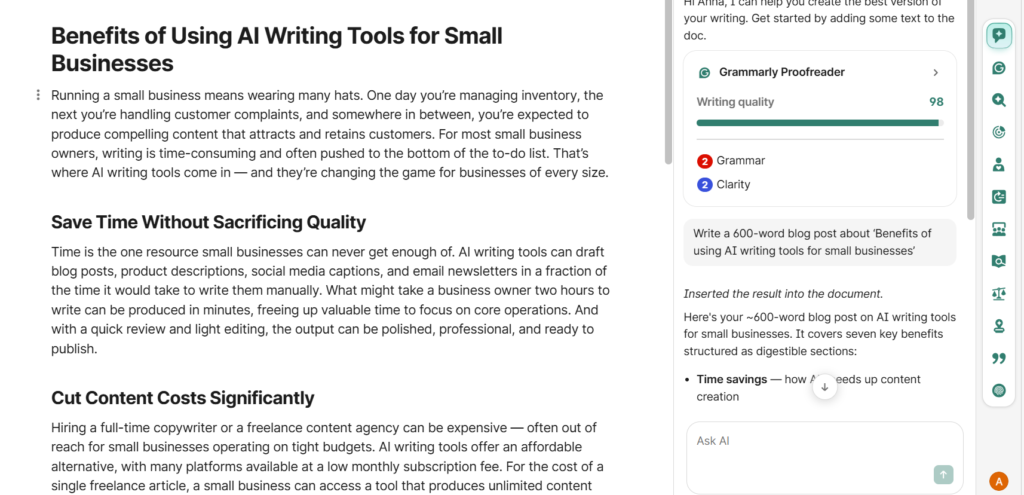
Language Quality
Strengths
- Clear and focused topic – The article directly answers the prompt about the benefits of AI writing tools for small businesses.
- Easy-to-read language – Sentences are short and simple, making the content accessible to a wide audience.
- Logical section headings – Each section highlights a specific benefit (time, cost, SEO, scalability).
- Relevant to small business realities – Mentions common pain points like limited time, small budgets, and multitasking.
- Marketing-friendly tone – The text is persuasive without being overly technical.
- Clean flow – The article reads smoothly from start to finish
Minor Issues
- Very general statements – Many claims are broad and lack examples or data.
- No specific tools mentioned – Adding examples of AI writing tools could improve credibility.
- Some sections are predictable – The benefits follow a common AI-generated structure often seen in marketing content.
- Limited depth – The article explains benefits but doesn’t explore how businesses should implement the tools.
Overall: Solid AI-generated draft. Clear, readable, and useful as a starting point, but it would benefit from added examples, data, and slightly more personality to feel more authoritative and human-written.
Structural Logic
Strengths
- The article generally follows a logical marketing structure:
- Problem → Opportunity → Proof → Benefits → Investment justification → Conclusion
- Problem
The introduction explains the challenge of running a small business and needing to produce content. - Opportunity
AI writing tools are introduced as a solution. - Benefits
Multiple sections clearly explain advantages:- Time savings
- Cost reduction
- Brand consistency
- Overcoming writer’s block
- SEO improvements
- Scalability
- Investment justification
The cost comparison with hiring writers reinforces the value. - Conclusion
The final section summarizes the argument and ends with a forward-looking statement.
Minor Improvements
- The “proof” element is weak — there are no statistics, case studies, or real-world examples.
- The SEO section could include a practical example, such as how AI helps generate keyword-optimized blog posts.
- The conclusion could reference small business growth or ROI more concretely.
Overall: Good structural logic. The article follows a persuasive marketing flow but would be stronger with supporting evidence or examples.
What Feels AI-Generated
Several signals suggest the article was produced by AI:
- Very balanced paragraph length throughout the article.
- Predictable benefit list structure (“Save Time”, “Cut Costs”, “Maintain Consistency”, etc.).
- Generic phrasing, such as:
- “changing the game for businesses of every size”
- “punch above their weight”
- “the future is here”
These phrases are common in AI-generated marketing content.
What Helps It Sound Human
- The opening paragraph feels natural and relatable, especially the “wearing many hats” description.
- The tone is conversational, not overly formal.
- The use of real business challenges (time, budget, content production) helps make the text feel authentic.
How to Improve
Add:
- One short real-world example, e.g. a small business using AI for product descriptions.
- One statistic about AI adoption or productivity gains.
- A short anecdote or scenario describing how a business owner might use the tool during a typical workday.
Example improvement:
Instead of:
“AI writing tools can draft blog posts, product descriptions, social media captions, and email newsletters in minutes.”
Add something like:
“For example, a small online store owner could generate product descriptions for an entire catalog in one afternoon instead of spending days writing them manually.”
Overall
Slightly AI-like but still readable and natural. With a few examples or specific details, it would sound much more human.
Repetition Level
Observed Repetitions
The phrase “AI writing tools” appears frequently across sections, sometimes multiple times within the same paragraph.
Examples include repeated patterns like:
- “AI writing tools can…”
- “AI writing tools help…”
- “AI writing tools offer…”
The benefit-based structure also repeats a similar sentence pattern:
- Introduce benefit
- Explain benefit
- Reinforce benefit
Why It’s Not a Major Issue
- The repetition actually supports clarity and SEO for the topic.
- Each section focuses on a different advantage, so the repetition does not significantly reduce readability.
- The article length (around 600 words) keeps the repetition within acceptable limits.
Minor variation could improve style, for example replacing some instances with:
- “these tools”
- “AI-powered writing assistants”
- “automated content platforms”
Overall, the repetition is noticeable but not problematic.
| Criterion | Score |
|---|---|
| Language Quality | ⭐⭐⭐⭐☆ (4 / 5) |
| Structural Logic | ⭐⭐⭐⭐☆ (4 / 5) |
| Natural Tone | ⭐⭐⭐☆☆ (3 / 5) |
| Repetition Control | ⭐⭐⭐⭐☆ (4 / 5) |
2️⃣ Test: SEO content
Prompt:
Write an SEO-optimized article outline for the keyword: best AI writing tools.
The output can be seen here ->
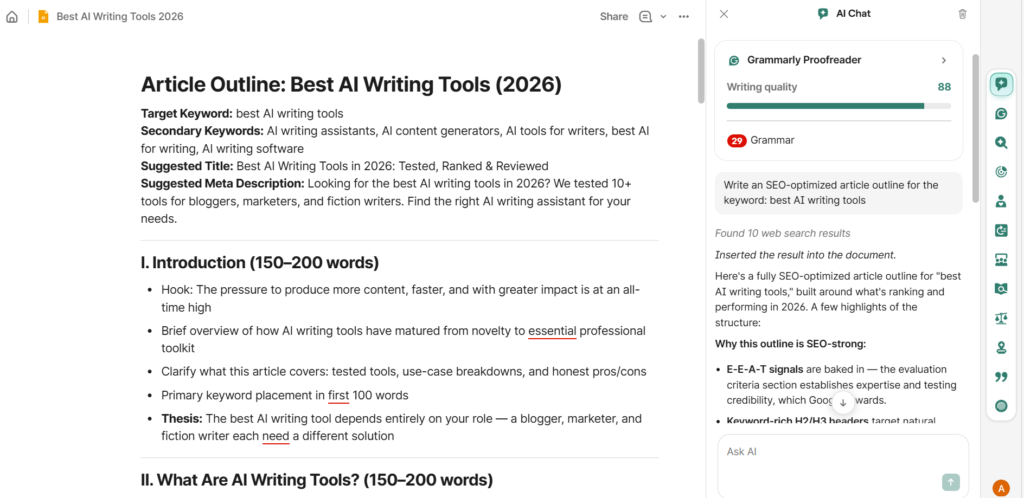
H2 / H3 Headings Quality
Strengths
• Clear hierarchical structure that follows a logical flow (introduction → explanation → evaluation → tools → decision guide).
• Headings are descriptive and user-friendly (e.g., “How to Choose the Right AI Writing Tool”).
• Category-based tool sections make scanning easy.
• Good alignment with SEO article structure for list-type queries.
Minor Improvement
• Some headings could include the target keyword or variations more explicitly (e.g., “Best AI Writing Tools for SEO Content” instead of “Best for SEO Content”).
• Consider adding comparison or table section headings, which often improve featured snippet and SEO performance.
Verdict
Very strong heading structure overall. With minor keyword optimization in a few H2/H3 headings, it would be close to perfect for SEO and readability.
Natural Keyword Usage
Strengths
• Primary keyword “best AI writing tools” appears naturally in the introduction and contextually across sections.
• Secondary keywords like AI writing assistants, AI content generators, and AI writing software are used organically without sounding forced.
• Keyword placement supports readability rather than interrupting it.
Minor Improvement
• A few sections rely heavily on tool names instead of keyword variants. Adding subtle variations like:
• “AI writing software for marketers”
• “best AI tools for writers”
• “AI content generator platforms”
would improve semantic SEO coverage.
• One additional use of the primary keyword in a mid-article section would strengthen topical relevance.
Verdict
Keyword usage is natural and reader-focused, which is good for modern SEO. A few additional semantic variations would further strengthen the content.
Search Intent Understanding (Commercial Intent)
Strengths
• The article clearly targets commercial investigation intent — users comparing tools before choosing one.
• Tool breakdowns with use cases, strengths, and pricing match how readers evaluate software.
• The “How to Choose the Right Tool” section directly supports decision-making.
• FAQ section addresses common comparison questions and improves snippet potential.
Minor Improvement
• Adding a comparison table of tools (features + pricing) would further enhance commercial intent satisfaction.
Verdict
Excellent alignment with search intent. The content strongly matches what users searching for “best AI writing tools” are looking for: comparisons, recommendations, and decision guidance.
| Criterion | Score |
|---|---|
| H2 / H3 Headings | ⭐⭐⭐⭐☆ (4.5 / 5) |
| Structure Logic | ⭐⭐⭐⭐⭐ (5 / 5) |
| Keyword Naturalness | ⭐⭐⭐⭐⭐☆ (4.3 / 5) |
| Commercial Intent | ⭐⭐⭐⭐⭐ (5 / 5) |
3️⃣ Test: Product description
Prompt:
Write a persuasive product description for an AI writing tool for marketers.
The output can be seen here ->
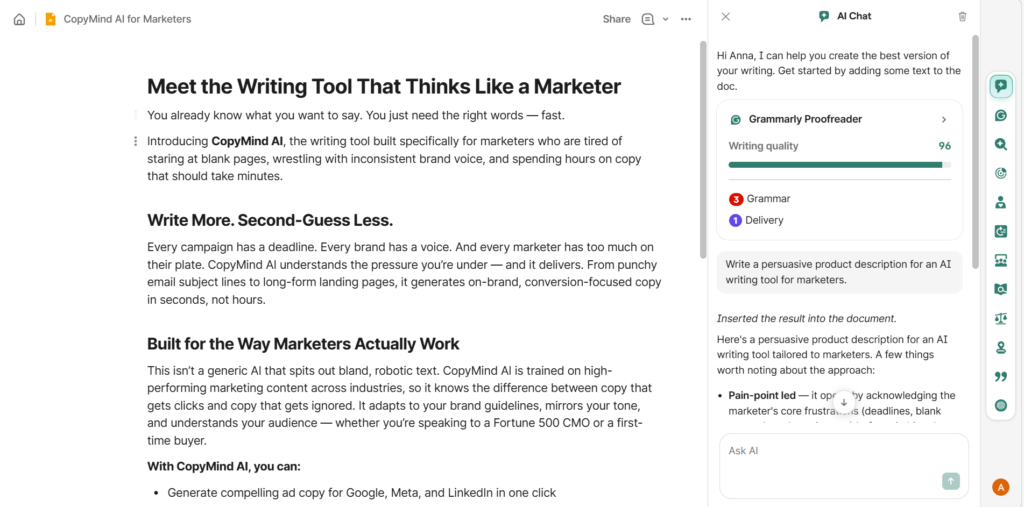
Sales-Oriented Writing Style
Pros
- The text clearly focuses on benefits, not just features.
- It explains how the tool helps marketers save time and improve results.
- The tone is confident and persuasive.
- It uses strong action language (e.g., “Stop,” “Write,” “Generate,” “Craft”).
Cons
- Some phrases feel too general or repetitive.
- It sounds similar to many other AI marketing pages.
- It does not include real examples or stories.
Call to Action (CTA)
Pros
- The ending is strong and motivating.
- It creates urgency and encourages action.
- The message feels inspiring.
Cons
- There is no clear action button (for example: “Start free trial” or “Sign up now”).
- The reader is not told exactly what to do next.
- The CTA is emotional, but not specific.
Specificity vs. Generic Messaging
Pros
- It includes numbers (3x faster, 40% higher open rates).
- It mentions specific platforms (Google, Meta, LinkedIn).
- It lists clear features of the product.
Cons
- The statistics are not explained or supported.
- It does not give real customer examples.
- Some sentences are still very general.
Overall Evaluation
The text is strong, clear, and persuasive.
However, it is still a bit generic and could include more concrete details and a clearer call to action.
If you want, I can also:
Or score it from 1–5 in each category 😊
Improve it to sound more natural
Make it more powerful for sales
| Criterion | Score |
|---|---|
| Sales Writing Style | ⭐⭐⭐⭐☆ (4 / 5) |
| Call to Action (CTA) | ⭐⭐⭐☆☆ (3 / 5) |
| Message Specificity | ⭐⭐⭐⭐☆ (3.5 / 5) |
4️⃣ Test: Social media post
Prompt:
Write a Facebook post promoting an AI writing tool for content creators.
The output can be seen here ->
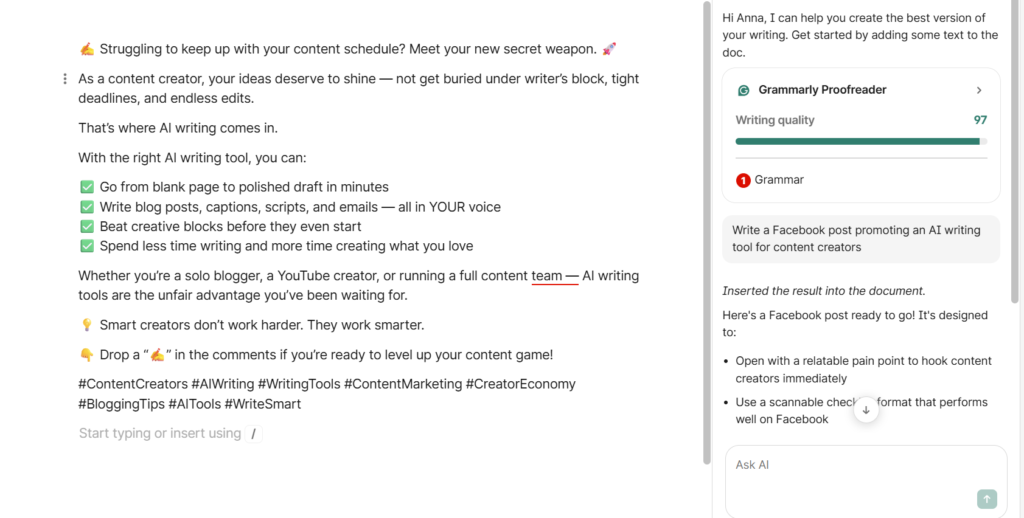
Tone (Does It Sound Human?)
Pros:
- The text sounds friendly and positive
- It speaks directly to the reader (“your ideas,” “your content game”).
- The message feels motivating and supportive.
- Emojis make it more natural for social media.
Cons:
- Some sentences feel a little generic.
- It sounds slightly like marketing copy, not fully personal.
- The tone is very polished, which can feel less authentic.
Overall:
Good human tone (8/10).
It sounds natural for Facebook, but it could be slightly more personal to feel even more real.
Length
Pros:
- The post is not too long.
- It is easy to read quickly.
- The structure with bullet points makes it clear.
- Good balance between explanation and CTA.
Cons:
- It could be a little shorter for faster scrolling.
- Some sentences repeat similar ideas (productivity, saving time).
Overall:
Good length (8.5/10).
It works well for Facebook and keeps attention.
Engaging Hook
Pros:
- The first sentence is clear and relatable.
- It addresses a common problem (content schedule).
- It creates curiosity (“Meet your new secret weapon”). 🚀
- It speaks directly to content creators.
Cons:
- The hook is good, but not very surprising.
- It could include a stronger emotional problem (stress, pressure, burnout).
- It does not ask a question, which could increase engagement.
Overall:
Strong hook (8/10).
It works well, but it could be more emotional or more specific.
| Criterion | Score |
|---|---|
| Human Tone | ⭐⭐⭐⭐☆ (4 / 5) |
| Length | ⭐⭐⭐⭐⭐ (5 / 5) |
| Engaging Hook | ⭐⭐⭐⭐☆ (4 / 5) |
📊 The Final Grammarly Pro – Review
| Criterion | Score |
|---|---|
| Ease of use | ⭐⭐⭐⭐⭐ (5 / 5) |
| Content quality | ⭐⭐⭐⭐☆ (4 / 5) |
| SEO usefulness | ⭐⭐⭐⭐⭐ (5 / 5) |
| Speed | ⭐⭐⭐⭐⭐ (5 / 5) |
| Value for money | ⭐⭐⭐⭐⭐ (5 / 5) |
Want to see how this tool compares to others?
Check our full comparison before you decide.
View Best AI Writing Tools in 2026

Check Other AI Writing Tool Tests
Read simple, honest reviews of popular AI writing tools. Compare features, prices, SEO help, and real writing results.
Writesonic Review
AI writing, SEO content, and marketing copy test.
Jasper Review
Is this popular AI writing tool still worth it?
Frase Review
AI content briefs, SEO help, and optimization test.
QuillBot Review
A real AI text test with no editing tricks.
Rytr Review
Simple AI writing tool for short content and ideas.
Simplified Review
AI writing, design, and social content in one place.
Scalenut Review
AI SEO writing platform for blogs and rankings.
Grammarly Pro Review
Grammar, tone, AI writing, and editing help tested.