Writesonic – AI Writing Tool – Review
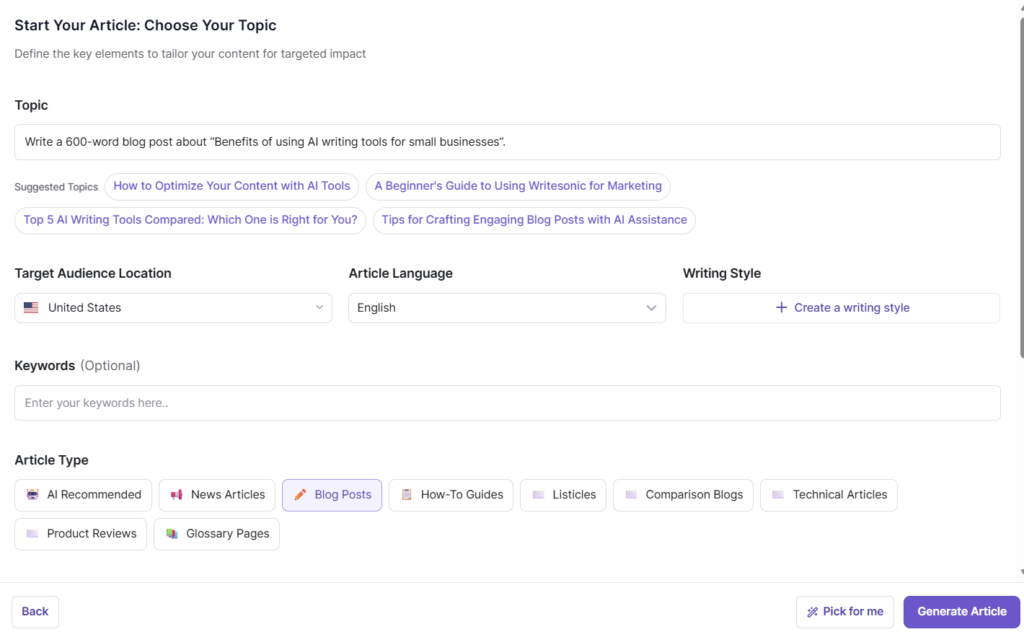
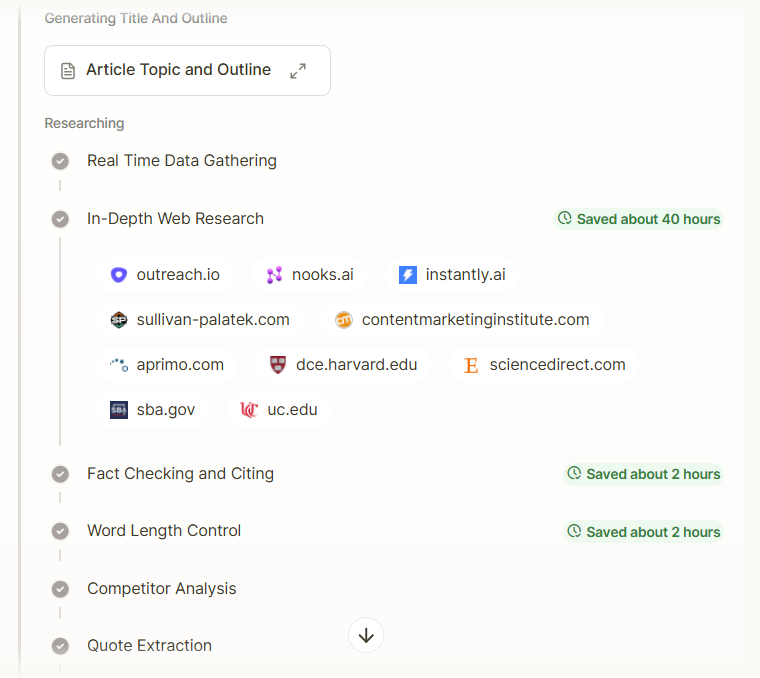
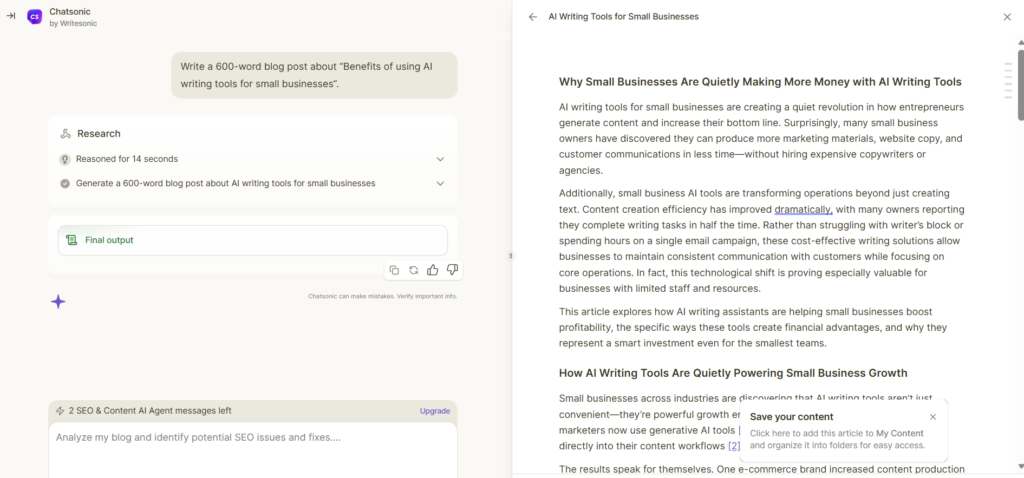
1️⃣ Test: Short blog article
Prompt:
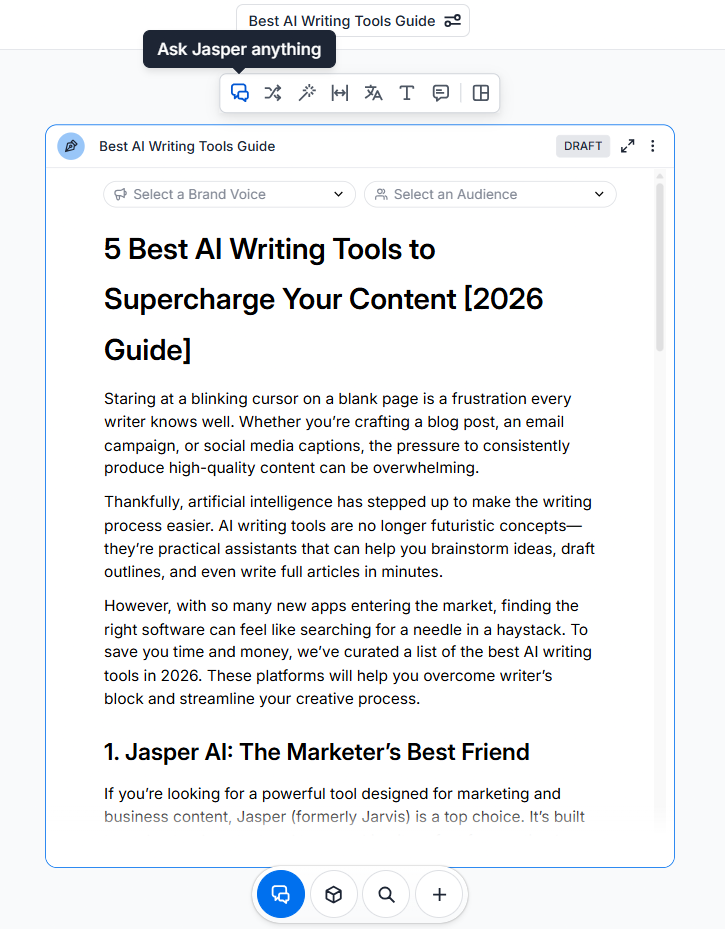
Write a 600-word blog post about “Benefits of using AI writing tools for small businesses”.
The output can be seen here ->
Strengths
- The writing is clear, professional, and grammatically correct all the way through.
- The choice of words is suitable for a business or marketing audience.
- Transitions like “Additionally,” “Consequently,” and “Moreover” are employed accurately.
- The sentences are nicely structured and simple to understand.
Minor Issues
- Certain sentences may be a bit lengthy and packed with too much information, making them harder to read.
- Using formal connectors too often can give off a more academic vibe instead of a casual, conversational tone.
Overall: High-quality English with strong clarity and credibility.
Structural Logic
Strengths
- Logical progression:
- Problem → Opportunity → Proof → Benefits → Investment justification → Conclusion
- Clear section headers that guide the reader.
- The “8 Ways” list is particularly effective and scannable.
- Conclusion neatly summarizes key arguments without introducing new ideas.
Minor Improvements
- The introduction could be shortened slightly to reach the core benefit faster.
- References could be visually separated more clearly from the conclusion (for UX).
Overall: Very strong structure that supports both SEO and reader comprehension.
Does It Sound “Robotic”?
What Feels AI-Generated
- Repeated sentence patterns:
- “These tools allow…”
- “The evidence clearly shows…”
- “What truly makes these tools valuable…”
- Heavy reliance on neutral, safe phrasing.
- Limited emotional language or real-world anecdotes.
What Helps It Sound Human
- Concrete statistics and examples.
- Natural flow between paragraphs.
- No obvious grammar or phrasing errors typical of raw AI output.
How to Improve
- Add:
- A short real-life scenario or quote.
- Occasional contractions (e.g., don’t, can’t).
- One or two opinion-based sentences.
Overall: Not “obviously AI,” but still slightly polished and cautious in tone.
Repetition Level
Observed Repetitions
- Frequent reuse of:
- “AI writing tools”
- “small businesses”
- “these tools”
- “content production”
- Repetitive sentence openings with transition words.
Why It’s Not a Major Issue
- Repetition supports SEO.
- Terms are contextually relevant and not spammy.
| Criterion | Score |
|---|---|
| Language Quality | ⭐⭐⭐⭐☆ (4.5 / 5) |
| Structural Logic | ⭐⭐⭐⭐⭐ (5 / 5) |
| Natural Tone | ⭐⭐⭐⭐☆ (4 / 5) |
| Repetition Control | ⭐⭐⭐⭐☆ (4.4 / 5) |
2️⃣ Test: SEO content
Prompt:
Write an SEO-optimized article outline for the keyword: best AI writing tools.
The output can be seen here ->
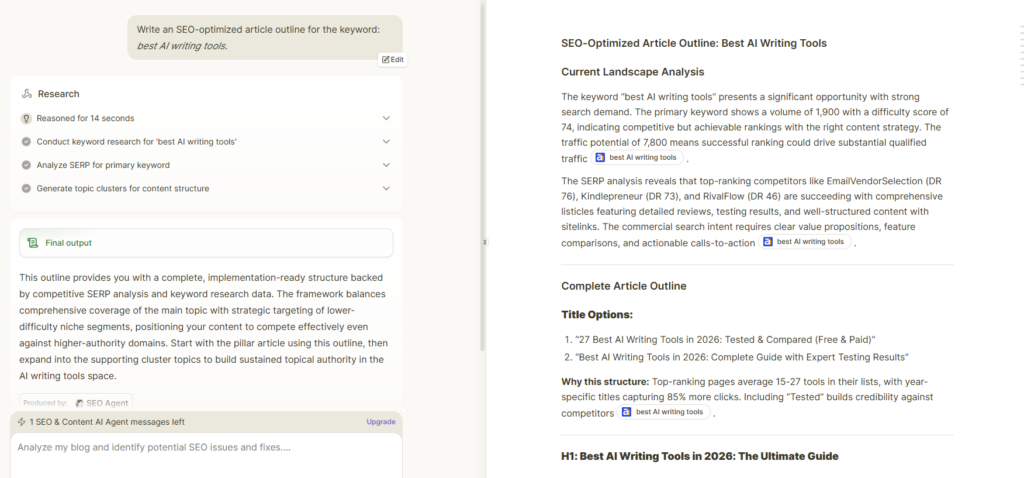
H2 / H3 Headings Quality
Headings are clear, descriptive, and highly scannable.
Excellent hierarchy (H2 → H3) that matches both user expectations and SERP structures.
Headings align well with comparison, evaluation, and decision-making intent.
Strong balance between informational and commercial sections (reviews, comparisons, FAQs).
Verdict: Excellent — on par with top-ranking affiliate/listicle pages.
Natural Keyword Usage
- Keywords are integrated strategically and logically within sections.
- Primary and secondary keywords are placed where users expect them (titles, reviews, FAQs).
- No obvious keyword stuffing; intent-based placement is clear.
Minor Improvement:
- Some keyword references feel slightly analytical/SEO-internal (e.g. volume/difficulty mentions) and should be removed in the final published version.
Verdict: Very strong and mostly natural; light cleanup will make it fully human.
Search Intent Understanding (Commercial Intent)
- Clear alignment with commercial investigation intent.
- Includes all critical conversion elements:
- Tool comparisons
- Pros & cons
- Pricing tiers
- “Best for” segmentation
- FAQs addressing buyer objections
- Free vs paid segmentation captures both early- and late-stage buyers.
Verdict: Excellent intent matching — optimized for affiliate conversions and CTR.
| Criterion | Score |
|---|---|
| H2 / H3 Headings | ⭐⭐⭐⭐⭐ (5 / 5) |
| Structure Logic | ⭐⭐⭐⭐⭐ (5 / 5) |
| Keyword Naturalness | ⭐⭐⭐⭐☆ (4.5 / 5) |
| Commercial Intent | ⭐⭐⭐⭐⭐ (5 / 5 |
3️⃣ Test: Product description
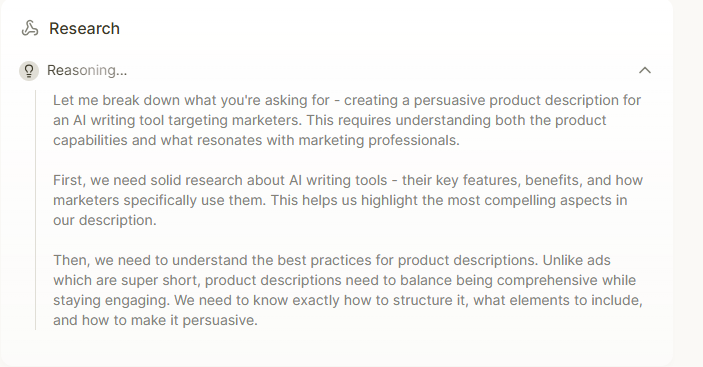
Prompt:
Write a persuasive product description for an AI writing tool for marketers.
The output can be seen here ->
Sales-Oriented Writing Style
Pros
- Very strong problem–solution structure that immediately addresses a real marketing pain point (content bottlenecks, deadlines, scalability).
- Benefits are clearly prioritized over features (speed, consistency, performance, growth).
- Uses outcome-driven language (“scale your content,” “drive real engagement,” “amplify your results”) that aligns well with decision-makers.
- Social proof (real quote with metrics) significantly increases credibility and sales impact.
- Reads like a polished SaaS landing page rather than a generic AI tool description.
Cons
Could further sharpen emotional triggers by highlighting consequences of not using the tool.
A few phrases lean toward standard SaaS wording (“advanced AI technology,” “heavy lifting”), which slightly reduces distinctiveness.
Call to Action (CTA)
Pros
- CTA is clear, direct, and benefit-focused (“Start your 14-day free trial”).
- Low-friction offer reduces buyer hesitation.
- Positioned naturally at the end after trust and value are fully established.
- Reinforces social proof (“15,000 marketing teams trust…”).
Cons
Could introduce more urgency or risk reversal (e.g. “No credit card required,” “Cancel anytime”).
Only one main CTA; adding a secondary soft CTA earlier (e.g. “See how it works”) could increase conversions.
Specificity vs. Generic Messaging
Pros
- Excellent use of specific, concrete details:
- Measurable results (70% faster production, 40% better performance, 180% traffic growth).
- Named integrations (HubSpot, Mailchimp, WordPress).
- Exact feature descriptions and use cases.
- Clear differentiation from generic “AI writer” tools by focusing on marketing workflows.
- The testimonial feels believable and context-rich.
Cons
Could benefit from one brief micro-example (e.g. a sample output or mini use case).
| Criterion | Score |
|---|---|
| Sales Writing Style | ⭐⭐⭐⭐⭐ (5 / 5) |
| Call to Action (CTA) | ⭐⭐⭐⭐☆ (4.5 / 5) |
| Message Specificity | ⭐⭐⭐⭐☆ (4.5 / 5) |
4️⃣ Test: Social media post
Prompt:
Write a Facebook post promoting an AI writing tool for content creators.
The output can be seen here ->
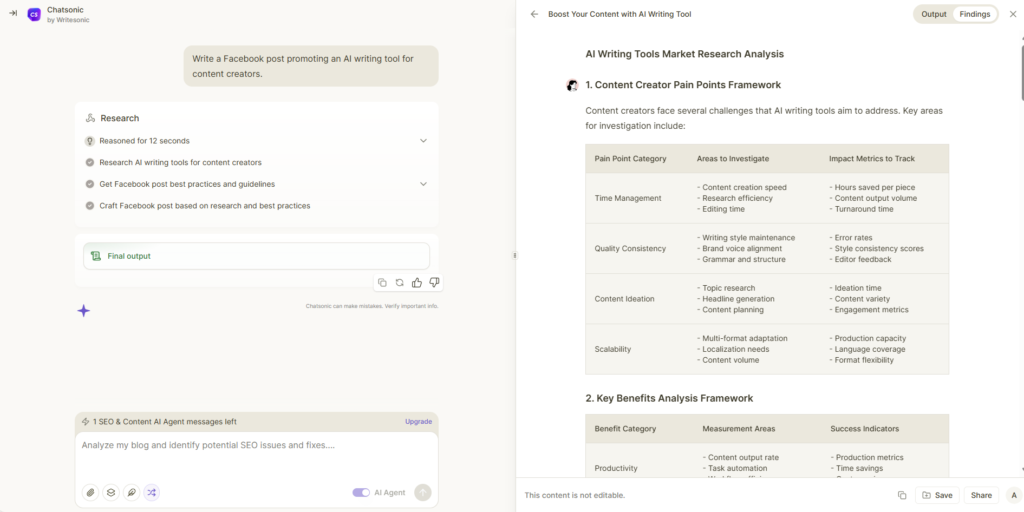
Tone (Does It Sound Human?)
Pros:
- Posts are conversational and relatable — use of emojis (😤, ⚡, 🤔) makes them feel casual and social-media native.
- Strong use of natural phrasing: “We’ve all been there,” “Your future self will thank you,” “Imagine having a writing partner that never gets tired.”
- Social proof and first-person examples (Variation 3) enhance authenticity.
- Questions and calls for engagement (Variation 5) sound genuinely human and community-focused.
Cons:
- Some lines feel slightly formulaic or “marketing-polished,” e.g., “Smart content creators have found the solution,” “Join thousands of creators who’ve already made the switch.” These are persuasive but hint at AI or copywriting structure.
- Could add more minor imperfections or playful phrasing to fully mimic a human casual post.
Overall: Very human-sounding, minor tweaks could make it feel even more conversational and less polished.
Length
Pros:
- Each variation is concise and fits social media norms (short paragraphs, 2–4 sentences).
- Variations provide enough context to explain benefits or pain points without overwhelming the reader.
- Each post is scroll-friendly, which is critical for Facebook.
Cons:
- Some variations (like Variation 2 and 3) are slightly longer; for Facebook, trimming 1–2 sentences could improve skim-readability.
- Could benefit from breaking up text with line breaks or emojis to further enhance scannability.
Overall: Good length for engagement, with room for minor tightening.
Engaging Hook
Pros:
- Variation 1: Opens with a relatable pain point — staring at a blank page — immediately connects with the target audience.
- Variation 2: Highlights productivity benefit and curiosity — “What would you do with 10 extra hours each week?”
- Variation 3: Starts with a real testimonial, immediately building credibility.
- Variation 4: Presents a problem-solution dynamic instantly — “You’re either spending too much time writing or not enough time perfecting your message.”
- Variation 5: Starts with a question to encourage community interaction — great for social engagement.
Cons:
- Hooks are strong overall; very minor adjustment could make Variation 4 more punchy by shortening the first sentence.
Overall: Excellent — all variations immediately capture attention and are well-tailored to the platform.
| Criterion | Score |
|---|---|
| Human Tone | ⭐⭐⭐⭐☆ (4.5 / 5) |
| Length | ⭐⭐⭐⭐☆ (4 / 5) |
| Engaging Hook | ⭐⭐⭐⭐⭐ (5 / 5) |
📊 The Final Writesonic Review
| Criterion | Score |
|---|---|
| Ease of use | ⭐⭐⭐⭐⭐ (5 / 5) |
| Content quality | ⭐⭐⭐⭐☆ (4.5 / 5) |
| SEO usefulness | ⭐⭐⭐⭐⭐ (5 / 5) |
| Speed | ⭐⭐⭐⭐☆ (4 / 5) |
| Value for money | ⭐⭐⭐⭐⭐ (5 / 5) |
Want to see how this tool compares to others?
Check our full comparison before you decide.
View Best AI Writing Tools in 2026