
If you plan to publish content every day, AI writing tools can save you hours of work. But how much do they really cost per month?
In this guide, we compare real pricing for popular tools like Writesonic, Jasper, Rytr, and Scalenut based on daily content creation.
In this comparison, we analyze a real-world use case: creating one AI-assisted article per day for 30 days. Each article is assumed to be 1,000–1,500 words, edited and refined for blog publishing and SEO performance. The goal is not short drafts or outlines, but publish-ready content suitable for niche websites, affiliate blogs, and content-driven businesses.
To ensure a fair comparison, we calculated the minimum monthly plan required for each AI writing tool to handle this workload. Word limits, plan restrictions, and content volume were taken into account. Free plans were included only when their limits were sufficient; otherwise, the lowest paid plan that realistically fits the monthly word usage was selected.
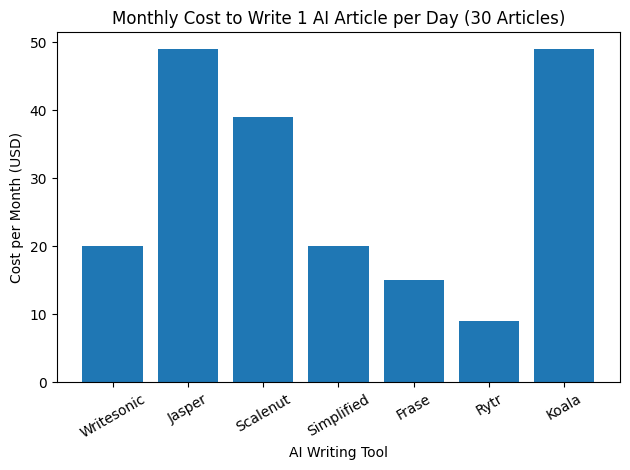
Below, you’ll find a cost comparison and bar chart showing the monthly price of popular AI writing tools — including Writesonic, Jasper, Scalenut, Frase, Rytr, Simplified, and Koala — when used for daily article production. This breakdown helps identify which tools offer the best value for money when content volume and quality are equally important.
Want to see how all tools compare to others?

Cost Estimate — 30 Articles / ~30,000–45,000 Words
Writesonic
- Plan used: Free plan only if 10,000 words total is enough (NOT sufficient for ~30,000–45,000 words) → needs paid plan.
- Required plan: Unlimited/Pro (≈200,000+ words) — adequate for daily long-form.
- Monthly cost: $20 (Unlimited plan)
→ Total: $20
Jasper
- Plan used: Creator/Pro (words plenty for 30K+). Jasper plans include effectively unlimited words at higher tiers.
- Monthly cost: $49/month (Creator)
→ Total: $49
Scalenut
Pricing varies by source, but the Essential plan should cover ~30–75 articles depending on tool limits (Scalenut focuses on SEO + articles).
- Plan used: Essential (~100,000 words) — enough for you.
- Monthly cost: ≈ $39/month (if billed monthly)
→ Total: ≈ $39
Simplified
Simplified does have a free plan for basic writing and design, but its AI article generation limits are generally low/undefined on free tier.
- Plan used: Free if you only generate small snippets (not enough for long-form).
- Recommended paid plan: Pro (≈ $18-$20/month) — gives better writing limits.
→ Total estimate: ≈ $18–$20
Frase
- Plan used: Entry-level paid plan ($14.99/month) — good for SEO content and long-form article creation. Frase typically does not offer a free plan with enough words for 30 articles.
- Monthly cost: $14.99
→ Total: $14.99
Rytr
Rytr pricing is character-based but translates into enough words if you choose the “Unlimited” plan.
- Free plan: ~10,000 characters only — ~2,000 words (too small for daily articles).
- Paid plan: “Unlimited” – $9/month (or ~ $24.50/month depending on source).
→ Total: ≈ $9–$24.50 (choose Unlimited to be safe)
Koala AI
- Plan used: Essentials ($9/month) with ~15,000 words — borderline low for 30 articles; better use Professional (~$49/month) if you want 100,000 words.
- Monthly cost:
- If low-volume okay (short articles): $9
- For full long-form capacity: $49
Summary Table
| Tool | Cost for 1 Month | Best Plan for ~30 Articles |
|---|---|---|
| Writesonic | $20 | Unlimited/Pro plan (~200K+ words) |
| Jasper | $49 | Creator plan (enough words) |
| Scalenut | ≈ $39 | Essential plan (~100K words) |
| Simplified | ≈ $18–$20 | Pro plan (better limits) |
| Frase | $14.99 | Basic paid plan |
| Rytr | ≈ $9–$24.50 | Unlimited plan recommended |
| Koala AI | $9 or $49 | Essentials (small) or Professional (100K words) |
Notes
- Free plans usually have very low monthly limits (Writesonic 10,000 words / Rytr 10,000 characters), so they’re not sufficient for 30 long articles.
- Frase’s $14.99 plan is the lowest that covers long-form well for a month.
- Rytr Unlimited is the cheapest overall if you only care about raw generation, not SEO features.
- Koala’s lower plan is cheap but may not give enough total words for daily long posts; its Professional ($49) is safer for ~30×1,000+ jobs.
Long-term strategy
Now, let’s take this analysis one step further and look beyond a single month. In most real projects, content creation is not a short-term experiment but a long-term strategy. If we assume the same workload — one AI-assisted article per day — but extend it to an entire year, the cost differences between tools become much more significant.
When calculated annually, even small monthly price gaps add up quickly. Budget-friendly tools such as Rytr and Frase stand out as the most cost-effective options over 12 months, especially for creators focused on volume and basic content generation. Writesonic and Simplified remain solid mid-range choices, offering a balance between price and features. On the other hand, premium platforms like Jasper and Koala (Professional plans) become the most expensive solutions in a yearly comparison, making them better suited for teams that prioritize advanced workflows, brand voice control, or higher-end content features over raw cost efficiency.
From a long-term perspective, the “best” tool is not only about quality, but about sustainable cost per article. When publishing hundreds of articles per year, choosing the right AI writing tool can result in hundreds of dollars saved annually — without sacrificing consistency or output.
Yearly Cost Summary (1 Article per Day)
| AI Writing Tool | Monthly Cost (USD) | Yearly Cost (USD) | Plan Used |
|---|---|---|---|
| Rytr | $9 | $108 | Unlimited |
| Frase | $14.99 | $179.88 | Basic |
| Writesonic | $20 | $240 | Unlimited / Pro |
| Simplified | $20 | $240 | Pro |
| Scalenut | $39 | $468 | Essential |
| Jasper | $49 | $588 | Creator |
| Koala AI | $49 | $588 | Professional |

So far, all our calculations are just numbers. They show how much each AI tool costs, but price is not the only thing that matters. Each tool comes with extra features in its plan, like SEO help, content briefs, keyword suggestions, templates, or workflow tools. These features can make a big difference in value.
Another important point is the quality of the AI-generated articles. Not all tools write the same way — some need more editing, some are better structured, and some give more accurate or natural content. A cheaper tool might end up costing more time if you have to fix the articles.
That’s why the next step is to look at real articles from each AI tool. Testing actual outputs will show which tool gives the best mix of cost, quality, and helpful features.
See Writesonic article example ->
See Simplified article example ->
See Scalenut article example ->