Have you ever asked AI a question, received a confident answer, checked it yourself and thought: “Wait. This is completely wrong.”
I have.
And sometimes the mistake is not small. AI can invent a statistic, confuse two people, give you an old price, create a source that does not exist, or explain something in a very convincing way that is simply false.
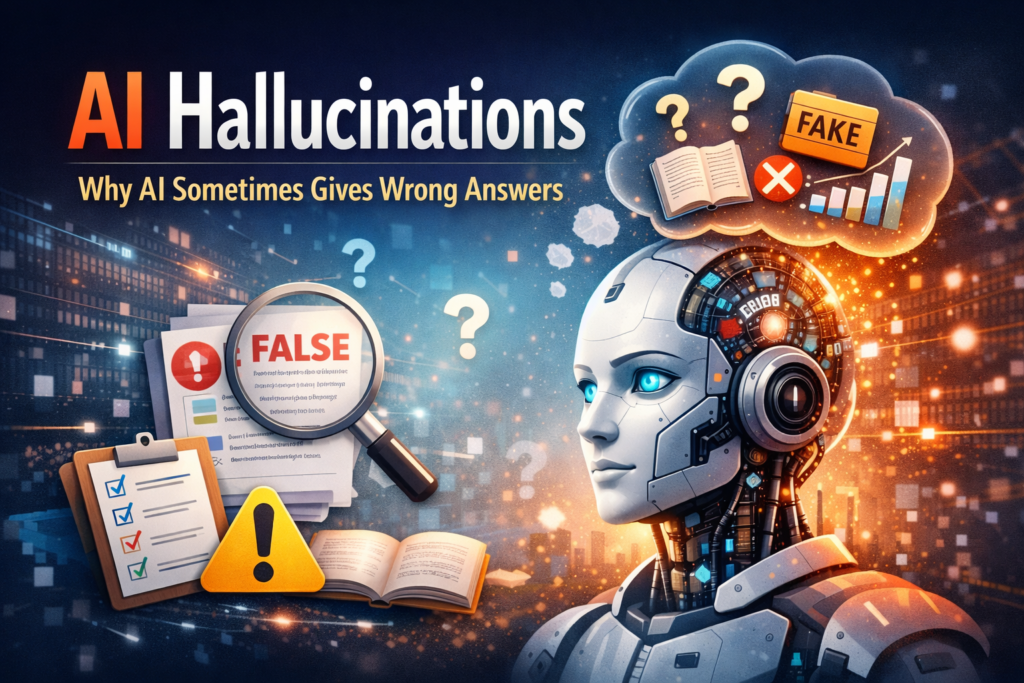
This problem is usually called an AI hallucination.
The important thing to understand: AI hallucination is not simply “AI making a typo.”
It happens when an AI system produces information that is incorrect, unsupported, invented, or misleading — while presenting it like a normal answer.
This is one of the most important things every AI user should understand in 2026.
Not because AI is useless. It is extremely useful.
But because fluent writing can easily look like reliable knowledge.
What Is an AI Hallucination?
An AI hallucination happens when an AI system generates information that is not properly supported by facts or available evidence.
The answer can include:
- invented facts,
- wrong dates,
- fake statistics,
- incorrect names,
- non-existent research papers,
- fake quotations,
- incorrect product features,
- made-up URLs,
- false explanations,
- information that was once true but is no longer current.
The most dangerous part is not that AI can be wrong.
Humans are wrong too.
The dangerous part is that the wrong answer can sound excellent.
An answer can be clear, professional, detailed and completely wrong at the same time.
Why Does AI Hallucinate?
To understand hallucinations, we need to understand one basic thing about language models.
They are built to generate useful sequences of language.
They do not work like a traditional database where every answer is stored in a clean table of verified facts.
When you ask a question, the model creates a response based on patterns, context, instructions and information available to it.
That process can produce excellent answers.
But it can also produce something that looks right without actually being right.
1. AI predicts language, not truth
A language model is very good at predicting what kind of words should come next.
For example:
“The capital of France is…”
The pattern is very strong, so the model is likely to answer correctly: Paris.
But not every question has such a clear pattern.
If you ask about a very small company, an obscure historical event or a study that may not exist, the model has much less reliable information to work with.
It may still produce an answer because producing an answer is part of its job.
2. The information may be incomplete
Sometimes AI has part of the story but not all of it.
Imagine it has seen information about:
- a company,
- several pricing plans,
- an old version of the website,
- reviews from other blogs.
It may combine those pieces into one answer.
The result can look logical but still contain details that were never true together.
3. Your question can contain a false assumption
This is a very interesting problem.
Imagine you ask:
But Product X was never released.
A weak response may accept your assumption and start explaining why the fictional event happened.
A stronger response should first check whether the event is real.
4. AI tries to be helpful
This sounds strange, but helpfulness can create problems.
Users usually want an answer.
So AI systems are designed to respond.
When the system has weak information, there can be tension between two goals:
- give the user something useful,
- avoid saying something unsupported.
Good AI systems are getting better at admitting uncertainty.
But you should still not assume they will always say, “I don’t know.”
5. The topic may be too new
Current information creates another risk.
A model may know a lot about an AI tool, but the company changed its pricing yesterday.
If the AI answers from older knowledge, the result may now be wrong.
This is why I treat questions about:
- pricing,
- software features,
- news,
- politics,
- laws,
- product availability,
- current statistics
differently from general educational questions.
You can read more about this in my guide on whether AI really knows today’s data.
Not Every AI Mistake Is a Hallucination
This distinction is important.
People sometimes call every bad AI answer a hallucination.
I would not.
| Problem | Example | Hallucination? |
|---|---|---|
| Formatting mistake | You asked for 5 bullets and AI gave 6. | Usually no |
| Instruction failure | You asked for simple English and AI used difficult language. | No |
| Calculation mistake | AI adds numbers incorrectly. | Not necessarily |
| Outdated fact | AI gives an old software price as if it is current. | Can behave like one |
| Invented fact | AI says a company launched a feature that never existed. | Yes |
| Fake source | AI invents a research paper and citation. | Yes |
The label matters less than the practical lesson:
The Most Common Types of AI Hallucinations
Invented facts
This is the classic example.
You ask a direct question and AI generates a factual statement that is not true.
“Tool X launched in 2019 and was founded by John Smith.”
The company may have launched in a different year, and John Smith may not exist.
Fake statistics
This one is especially dangerous for bloggers.
AI may create a realistic percentage such as:
That number looks believable.
But unless I can find the study, I do not publish it.
Invented research papers
AI can sometimes generate research titles that sound extremely realistic.
It may even give:
- authors,
- journal names,
- publication years,
- page numbers,
- DOI-style references.
And the study may not exist.
This is why asking for a citation is only the first step.
You still need to check that citation.
Fake quotations
Quotes are another high-risk area.
If you ask AI:
AI may find a real quote.
But it may also create a sentence that sounds like something Steve Jobs could have said.
If I cannot find the original source, I do not use the quotation marks.
Wrong dates
AI can know the event but attach the wrong date.
This can happen with:
- product launches,
- historical events,
- company announcements,
- software releases.
An answer can therefore be mostly correct but still contain one important factual error.
Fake URLs
Sometimes AI creates a URL that looks exactly like a real page.
The domain may be real.
The page may not be.
I always open links before using them as sources.
Feature hallucinations
This is a big one for AI tool reviews.
An AI can describe a feature that sounds completely logical for a product.
For example:
The feature may exist in another product.
It may exist only in a more expensive plan.
Or it may not exist at all.
For software reviews, I prefer checking the product myself or using the official documentation.
Hallucinations Can Be Partly Correct
This is one of the hardest cases to detect.
A bad answer is easy to reject when everything is wrong.
A partly correct answer is more dangerous.
Imagine AI says:
Maybe:
- the free plan is real,
- the language number is real,
- the $19 price is two years old.
Now 2 out of 3 claims are correct.
That makes the wrong claim harder to notice.
Why AI Can Sound So Confident When It Is Wrong
This confused me a lot when I started working with AI.
Humans often show uncertainty with phrases like:
- “I think…”
- “I am not sure…”
- “Maybe…”
AI-generated language does not always work this way.
The sentence:
can be produced in exactly the same writing style whether the information is strongly supported or very weak.
So we must separate:
- language confidence, and
- evidence confidence.
They are not the same.
Does AI Know When It Is Hallucinating?
Not reliably.
This is why simply asking:
is not a strong fact-checking method.
Sometimes AI will reconsider and correct itself.
Sometimes it will repeat the same mistake with even more confidence.
Sometimes it will give you a different answer that is also wrong.
I prefer to ask for evidence.
That is a much better instruction.
Can Web Search Stop Hallucinations?
It can reduce them.
It does not eliminate them.
When an AI system can search the web, it has access to information outside its built-in model knowledge.
This is very useful.
But the AI can still:
- find an old page,
- choose a weak source,
- misread the source,
- combine two sources incorrectly,
- make a claim that the source does not support.
What Is Grounding?
You may hear the word grounding when people talk about AI accuracy.
Grounding means connecting the AI answer to specific information or evidence instead of allowing the model to answer only from general learned patterns.
For example, an AI answer can be grounded in:
- a company website,
- a PDF,
- a database,
- your uploaded document,
- search results,
- product documentation.
This usually reduces hallucination risk because the model has something concrete to work from.
But again, the source itself needs to be good.
What Is RAG?
You may also see the term RAG.
It means Retrieval-Augmented Generation.
The name sounds technical, but the basic idea is simple.
Instead of asking the AI to answer only from its built-in knowledge, the system first retrieves relevant information.
Then the model uses that information to create the answer.
Your question → Search or retrieve documents → Find relevant information → Give that information to the AI → Generate the answer
This can make answers much more reliable.
But RAG can still fail if:
- the wrong document is retrieved,
- the data is old,
- the document is incomplete,
- the model misunderstands the text.
Why Hallucinations Matter for Bloggers
For casual brainstorming, a small mistake may not matter much.
For publishing, it matters.
If I publish a false claim on my website, readers do not blame the AI.
They blame my website.
Hallucinations can cause:
- wrong product information,
- fake statistics in articles,
- bad buying recommendations,
- incorrect links,
- damaged trust,
- extra work fixing old content.
This is why I treat AI-generated research differently from AI-generated brainstorming.
My Risk Levels for AI Content
| Task | Risk | What I Do |
|---|---|---|
| Headline ideas | Low | Use AI freely and choose the best option. |
| Article structure | Low | Review for logic and completeness. |
| General explanation | Medium | Check important facts. |
| Software features | Medium–High | Check official documentation or test the tool. |
| Prices and plans | High | Check the official pricing page. |
| Statistics and studies | High | Find the original source. |
| Medical, legal or financial claims | Very High | Use high-quality current sources and expert guidance when appropriate. |
My Real Fact-Checking Workflow
When I use AI for an article, I do not check every adjective and every simple sentence.
I focus on factual claims that could damage the article if they are wrong.
Step 1: Mark factual claims
I look for:
- numbers,
- dates,
- statistics,
- prices,
- features,
- names,
- study results,
- quotations.
Step 2: Ask for sources
Step 3: Prefer primary sources
If the claim is about a tool price, I want the pricing page.
If it is about a feature, I want product documentation.
If it is a statistic, I want the original report or study.
Step 4: Open the source
This is important.
I do not trust a source only because AI gives me a clickable link.
I check whether the source actually contains the claim.
Step 5: Remove claims I cannot verify
This can feel painful when the sentence sounds good.
But if I cannot support an important factual claim, I would rather remove it than publish something questionable.
Prompts I Use to Reduce Hallucinations
No prompt can completely remove hallucinations.
But some instructions make the process safer.
Prompt 1: Do not guess
Prompt 2: Separate fact from assumption
Prompt 3: Check the premise
Prompt 4: Verify statistics
Prompt 5: Find weak claims
What Does Not Work Well?
Some methods sound good but are weaker than they look.
“Are you sure?”
This may help, but it does not provide evidence.
Asking the same AI three times
The model can repeat the same error.
Asking three different AI tools
This is better, but they can all repeat information from the same weak sources.
Trusting an answer because it includes links
A link does not prove the sentence.
Trusting the longest answer
More detail can create more opportunities for errors.
The “Three AI Tools Agree” Trap
This deserves its own section because it is easy to misunderstand.
Imagine you ask three AI tools:
All three answer:
It feels convincing.
But they may all be repeating the same statistic from blogs that copied each other.
That is not the same as three independent studies.
Can Hallucinations Be Eliminated Completely?
Probably not with current generative AI systems.
They can be reduced through:
- better models,
- better training,
- web search,
- retrieval systems,
- tool use,
- stronger prompts,
- human review.
But the possibility of error remains.
This is why the goal should not be:
A better goal is:
When I Trust AI More — and When I Trust It Less
I trust AI more for:
- brainstorming,
- rewriting,
- summarizing text I provide,
- creating outlines,
- generating examples,
- explaining common concepts.
I trust it less without verification for:
- statistics,
- prices,
- medical claims,
- legal facts,
- current news,
- exact quotations,
- research citations,
- new or obscure topics.
My Simple Rule
Use AI for speed.
Use evidence for truth.
That is the rule I now use when creating content.
I do not need to distrust everything AI says.
I just need to understand which claims deserve verification.
AI Hallucination Checklist Before Publishing
- Did AI give me an exact number?
- Did it mention a study?
- Did it give a quote?
- Did it give a current price?
- Did it mention a recent feature?
- Did it provide a source?
- Did I open that source?
- Does the source actually support the claim?
- Could the information have changed recently?
- Would a wrong answer harm the reader?
If the answer to the last question is yes, I verify more carefully.
Final Thoughts
AI hallucinations do not mean we should stop using AI.
They mean we should use it intelligently.
AI is excellent at helping me move faster. It helps me plan, research, organize and improve content.
But I no longer treat a confident AI answer as evidence.
I ask one extra question:
Sometimes the answer is obvious.
Sometimes I need to open a source.
And sometimes I discover that the AI invented something that sounded almost perfect.
That is exactly why learning about hallucinations matters.
If you are still learning how AI writing works, read my simple explanation of AI writing.
You can also see my guide to common beginner mistakes when using AI writing tools and my article about AI content ethics.
FAQ: AI Hallucinations
What is an AI hallucination?
An AI hallucination is an answer that contains invented, incorrect or unsupported information but is presented as if it were normal factual information.
Why do AI hallucinations happen?
Language models generate responses from learned patterns, context and retrieved information. When information is weak, missing, unclear or incorrectly retrieved, the model can produce a plausible but false answer.
Does AI know when it is wrong?
Not reliably. Asking “Are you sure?” may help, but it is better to ask AI to verify the claim and provide evidence.
Can AI invent sources?
Yes. AI can sometimes invent article titles, studies, researchers, quotations or URLs. Always open and verify important sources.
Does web search stop hallucinations?
No. Search can reduce the risk because the AI has access to current information, but it can still use weak sources or misunderstand what it finds.
Are old facts hallucinations?
Not always. A fact may have been correct when the model learned it. But if AI presents outdated information as current information, the result can still mislead the user.
Can better prompts stop hallucinations?
Better prompts can reduce the risk. Asking AI not to guess, to show sources and to separate verified facts from assumptions can help. It cannot guarantee perfect accuracy.
Should I compare several AI tools?
Yes, but do not use agreement as proof. Several tools can repeat the same incorrect information. For important claims, check the original source.
Should bloggers use AI-generated statistics?
Only after verification. Find the original study, report or official dataset before publishing the number.
Should we stop using AI because it can hallucinate?
No. AI is still an excellent assistant. The important part is knowing when an answer needs human verification.
Want to improve the way you use AI without losing your own judgment? Continue with my beginner’s guide to writing with AI without losing your voice.