Have you ever written to AI: “You are wrong. Check again.”
I have. And since that moment, I always double-check what AI tells me.
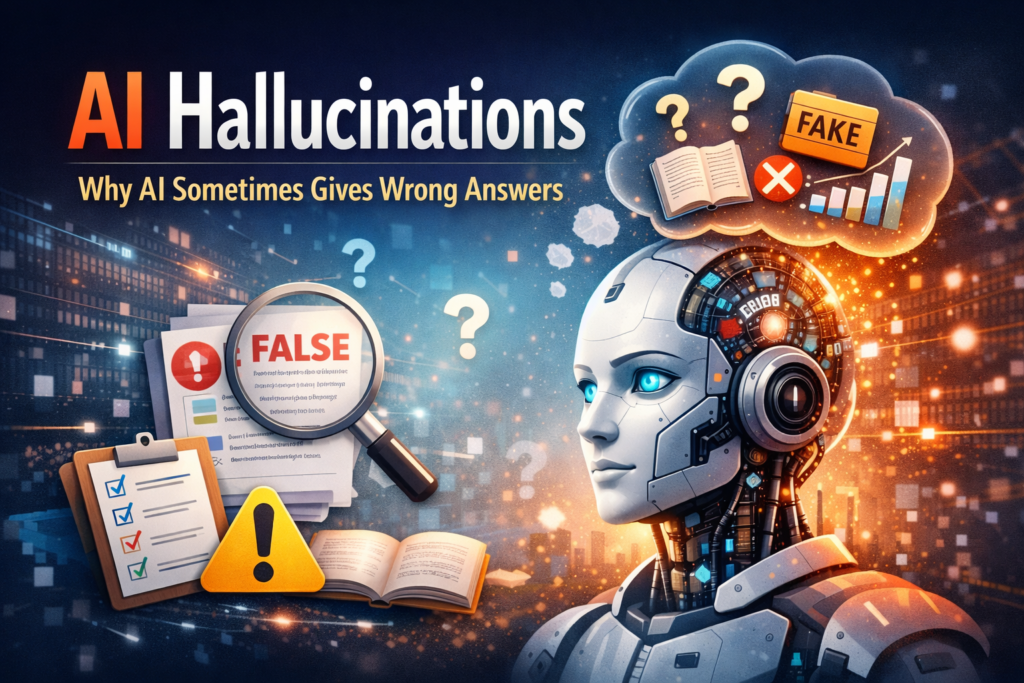
AI is powerful, fast, and helpful. But it is not perfect. Sometimes it gives answers that sound correct… but are not true. This is called AI hallucination.
Let’s look at why this happens and how AI really creates answers.
How AI Generates Answers
To understand AI mistakes, we must first understand how AI works.
AI tools like ChatGPT do not think like humans. They do not “know” facts the same way we do. Instead, they:
- analyze huge amounts of text data
- learn patterns in language
- predict the most likely next word
In simple words: AI is a very advanced prediction machine.
When you ask a question, the AI:
- Reads your prompt
- Looks at patterns it learned during training
- Predicts the most probable response
- Builds the answer word by word
It does this very fast — in milliseconds.
What Happens When AI Does Not Know the Answer?
Here is the important part.
When AI is unsure or lacks exact information, it usually does not say “I don’t know.”
Instead, it generates the most probable sounding answer based on patterns.
This means the response may:
- sound confident
- look professional
- be partially or completely wrong
The AI is not lying on purpose. It is simply doing what it was trained to do — predict likely text.
Trust AI for speed.
Trust humans for final verification.
What Are AI Hallucinations?
AI hallucination is when an AI system generates false or misleading information that sounds correct.
Common examples include:
- invented facts
- fake statistics
- non-existent sources
- wrong explanations
- made-up names or dates
The dangerous part?
👉 The answer often looks very believable.
Why Do AI Hallucinations Happen?
There are several main reasons:
1. Prediction Over Knowledge
AI focuses on probability, not truth.
If something sounds right, the model may generate it.
2. Missing or Weak Data
If the training data is limited or unclear, AI fills the gaps.
3. Complex or Vague Prompts
Unclear questions increase the risk of hallucinations.
4. Overconfidence in Language Models
AI is designed to produce fluent text, even when uncertain.
Real-World Example
You ask:
“Give me statistics from a 2023 Harvard study about X.”
If such a study does not exist, AI may still generate:
- a realistic-sounding percentage
- a believable study title
- even a fake citation
This is a classic hallucination.
How to Reduce AI Hallucinations
Good news — you can reduce the risk.
Best practices:
- Always fact-check important information
- Ask AI to provide sources
- Use clear and specific prompts
- Compare answers across tools
- Treat AI as an assistant, not an authority
Final Thoughts
AI is an amazing productivity tool. But it is not a perfect source of truth.
Remember:
- AI predicts — it does not truly “know”
- confident answers can still be wrong
- human verification is still essential
Since the day I told AI “check again”, I never fully trust the first answer.
FAQ: AI Hallucinations (Simple Guide)
❓ Why do AI hallucinations happen?
- The main reason is how language models work.
- AI models learn patterns in text and predict the next word in a sentence. They do not truly understand facts or the real world.
- Because of this, they sometimes produce answers that are statistically likely but factually wrong.
❓ Does AI know when it is wrong?
- Not always.
- Research shows models may guess instead of saying “I don’t know,” because training often rewards correct answers more than honest uncertainty.
- This makes the AI sound confident even when it is mistaken.
❓ What are common examples of AI hallucinations?
Typical examples include:
- fake statistics
- invented research papers
- wrong dates or names
- non-existent sources
These outputs can look very realistic, which makes them risky.
❓ Do hallucinations mean AI is lying?
No.
AI is not conscious and does not intend to deceive. It generates text based on patterns and probabilities, not on verified knowledge.
So hallucinations are prediction errors, not intentional lies.
❓ What increases the risk of hallucinations?
Experts point to several factors:
- poor or incomplete training data
- unclear or vague prompts
- biases or errors in datasets
- the probabilistic generation process
All of these can lead the model to produce incorrect outputs.
❓ Can AI hallucinations be completely eliminated?
- Probably not fully.
- Researchers say hallucinations are a fundamental challenge for large language models, although they can be reduced.
- Companies are working on methods like better data, grounding in external sources, and improved evaluation.
❓ How can users reduce the risk?
Best practices recommended by experts:
- verify important facts
- ask for sources
- use clear prompts
- cross-check with trusted websites
Because AI does not automatically fact-check its answers, human review is still important.
❓ Should we stop using AI because of hallucinations?
No — but use it wisely.
AI tools are very useful, but they should be treated as assistants, not perfect sources of truth. Many experts say critical thinking and verification are essential when using generative AI.