A weak Etsy prompt usually gives you generic text.
But the answer is not simply “write a longer prompt.”
The better method is to give AI the right context: what the product is, who may buy it, what is actually true, what part of the listing you are working on and what the AI must not invent.
In this guide, I will show you the Etsy prompts I would actually use in 2026 — and more importantly, how I would improve the output before publishing it.
QUICK ANSWER
What makes a good Etsy AI prompt?
A useful Etsy prompt gives AI five things: product facts, buyer context, task, structure and limits. The output should still be reviewed by the seller before it goes live.
WANT TO SKIP THE PROMPT BUILDING?
Etsy AI Lab
I built Etsy AI Lab because I did not want to rewrite the same instructions every time I worked on a listing. You can generate titles, descriptions and tag ideas, then audit and improve the result.
BEFORE THE PROMPTS
Prompts Matter — But They Are Not Magic
I agree with one thing from the old version of this article: the way you ask AI for something changes the result.
But I would not say:
“A strong prompt gives content that sells.”
That goes too far.
A strong prompt can give you a better draft. It cannot guarantee clicks, favorites, ranking or sales.
Product demand, photos, price, competition, reviews, shipping, trust and the quality of the item all matter too.
My rule: Use prompts to improve the work. Do not use prompts to create fake certainty.
My 5-Part Etsy Prompt Formula
I use the same structure again and again.
What is actually true about the product?
Who may be looking for it?
Title, description, tags, FAQ, rewrite?
How should the answer look?
What must AI avoid inventing?
Weak Prompt vs Better Prompt
WEAK
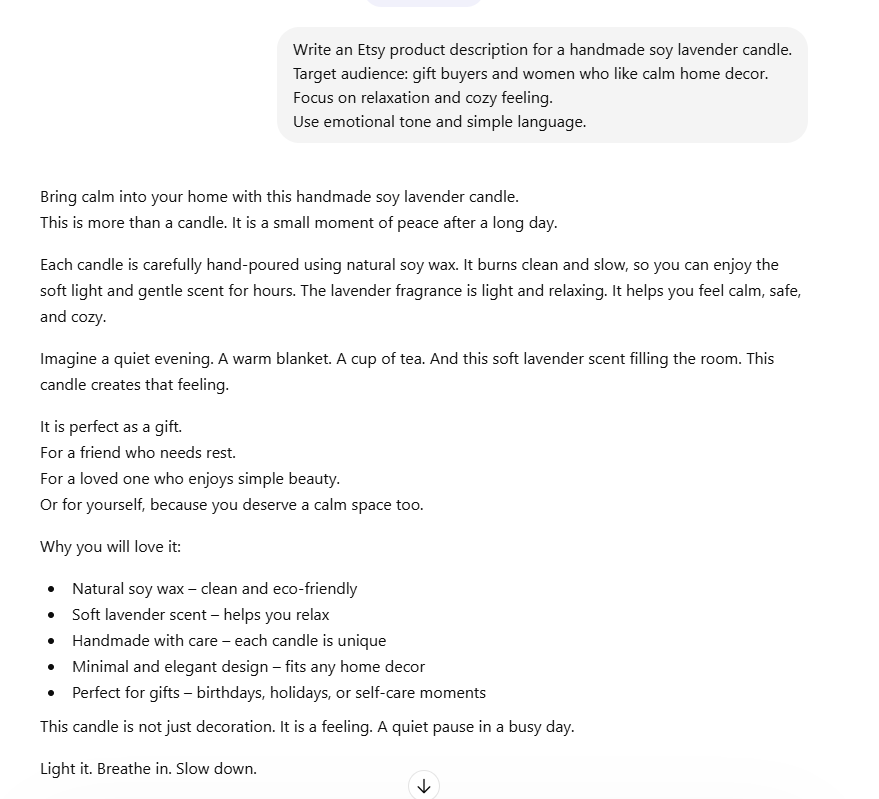
“Write an Etsy description for a candle.”
AI has to guess the product, buyer, tone, materials, purpose and structure.
BETTER
“Write an Etsy description for a handmade 8 oz lavender soy candle with a cotton wick. The buyer may be looking for a relaxing home candle or a small gift. Use warm, simple English. Start by clearly explaining the product, then add product facts, use ideas and a short closing. Do not invent burn time, ingredients, shipping or claims I did not provide.”
DESCRIPTION
Etsy Product Description Prompt
This is one of the most useful Etsy prompts because descriptions need both clarity and buyer context.
COPY THIS PROMPT
Write an Etsy product description for [product].
Verified product facts: [facts].
Buyer: [buyer].
Main use or occasion: [use].
Important search phrases: [keywords].
Use clear, friendly English. Start by explaining exactly what the product is. Then write one short benefit-focused paragraph, followed by easy-to-scan product details and important ordering information. Use keywords naturally. Do not invent materials, dimensions, features, shipping details or benefits that I did not provide.
My take: The “do not invent” line is one of the most useful parts of this prompt.
See my full guide: How to Write Etsy Descriptions With AI →
TITLE
Buyer-Friendly Etsy Title Prompt
I would not tell AI to stuff as many keywords as possible into 140 characters.
Etsy’s newer title guidance focuses more on clarity and buyer-friendly wording.
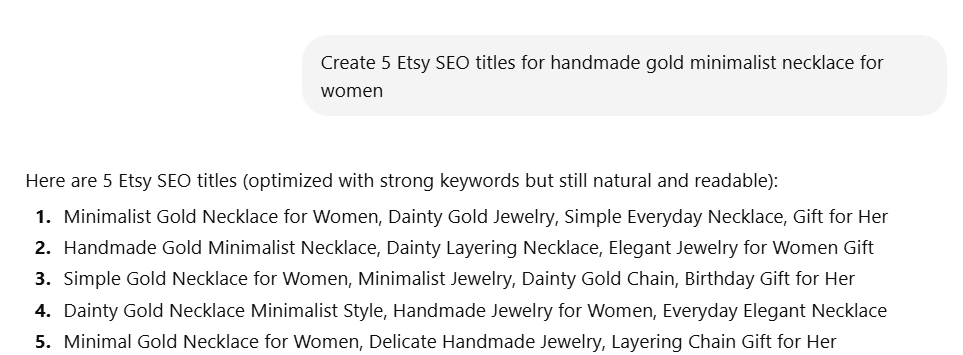
Create 7 Etsy title options for [product]. Make each title clear and easy for a shopper to understand. Put the strongest product phrase near the beginning when natural. Include important differentiators such as [material/style/recipient/use]. Avoid repetitive keyword lists and awkward punctuation. Do not invent features. After each title, explain in one sentence why you structured it that way.
I like asking AI to explain the title. It makes weak logic easier to spot.
More examples: Etsy Product Titles AI Examples →
TAGS
Etsy Tag Brainstorm Prompt
I changed this prompt a lot from the old article.
I do not ask AI for “traffic-focused tags” because a general model does not automatically know current Etsy traffic.
BETTER PROMPT
Brainstorm Etsy tag ideas for [product].
Product facts: [facts].
Buyer: [buyer].
Style: [style].
Possible occasions: [occasions].
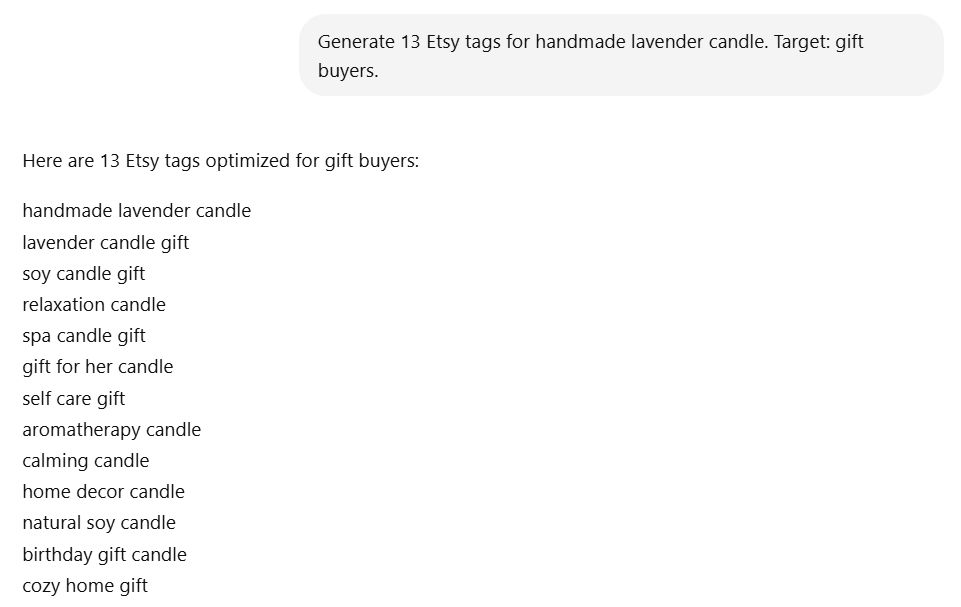
Explore different search angles: product type, recipient, style, use, material, occasion and important features. Avoid vague phrases and unnecessary repetition. Do not claim search volume or competition. Give me a larger idea pool first, not only 13 final tags.
This is much more useful because AI becomes a brainstorming assistant instead of pretending to be a marketplace database.
Full guide: Etsy Tags Generator AI →
COPY IMPROVEMENT
Features + Benefits Prompt
I no longer like the advice “turn every feature into an emotional benefit.”
Buyers still need facts.
Review these product features: [features]. For each feature, write one useful buyer-focused explanation. Keep the original fact visible. Do not exaggerate. Do not add emotional language unless it fits naturally. Do not create benefits that cannot be supported by the product information.
OPTIMIZATION
Full Etsy Listing Audit Prompt
This is one of my favorite ways to use AI.
Do not immediately ask AI to rewrite everything.
Ask it to diagnose first.
AUDIT PROMPT
Review this Etsy listing without rewriting it yet.
Product: [product]
Buyer: [buyer]
Title: [title]
Description: [description]
Tags: [tags]
Score these areas from 1–10:
1. Clarity
2. Product accuracy
3. Buyer intent
4. Title readability
5. Description usefulness
6. Tag variety
7. Repetition
For every weak area, explain exactly what should change. Do not invent Etsy search volume, competition or ranking data.
This is basically the idea behind my Etsy AI Lab Audit: diagnose first, improve second.
POSITIONING
Different Buyer Angle Prompt
Sometimes the product is fine. The angle is weak.
Take this product: [product]. Show me five different buyer angles without changing the product facts. For each angle, explain who the buyer may be, what they may care about and which product details should be emphasized. Do not assume that one angle has more demand unless real data is provided.
BUYER QUESTIONS
Etsy FAQ Prompt
Create 8 useful buyer questions for this Etsy product: [product]. Use only the facts I provide: [facts]. Focus on questions about size, material, personalization, use, digital delivery, care, ordering or other relevant concerns. If an answer cannot be supported by the provided facts, mark it as “seller must provide this information” instead of inventing an answer.
I really like the last instruction because it turns missing information into a checklist.
OPENING
First-Sentence Prompt
I changed the old “emotional hook generator” because I do not think every Etsy listing needs a dramatic hook.
Write 10 first-sentence options for this Etsy description: [product]. Each sentence should clearly tell the buyer what the product is while sounding natural. Avoid vague hooks such as “Looking for the perfect gift?” and avoid exaggerated words such as stunning, magical, must-have or game-changing.
SHOP STORY
Etsy Shop About Prompt
AI should not invent your shop story.
Help me write an Etsy About section using only these facts: [your story]. Keep the tone warm, simple and personal. Explain why I started the shop, what I make and what matters to me when creating products. Do not invent a personal story, mission, family history or craft process.
PRODUCT IDEAS
Buyer-Problem Product Idea Prompt
This is another prompt I completely changed.
I would not ask AI to “focus on trends” unless I actually gave it current trend data.
I want to create Etsy products for [buyer type]. List 15 specific problems, occasions or tasks this buyer may need help with. Then suggest one product idea for each problem. Keep the ideas specific. Do not label anything “profitable,” “trending” or “high demand” unless real marketplace data is provided.
Continue here: How to Find Etsy Niches With AI →
DIGITAL PRODUCTS
Digital Product Structure Prompt
Help me structure a digital Etsy product for [buyer/problem]. The product idea is [idea]. Suggest useful sections, pages or components. For each part, explain what problem it solves. Do not create medical, legal, financial or professional claims. Keep the product practical and easy to use.
MARKET RESEARCH
Competitor Pattern Analysis Prompt
You can use AI to look for patterns without asking it to copy competitors.
I will paste information from several Etsy listings in the same category. Analyze them for patterns only. Identify repeated product features, buyer language, common use cases, pricing presentation and missing information. Do not copy titles, descriptions or unique wording. Do not tell me which listing sells best unless sales data is provided.
CUSTOMER LANGUAGE
Review Analysis Prompt
If you have your own buyer reviews, AI can help find useful patterns.
Analyze these customer reviews from my own shop: [reviews]. Group repeated themes into: what buyers loved, what confused them, what they mention about quality, what they mention about delivery or use, and language I may want to use when improving future listings. Do not invent themes that are not present in the reviews.
HUMANIZE
Remove Generic AI Language Prompt
Edit this Etsy description without changing the product facts. Remove generic AI-style marketing phrases, repeated ideas and exaggerated adjectives. Keep the language simple and natural. Replace vague claims with useful product details where possible. Do not add new facts. Show me the original sentence and your improved sentence side by side.
FINAL CHECK
Pre-Publish Etsy Listing Prompt
Review this Etsy listing before publication. Do not rewrite it immediately. Check for factual gaps, contradictions, vague wording, repeated keywords, confusing product information, missing buyer questions and any claim that may be too strong. Then give me a prioritized list: FIX NOW, IMPROVE LATER, and OK AS IS.
BETTER THAN ONE GIANT PROMPT
Prompt Stacking: The Method I Prefer
I still like the idea from the old article, but I would describe it differently.
Instead of asking AI to do everything at once, I break the work into stages.
I do not believe there is a magic number like “use 3–5 prompts per listing.” Use as many steps as the task actually needs.
Real Prompt Stack: Handmade Candle Listing
Audit
Find unclear wording, missing facts and repetition.
Rewrite Description
Use only verified product information.
Title Options
Create clear buyer-friendly title variations.
Tag Brainstorm
Explore multiple buyer search angles.
Final Check
Review accuracy, clarity and consistency.
When I Would Use Prompts vs Etsy AI Lab
9 Prompt Mistakes I See Etsy Sellers Make
Less context usually means more guessing.
AI cannot promise conversion performance.
A generated keyword is not verified search volume.
Always provide verified product facts.
Breaking the job into stages can make problems easier to catch.
The framework can repeat. The facts and buyer context should change.
Some products need clarity more than emotion.
The first draft is often only the starting point.
Use AI to create hypotheses, then validate them with marketplace signals.
MY EXPERIENCE
Longer Prompts Are Not Always Better
This is something I learned after using AI for many different writing tasks.
A very long prompt can look impressive and still be bad.
It may repeat itself. It may give conflicting instructions. It may control things that do not matter while forgetting the one product fact that actually matters.
I prefer prompts that are specific rather than simply long.
Tell AI what it needs to know. Tell it what job to do. Tell it what not to invent. Then read the answer.
My 100-Point Etsy Prompt Score
CONTINUE THE ETSY WORKFLOW
Prompts Are Only One Part of the Listing
FINAL TAKE
The Best Etsy Prompt Is the One That Reduces Guessing
I do not think prompt engineering needs to be complicated.
A seller usually needs the same basic things:
That is enough to create much better AI output.
And if you find yourself rebuilding the same prompt over and over, that is exactly the type of repetitive work I would automate.
Use prompts when you want control. Use tools when you want a repeatable workflow.
FREE ETSY AI WORKSPACE
Tired of Rebuilding Etsy Prompts?
Use Etsy AI Lab to generate listing content, audit weak areas and improve the workflow without starting every task from an empty prompt.
Open Etsy AI Lab → Product Tour →QUESTIONS SELLERS ASK
FAQ: AI Prompts for Etsy Sellers
Can I use AI to write my Etsy listings?
Yes. AI can help you draft titles, descriptions, tag ideas and other listing content. You should still verify the facts and review the final result before publishing.
Do AI-written Etsy descriptions automatically rank?
No. There is no automatic ranking advantage just because a description was written with AI. Etsy search uses multiple listing and shop signals.
What is the best Etsy prompt for beginners?
Start with product facts, buyer context and one clear task. For example, ask AI to write a description using verified facts and tell it not to invent missing details.
How many prompts should I use for one Etsy listing?
I do not use a fixed number. A simple listing may need only a few steps. A complex one may need more. Use enough prompts to complete and check the work properly.
Can AI generate Etsy keywords?
AI can brainstorm keyword ideas and different buyer search angles. A general AI model should not be treated as proof of current Etsy search volume or competition.
Should I use the same prompt for every Etsy product?
You can reuse the same prompt framework, but the product facts, buyer, use case and important details should change for each listing.
Can AI tell me which Etsy product will sell?
I would not use AI as proof that a product will sell. It can help brainstorm ideas, but demand should be checked with real marketplace signals and your own shop data when available.
Should I edit AI-generated Etsy copy?
Yes. Check accuracy, tone, repetition, generic phrases and whether the content actually matches the product.
Are AI prompt bundles allowed to sell on Etsy?
Etsy’s current Creativity Standards list AI prompt bundles as an example of content that does not qualify as “designed by a seller.”
Is Etsy AI Lab better than writing prompts manually?
They are useful for different things. Manual prompts give you more flexibility for unusual tasks. Etsy AI Lab is better when you want a repeatable Etsy-specific workflow for listing generation, audits and improvements.