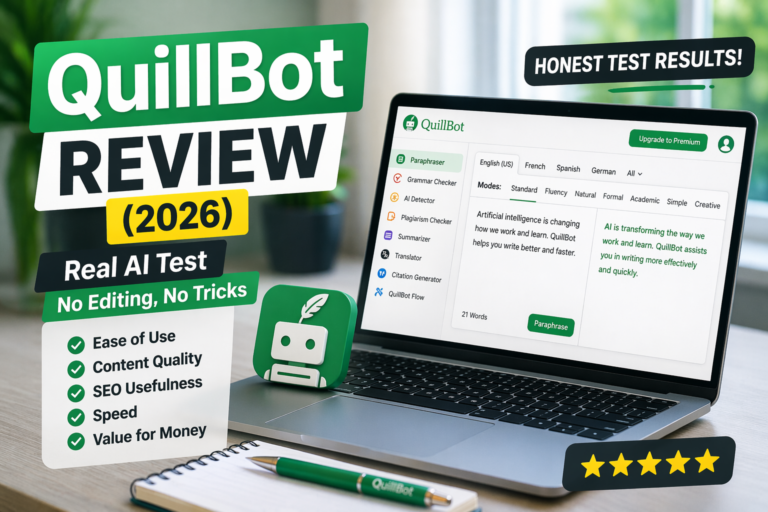
Most people think QuillBot is just a paraphrasing tool.
And yes… that’s what it’s known for.
But here’s something interesting.
QuillBot now also has an AI Chat feature.
Which means — it can generate content, just like tools like Jasper or Writesonic.
So we decided to test it differently.
Not rewriting.
Not improving.
Not “fixing” anything.
Just pure AI output.
We used QuillBot AI Chat in the free version, generated texts, and evaluated them exactly as they came out.
No editing.
No human touch.
No tricks.
Because this is what really matters:
What do you actually get if you just use the tool as a beginner?
In this review, you’ll see:
- real AI-generated content
- honest evaluation (quality, tone, SEO, structure)
- strengths and weaknesses
- and how QuillBot compares to tools like Writesonic or Jasper
This is a raw test.
No polishing. Just results 👇
TESTS- QuillBot – AI Writing Tool – Review
1️⃣ Test: Short blog article
Prompt:
Write a 600-word blog post about “Benefits of using AI writing tools for small businesses”.
The output can be seen here ->
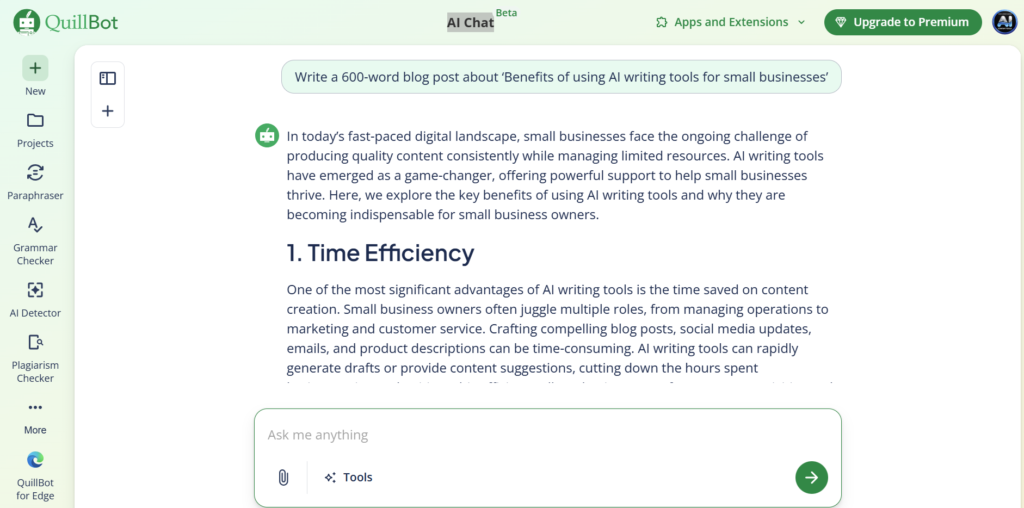
Language Quality
Strengths
Very clean and correct English. Sentences are clear and easy to understand. Good for pre-intermediate level readers. No grammar mistakes. Vocabulary is safe and professional.
Minor Issues
Too neutral and generic. Lacks emotion and personality. Some phrases feel overused and “template-like.”
Overall:
High quality and readable, but not very engaging or unique.
Structural Logic
Strengths
Strong and logical structure. Numbered sections make it easy to scan. Each paragraph has a clear purpose. Good intro and clear conclusion.
Minor Improvements
All sections follow the same pattern, which makes it predictable. No variation like examples or mini-stories.
Overall:
Very solid SEO structure, but slightly formulaic.
Does It Sound “Robotic”?
What Feels AI-Generated
Generic openings like “In today’s fast-paced digital landscape.”
Safe, neutral tone without opinions.
No real examples or personal touch.
What Helps It Sound Human
Good flow between sentences.
No weird phrasing or grammar issues.
Easy to read and understand.
How to Improve
Add a short real-life example.
Use contractions (don’t, can’t).
Add 1–2 opinion sentences.
Overall:
Not obviously AI, but still feels a bit too polished and generic.
Repetition Level
Observed Repetitions
Repeated phrases:
“AI writing tools”
“small businesses”
“these tools”
“content creation”
Similar sentence structures across sections.
Why It’s Not a Major Issue
Repetition supports SEO.
Keywords are relevant and natural in context.
Overall:
Moderate repetition — acceptable for SEO, but could be slightly reduced for better readability.
| Criterion | Score |
|---|---|
| Language Quality | ⭐⭐⭐⭐☆ (4 / 5) |
| Structural Logic | ⭐⭐⭐⭐⭐ (5 / 5) |
| Natural Tone | ⭐⭐⭐☆☆ (3 / 5) |
| Repetition Control | ⭐⭐⭐☆☆ (3 / 5) |
2️⃣ Test: SEO content
Prompt:
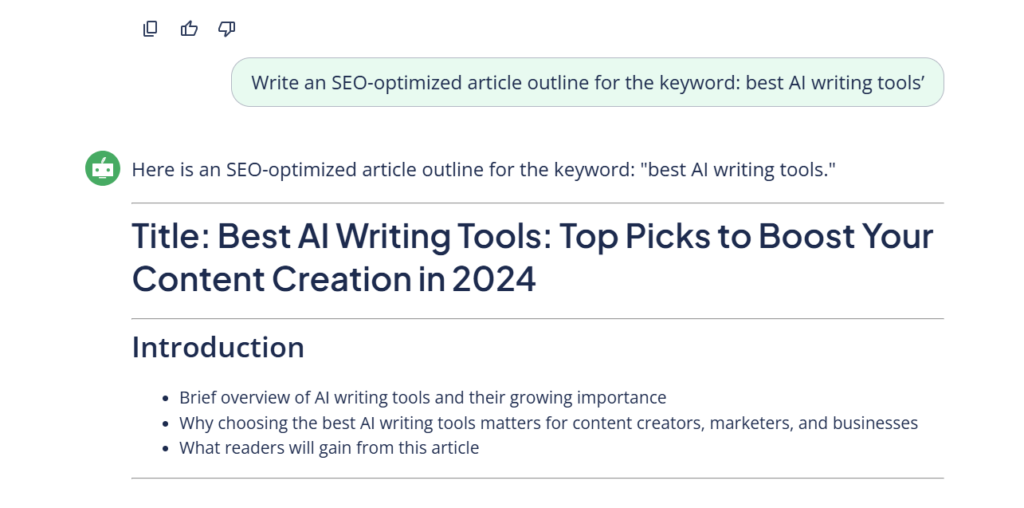
Write an SEO-optimized article outline for the keyword: best AI writing tools.
The output can be seen here ->
When I tested a prompt: “Write an SEO-optimized article outline for the keyword: best AI writing tools.”
QuillBot generated only headings (H2/H3 structure) — no full content.
At first, this may look correct. The structure was clean and SEO-friendly. But it did not deliver a full article.
So I tried again.
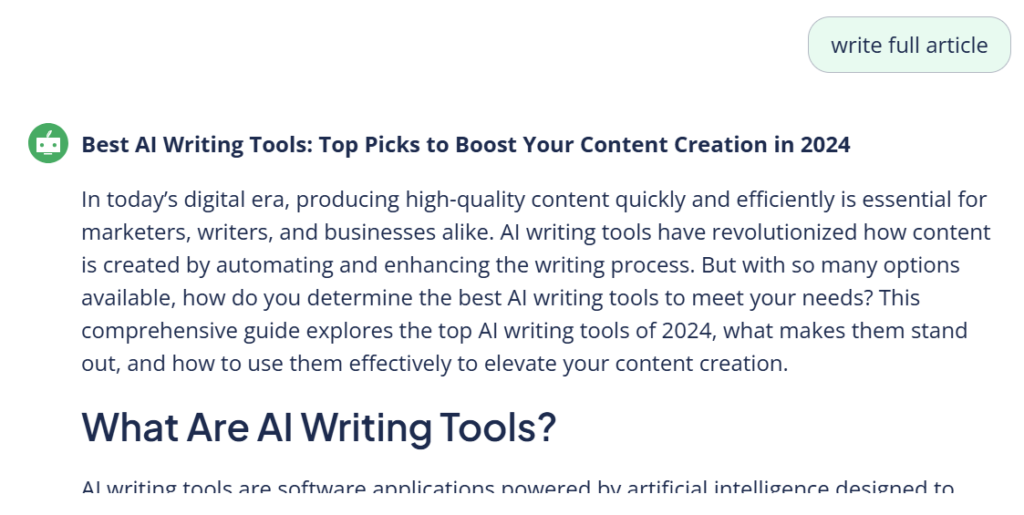
H2 / H3 Headings Quality
Strengths
Headings are clear, logical, and well-organized. They follow a strong SEO structure (What / Benefits / Criteria / Tools / How to / Trends / FAQ). Easy to scan and user-friendly.
Minor Issues
Headings are very standard and predictable. They don’t create curiosity or strong click motivation. Lack of power words or unique angles.
Overall:
Very solid structure for SEO, but not distinctive.
Natural Keyword Usage
Strengths
Main keyword “AI writing tools” is used consistently and naturally. No keyword stuffing. Variations like “best AI writing tools,” “AI tools,” and “writing tools” are used correctly.
Minor Issues
Keyword usage is slightly repetitive. Lacks long-tail variations and more natural phrasing (e.g., real user queries).
Overall:
Good SEO balance, but could feel more natural with more variation.
Search Intent Understanding (Commercial Intent)
Strengths
Clearly targets users looking for tools and comparisons. Includes “Top tools,” “Best for,” and pricing — good signals for commercial intent. FAQ also supports decision-making.
Minor Issues
Too informational, not enough persuasion. Lacks strong recommendations, opinions, or CTAs. Doesn’t clearly guide user to “choose this tool now.”
Overall:
Understands intent, but not strong enough for conversion (affiliate clicks).
| Criterion | Score |
|---|---|
| H2 / H3 Headings | ⭐⭐⭐⭐☆ (4/5) |
| Structure Logic | ⭐⭐⭐⭐⭐ (5 / 5) |
| Keyword Naturalness | ⭐⭐⭐⭐☆ (4/5) |
| Commercial Intent | ⭐⭐⭐☆☆ (3/5) |
3️⃣ Test: Product description
Prompt:
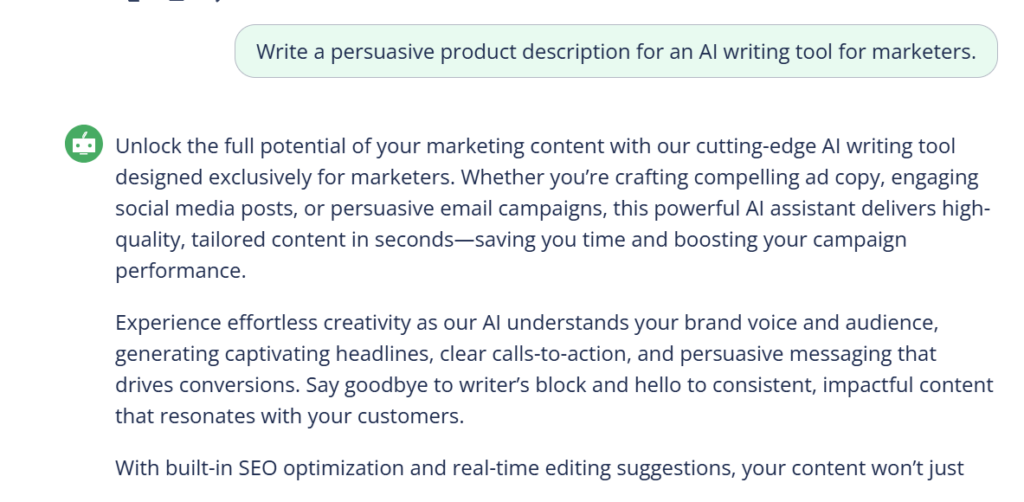
Write a persuasive product description for an AI writing tool for marketers.
The output can be seen here ->
Sales-Oriented Writing Style
Strengths
Strong persuasive tone. Focuses on benefits (time-saving, conversions, performance). Uses emotional triggers like “unlock potential,” “boost performance,” “transform.” Clearly written as sales copy.
Minor Issues
Feels a bit overhyped and “marketing-heavy.” Lacks proof (no data, no examples), which reduces trust.
Overall:
Very strong sales tone, but slightly too generic and promotional.
Call to Action (CTA)
Strengths
Clear CTA at the end: “Try it today.” Encourages action and creates urgency. Fits well with the overall message.
Minor Issues
Only one CTA and quite basic. Could be stronger with variation (e.g., benefit-driven CTA or risk-free angle).
Overall:
Good but not optimized for maximum conversions.
Specificity vs. Generic Messaging
Strengths
Mentions specific use cases (ads, social media, email campaigns). Talks about outcomes like conversions and engagement.
Minor Issues
Still very generic overall. No concrete examples, numbers, or real scenarios. Could apply to almost any AI tool.
Overall:
Balanced but leans too much toward generic marketing language.
| Criterion | Score |
|---|---|
| Sales Writing Style | ⭐⭐⭐⭐☆ (4/5) |
| Call to Action (CTA) | ⭐⭐⭐☆☆ (3/5) |
| Message Specificity | ⭐⭐⭐☆☆ (3/5) |
4️⃣ Test: Social media post
Prompt:
Write a Facebook post promoting an AI writing tool for content creators.
The output can be seen here ->
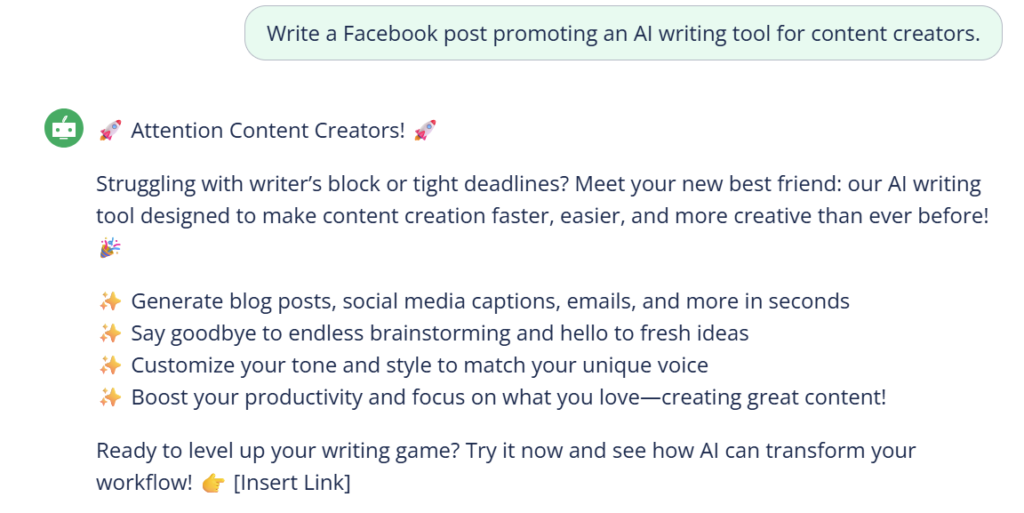
Tone (Does It Sound Human?)
The tone is friendly, energetic, and easy to connect with. It speaks directly to the reader (“Struggling with…?”), which makes it feel more personal. Emojis add emotion and make the text feel less robotic and more social-media-native. It sounds like a real person trying to help, not just inform.
However, it still has a slightly promotional feel. Phrases like “your new best friend” and “level up your writing game” are common in marketing copy. Adding one small real-life touch (like a quick example or relatable situation) would make it even more authentic and human.
Length
The length is well-optimized for platforms like Pinterest, LinkedIn, or Instagram. It’s short, clear, and easy to scan — especially with bullet points. Each line delivers value quickly, which is great for attention spans.
It doesn’t feel overwhelming, and the reader can understand the offer in seconds. However, it could be slightly improved by adding one specific outcome or mini-example (e.g., “write a full blog post in 60 seconds”) to increase impact without making it longer.
Engaging Hook
The hook is very strong. “🚀 Attention Content Creators!” immediately targets a clear audience and grabs attention. The follow-up question about writer’s block or deadlines connects with a real, common problem.
This combination (direct call + pain point) works very well. It makes the reader feel understood and encourages them to keep reading. The energy and emojis also help stop the scroll, especially on social platforms.
| Criterion | Score |
|---|---|
| Human Tone | ⭐⭐⭐⭐☆ (4/5) |
| Length | ⭐⭐⭐⭐☆ (4/5) |
| Engaging Hook | ⭐⭐⭐⭐⭐ (5/5) |
📊 The Final Writesonic Review
| Criterion | Score |
|---|---|
| Ease of use | ⭐⭐⭐⭐⭐ (5/5) |
| Content quality | ⭐⭐⭐⭐☆ (4/5) |
| SEO usefulness | ⭐⭐⭐⭐☆ (4/5) |
| Speed | ⭐⭐⭐⭐⭐ (5/5) |
| Value for money | ⭐⭐⭐⭐⭐ (5/5) |
FAQ – AI Writing Tool Test Results
❓ Is this AI writing tool good for beginners?
Yes. It’s very easy to use. You don’t need any technical skills. You just write a prompt, and the tool gives you ready text in seconds.
❓ Can I use this tool for SEO content?
Yes, but with small edits. The structure is strong and keyword usage is good. However, you should add your own examples, internal links, and unique insights to rank higher.
❓ Does the content sound human?
Mostly yes. The text is clear and natural. But sometimes it feels a bit too “perfect” or generic. Adding your own tone and small edits makes a big difference.
❓ Is the content ready to publish?
Almost. You can publish it, but it’s better to do quick editing:
- add examples
- add opinions
- make sentences more personal
❓ What is the biggest weakness of this tool?
The content can be too generic. It explains things well, but doesn’t stand out. You need to add your own experience to make it unique.
❓ What is the biggest strength?
Speed and structure. You get full articles, social posts, and sales copy in seconds — all well organized.
❓ Can this tool replace a human writer?
No. It’s best as a helper. It saves time, but the best results come when you combine AI + your own editing.
❓ Is it worth using a free AI writing tool?
Yes, 100%. For a free tool, the value is very high. It helps you create content faster and cheaper, especially if you are just starting.