Starting with AI writing is exciting. You can create content fast. Ideas come quickly. Everything feels easy. But here is the truth. Most people make the same mistakes when they start. I made them too at the beginning. And I can tell you, small mistakes can kill your results. Even if your content looks “good”.
Let’s fix that.
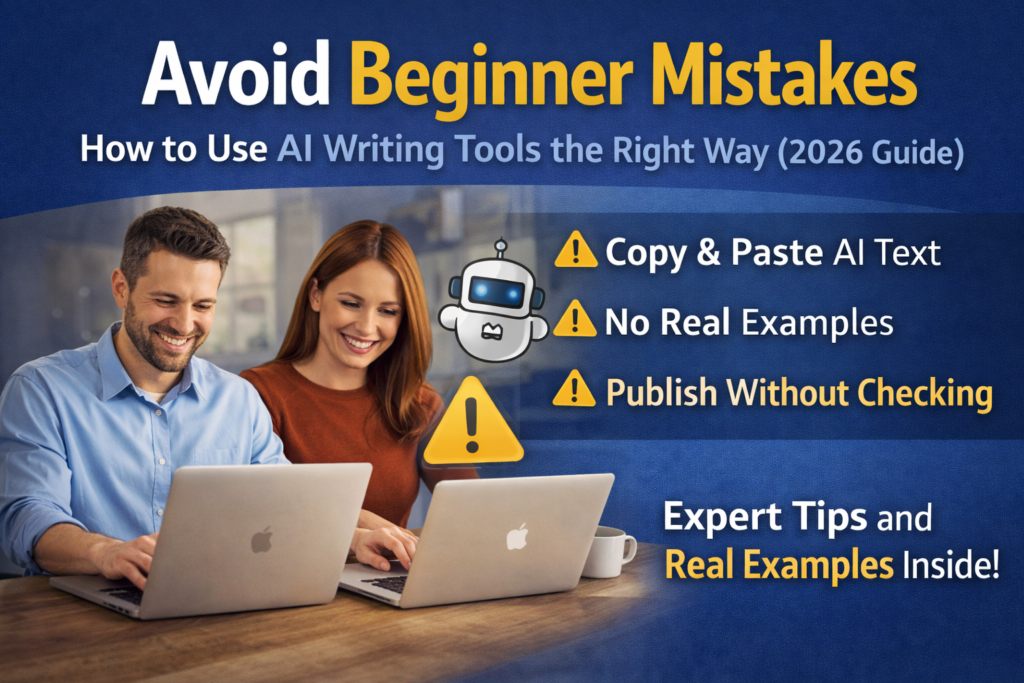
Mistake 1: Copy-Paste AI Content Without Editing
This is the biggest one.
You generate text → looks okay → publish.
Problem?
It sounds generic. Like thousands of other articles.
Example.
AI version:
“AI tools help improve productivity and content quality.”
Sounds correct. But boring.
Better version (after editing):
“I used AI to write 3 articles in one day. It saved time, but only after editing I saw real results in clicks.”
See the difference?
What to do:
- always rewrite parts of text
- add your own examples
- remove repeated phrases
If you want help with this, check:
Mistake 2: Writing for AI, Not for People
Many beginners try to “please AI”.
They:
- add too many keywords
- write unnatural sentences
- over-optimize
But Google is smarter now.
It rewards helpful content, not keyword stuffing.
Example.
Bad:
“Best AI tools for writing are the best AI tools for content writing tools.”
Good:
“Here are the AI tools I tested. Some are great for blog posts, others for product descriptions.”
Simple wins.
Mistake 3: Using Complicated Language
AI often writes in a very formal way.
Long sentences. Big words.
But users don’t like that.
From my experience, simple content performs better.
Example.
AI version:
“This methodology significantly enhances content optimization efficiency.”
Better version:
“This method helps you improve content faster.”
Same meaning. Much better to read.
Tip:
- keep sentences short
- mix short and longer ones
- write like you explain to a friend
Mistake 4: Not Checking Facts
AI can be wrong.
Not always. But often enough to be dangerous.
I’ve seen:
- wrong pricing
- fake features
- outdated info
Example.
AI says tool has “free plan”.
You check → it doesn’t.
If you publish that → you lose trust.
What to do:
- always check important facts
- especially in reviews and tutorials
Mistake 5: No Real Examples
This is why many articles feel empty.
They explain… but don’t show.
Example.
Weak:
“AI helps with Etsy SEO.”
Better:
“I used AI to generate Etsy tags. Out of 20 tags, only 5 were useful. The rest were too generic like ‘gift idea’.”
Real examples = trust.
If you want more real cases, see:
Mistake 6: Publishing Too Fast
AI makes it easy to publish a lot.
But more content ≠ better results.
I tested this.
Publishing many articles without editing did not improve traffic.
Updating and improving content worked better.
Tip:
- quality first
- then quantity
Mistake 7: Ignoring Structure
AI content often looks like one big block.
No clear flow.
Users don’t read like that.
Good structure:
- clear headings
- short paragraphs
- simple sections
Think like this.
Can someone scan your article in 10 seconds?
If yes → good.
Mistake 8: No Clear User Intent
Beginners often write without thinking:
“What does the user want?”
Example.
User searches: “best AI tools”
They want → comparison
User searches: “how to use AI writing”
They want → steps
If you mix everything → content becomes confusing.
Tip:
- focus on one goal per article
Mistake 9: Not Updating Content
AI content gets old fast.
Tools change. Features change. Trends change.
If you don’t update → rankings drop.
I update my articles regularly. Even small changes help.
Mistake 10: Treating AI Like a Magic Tool
AI is powerful. But it’s not magic.
It will not:
- build your strategy
- know your audience perfectly
- replace your thinking
Best results come when:
AI + your experience = content
My Simple Workflow (What Actually Works)
This is what I use.
Step 1: Ask AI for ideas
Step 2: Generate outline
Step 3: Create draft
Step 4: Edit and simplify
Step 5: Add examples
Step 6: Check facts
Step 7: Publish
Simple. But effective.
Final Thoughts
If you avoid these mistakes, you are already ahead of most beginners.
AI gives speed.
You give quality.
That’s the winning combination.
Don’t try to be perfect.
Start. Test. Improve.
That’s how real growth happens.
If you are still learning basics, start here:
FAQ
❓ What is the biggest mistake beginners make with AI writing?
Copying AI content without editing. This creates low quality, generic text.
❓ How can I improve AI-generated content?
Edit it, simplify language, and add real examples from your experience.
❓ Should I trust AI content 100%?
No. Always check facts, especially in tutorials and reviews.
❓ Is more content always better?
No. Quality content performs better than many low-quality articles.
❓ How do I make AI content sound natural?
Write in simple language, remove repetition, and add personal insights.
❓ Can beginners use AI tools effectively?
Yes. AI is perfect for beginners, but you need to learn how to edit and improve content.
❓ How long should I spend editing AI content?
Even 10–20 minutes can improve quality a lot.
❓ Does Google penalize AI content?
No. It penalizes low-quality content, not AI itself.
❓ What should I focus on first?
User value. If your content helps people, it will perform better.
❓ What is the best way to learn AI writing?
Practice. Test different prompts, edit results, and learn from what works.